What Survives Learned Symbolic Compression?
Back to the paper page. ICLR 2027 submission, August 2026.
All 22 pages are shown below.
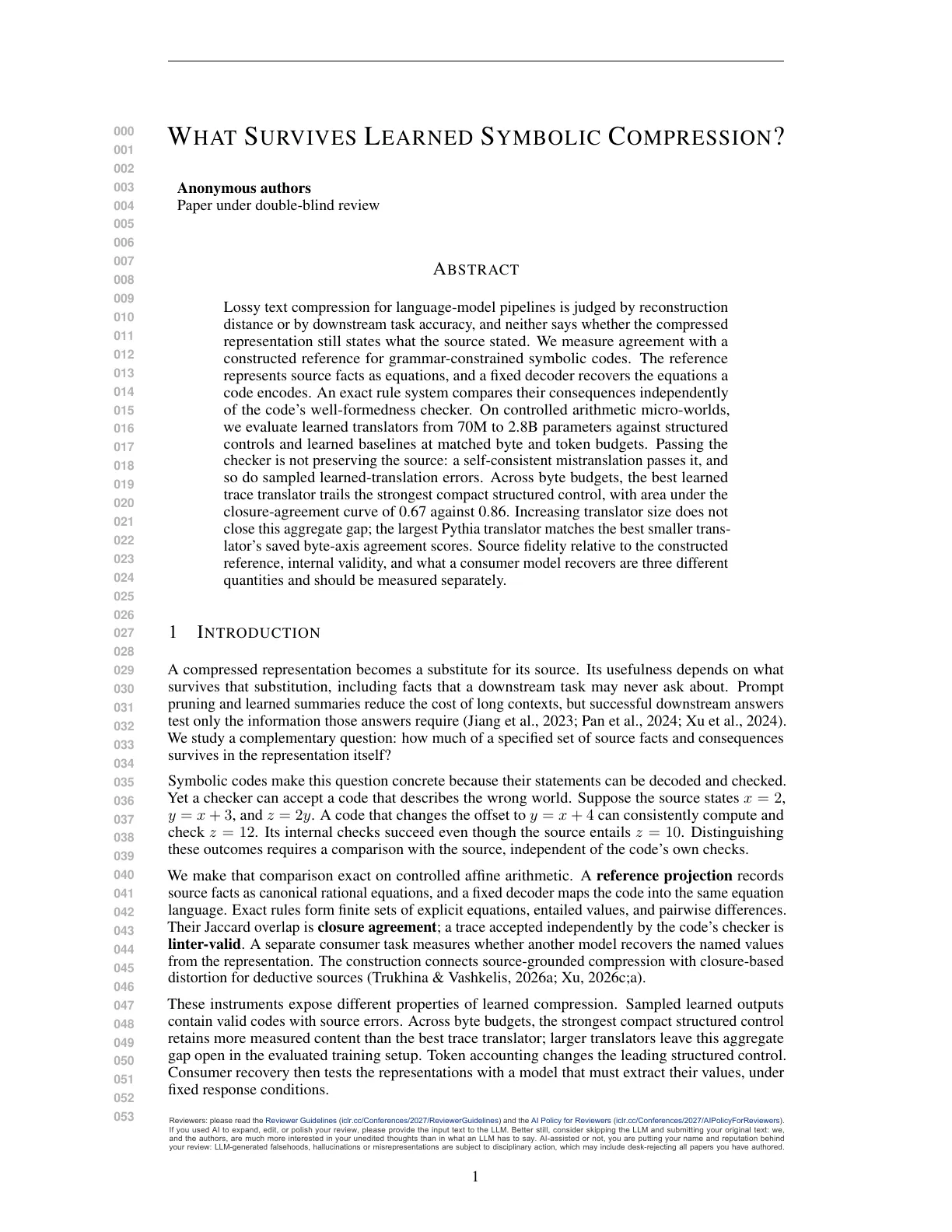
Text of page 1
W HAT S URVIVES L EARNED S YMBOLIC C OMPRESSION ?

Anonymous authors
Paper under double-blind review

A BSTRACT

Lossy text compression for language-model pipelines is judged by reconstruction
distance or by downstream task accuracy, and neither says whether the compressed
representation still states what the source stated. We measure agreement with a
constructed reference for grammar-constrained symbolic codes. The reference
represents source facts as equations, and a fixed decoder recovers the equations a
code encodes. An exact rule system compares their consequences independently
of the code’s well-formedness checker. On controlled arithmetic micro-worlds,
we evaluate learned translators from 70M to 2.8B parameters against structured
controls and learned baselines at matched byte and token budgets. Passing the
checker is not preserving the source: a self-consistent mistranslation passes it, and
so do sampled learned-translation errors. Across byte budgets, the best learned
trace translator trails the strongest compact structured control, with area under the
closure-agreement curve of 0.67 against 0.86. Increasing translator size does not
close this aggregate gap; the largest Pythia translator matches the best smaller translator’s saved byte-axis agreement scores. Source fidelity relative to the constructed
reference, internal validity, and what a consumer model recovers are three different
quantities and should be measured separately.

1

I NTRODUCTION

A compressed representation becomes a substitute for its source. Its usefulness depends on what
survives that substitution, including facts that a downstream task may never ask about. Prompt
pruning and learned summaries reduce the cost of long contexts, but successful downstream answers
test only the information those answers require (Jiang et al., 2023; Pan et al., 2024; Xu et al., 2024).
We study a complementary question: how much of a specified set of source facts and consequences
survives in the representation itself?

Symbolic codes make this question concrete because their statements can be decoded and checked.
Yet a checker can accept a code that describes the wrong world. Suppose the source states x = 2,
y = x + 3, and z = 2y. A code that changes the offset to y = x + 4 can consistently compute and
check z = 12. Its internal checks succeed even though the source entails z = 10. Distinguishing
these outcomes requires a comparison with the source, independent of the code’s own checks.

We make that comparison exact on controlled affine arithmetic. A reference projection records
source facts as canonical rational equations, and a fixed decoder maps the code into the same equation
language. Exact rules form finite sets of explicit equations, entailed values, and pairwise differences.
Their Jaccard overlap is closure agreement; a trace accepted independently by the code’s checker is
linter-valid. A separate consumer task measures whether another model recovers the named values
from the representation. The construction connects source-grounded compression with closure-based
distortion for deductive sources (Trukhina & Vashkelis, 2026a; Xu, 2026c;a).

These instruments expose different properties of learned compression. Sampled learned outputs
contain valid codes with source errors. Across byte budgets, the strongest compact structured control
retains more measured content than the best trace translator; larger translators leave this aggregate
gap open in the evaluated training setup. Token accounting changes the leading structured control.
Consumer recovery then tests the representations with a model that must extract their values, under
fixed response conditions.

Reviewers: please read the Reviewer Guidelines (iclr.cc/Conferences/2027/ReviewerGuidelines) and the AI Policy for Reviewers (iclr.cc/Conferences/2027/AIPolicyForReviewers).
If you used AI to expand, edit, or polish your review, please provide the input text to the LLM. Better still, consider skipping the LLM and submitting your original text: we,
and the authors, are much more interested in your unedited thoughts than in what an LLM has to say. AI-assisted or not, you are putting your name and reputation behind
your review: LLM-generated falsehoods, hallucinations or misrepresentations are subject to disciplinary action, which may include desk-rejecting all papers you have authored.

1
Text of page 2
2

The measurement compares two descriptions of the same world: the source-side reference and the
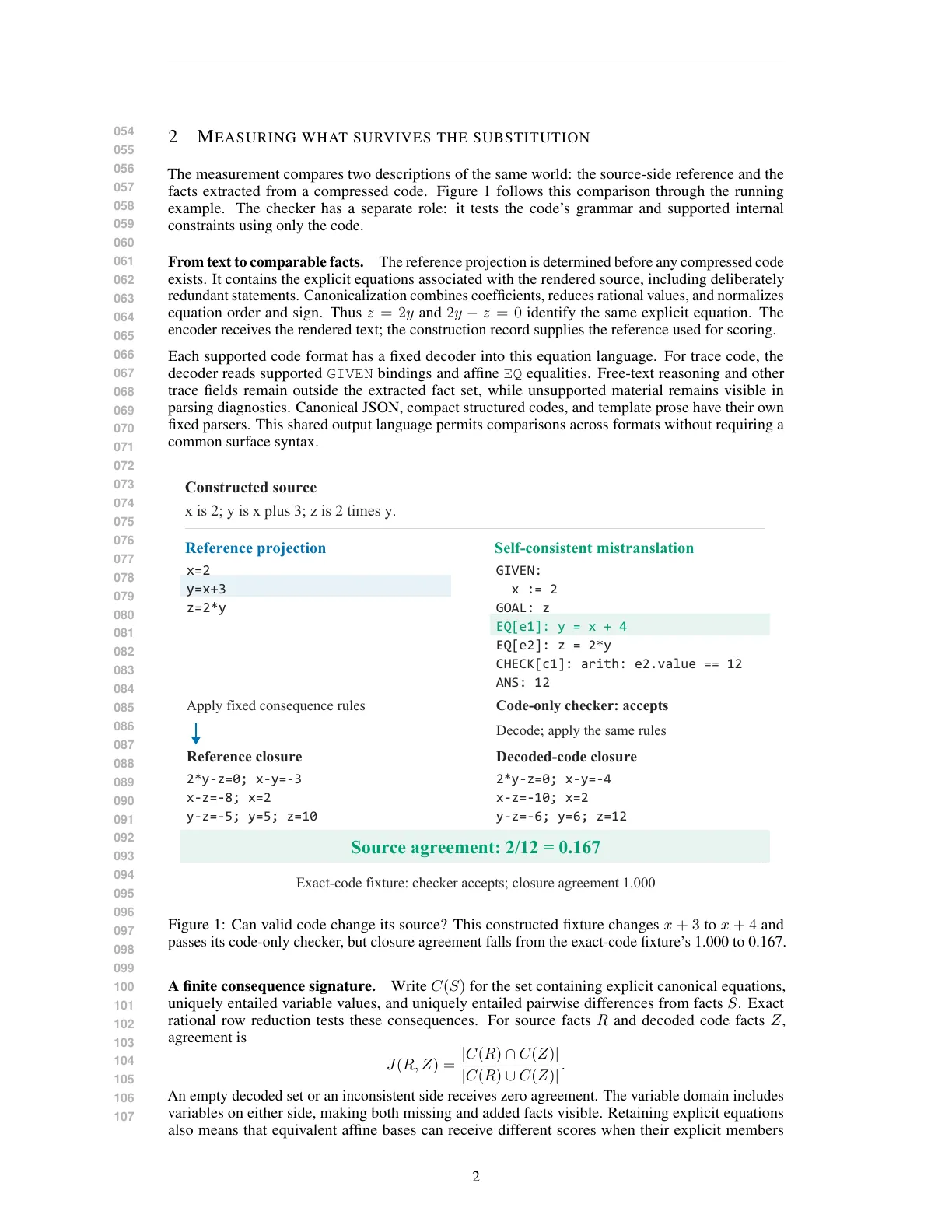
facts extracted from a compressed code. Figure 1 follows this comparison through the running
example. The checker has a separate role: it tests the code’s grammar and supported internal
constraints using only the code.

M EASURING WHAT SURVIVES THE SUBSTITUTION

From text to comparable facts. The reference projection is determined before any compressed code
exists. It contains the explicit equations associated with the rendered source, including deliberately
redundant statements. Canonicalization combines coefficients, reduces rational values, and normalizes
equation order and sign. Thus z = 2y and 2y − z = 0 identify the same explicit equation. The
encoder receives the rendered text; the construction record supplies the reference used for scoring.

Each supported code format has a fixed decoder into this equation language. For trace code, the
decoder reads supported GIVEN bindings and affine EQ equalities. Free-text reasoning and other
trace fields remain outside the extracted fact set, while unsupported material remains visible in
parsing diagnostics. Canonical JSON, compact structured codes, and template prose have their own
fixed parsers. This shared output language permits comparisons across formats without requiring a
common surface syntax.

Constructed source
x is 2; y is x plus 3; z is 2 times y.

Reference projection

Self-consistent mistranslation

x=2
y=x+3
z=2*y

GIVEN:
x := 2
GOAL: z
EQ[e1]: y = x + 4
EQ[e2]: z = 2*y
CHECK[c1]: arith: e2.value == 12
ANS: 12

Apply fixed consequence rules

Code-only checker: accepts

Decode; apply the same rules

Reference closure

Decoded-code closure

2*y-z=0; x-y=-3
x-z=-8; x=2
y-z=-5; y=5; z=10

2*y-z=0; x-y=-4
x-z=-10; x=2
y-z=-6; y=6; z=12

Source agreement: 2/12 = 0.167

Exact-code fixture: checker accepts; closure agreement 1.000

Figure 1: Can valid code change its source? This constructed fixture changes x + 3 to x + 4 and
passes its code-only checker, but closure agreement falls from the exact-code fixture’s 1.000 to 0.167.

A finite consequence signature. Write C(S) for the set containing explicit canonical equations,
uniquely entailed variable values, and uniquely entailed pairwise differences from facts S. Exact
rational row reduction tests these consequences. For source facts R and decoded code facts Z,
agreement is
|C(R) ∩ C(Z)|
J(R, Z) =
.
|C(R) ∪ C(Z)|
An empty decoded set or an inconsistent side receives zero agreement. The variable domain includes
variables on either side, making both missing and added facts visible. Retaining explicit equations
also means that equivalent affine bases can receive different scores when their explicit members

2
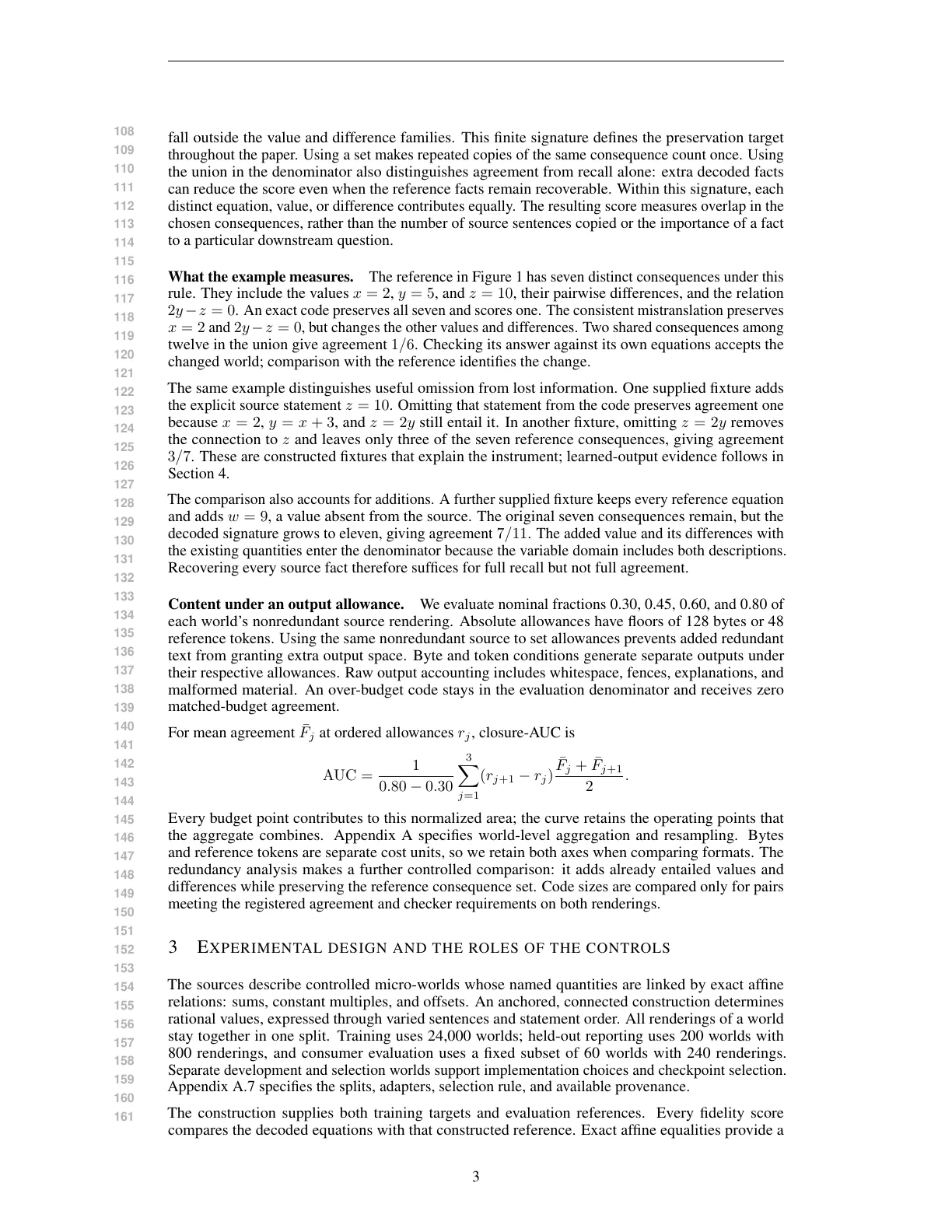
Text of page 3
fall outside the value and difference families. This finite signature defines the preservation target
throughout the paper. Using a set makes repeated copies of the same consequence count once. Using
the union in the denominator also distinguishes agreement from recall alone: extra decoded facts
can reduce the score even when the reference facts remain recoverable. Within this signature, each
distinct equation, value, or difference contributes equally. The resulting score measures overlap in the
chosen consequences, rather than the number of source sentences copied or the importance of a fact
to a particular downstream question.

What the example measures. The reference in Figure 1 has seven distinct consequences under this
rule. They include the values x = 2, y = 5, and z = 10, their pairwise differences, and the relation
2y − z = 0. An exact code preserves all seven and scores one. The consistent mistranslation preserves
x = 2 and 2y − z = 0, but changes the other values and differences. Two shared consequences among
twelve in the union give agreement 1/6. Checking its answer against its own equations accepts the
changed world; comparison with the reference identifies the change.

The same example distinguishes useful omission from lost information. One supplied fixture adds
the explicit source statement z = 10. Omitting that statement from the code preserves agreement one
because x = 2, y = x + 3, and z = 2y still entail it. In another fixture, omitting z = 2y removes
the connection to z and leaves only three of the seven reference consequences, giving agreement
3/7. These are constructed fixtures that explain the instrument; learned-output evidence follows in
Section 4.

The comparison also accounts for additions. A further supplied fixture keeps every reference equation
and adds w = 9, a value absent from the source. The original seven consequences remain, but the
decoded signature grows to eleven, giving agreement 7/11. The added value and its differences with
the existing quantities enter the denominator because the variable domain includes both descriptions.
Recovering every source fact therefore suffices for full recall but not full agreement.

Content under an output allowance. We evaluate nominal fractions 0.30, 0.45, 0.60, and 0.80 of
each world’s nonredundant source rendering. Absolute allowances have floors of 128 bytes or 48
reference tokens. Using the same nonredundant source to set allowances prevents added redundant
text from granting extra output space. Byte and token conditions generate separate outputs under
their respective allowances. Raw output accounting includes whitespace, fences, explanations, and
malformed material. An over-budget code stays in the evaluation denominator and receives zero
matched-budget agreement.

For mean agreement F̄ j at ordered allowances r j , closure-AUC is

AUC =

3
X
F̄ j + F̄ j+1
1
(r j+1 − r j )
.
0.80 − 0.30 j=1
2

Every budget point contributes to this normalized area; the curve retains the operating points that
the aggregate combines. Appendix A specifies world-level aggregation and resampling. Bytes
and reference tokens are separate cost units, so we retain both axes when comparing formats. The
redundancy analysis makes a further controlled comparison: it adds already entailed values and
differences while preserving the reference consequence set. Code sizes are compared only for pairs
meeting the registered agreement and checker requirements on both renderings.

3

E XPERIMENTAL DESIGN AND THE ROLES OF THE CONTROLS

The sources describe controlled micro-worlds whose named quantities are linked by exact affine
relations: sums, constant multiples, and offsets. An anchored, connected construction determines
rational values, expressed through varied sentences and statement order. All renderings of a world
stay together in one split. Training uses 24,000 worlds; held-out reporting uses 200 worlds with
800 renderings, and consumer evaluation uses a fixed subset of 60 worlds with 240 renderings.
Separate development and selection worlds support implementation choices and checkpoint selection.
Appendix A.7 specifies the splits, adapters, selection rule, and available provenance.

The construction supplies both training targets and evaluation references. Every fidelity score
compares the decoded equations with that constructed reference. Exact affine equalities provide a

3
Text of page 4
controlled setting for tracing information through compression. The reference language excludes
negation, modality, quantifiers, time, and uncertainty.

Learned encoders with fixed decoders. Trace translators use low-rank adapters on Pythia checkpoints from 70M to 2.8B parameters, with three seeds labelled A, B, and C (Biderman et al., 2023).
Additional Qwen translators provide a second-family comparison (Yang et al., 2025). The completed
grid contains 39 training cells across translators and learned controls. Adapter rank 16 and learning
rate 0.0002 were chosen on development data. All cells use an effective batch size of 128 and at
most three epochs; checkpoint selection maximizes closure-AUC on the separate selection worlds,
choosing the earliest checkpoint in a tie. Thus the size comparison evaluates the codes produced by a
common training and selection procedure. The structured controls—canonical JSON, CCL-Core,
CCL-Min, and fixed-template prose—use trained Pythia 1.4B encoders and deterministic decoders.
CCL-Core and CCL-Min adapt source-grounded formats to this domain (Trukhina & Vashkelis,
2026a). These comparisons evaluate complete encoding systems, including learning errors and
representation cost. The structured controls vary the target format; the scale ladder keeps the trace
format fixed while varying the translator. The release supports aggregate comparisons but omits raw
learned outputs, weights, and the imported construction and decoding implementations, including the
adapted CCL serialization (Appendix A.7).

Construction and task controls. The irredundant-core oracle reads the construction directly
and serializes its correct core facts. It shows how a complete reference code performs under the
same output allowances. LLMLingua-2 pruning and SemanticZip-style learned or strong encoders
supply task-oriented comparisons (Pan et al., 2024; Trukhina & Vashkelis, 2026b). These arithmetictask adaptations receive cost and consumer scores; their formats have no supplied deterministic
equation decoder for primary closure scoring. Appendix H records the separate unconstrained-prose
construction attempt.

Recovering values from representations. Consumers receive the representation and canonical
entity identifiers, then return a value map of integers or reduced fractions. The consumers are
Qwen3-Next-80B and GPT-OSS-20B, with a registered 256-token response cap (Qwen Team, 2025).
A secondary GPT-OSS condition keeps its prompt and changes decoding settings. Each output scores
the fraction of requested values recovered exactly, with parsing failures counted as incorrect. The
reported score averages these fractions. Source agreement, validity, and recovery thus use separate
instruments, with the saved statistical procedures specified in Appendix A.

4

P ASSING THE CHECKER LEAVES SOURCE ERRORS UNDETECTED

Learned translators also produce internally valid codes that change their source. Some sampled codes
satisfy both their checker and their output allowance while losing source agreement.

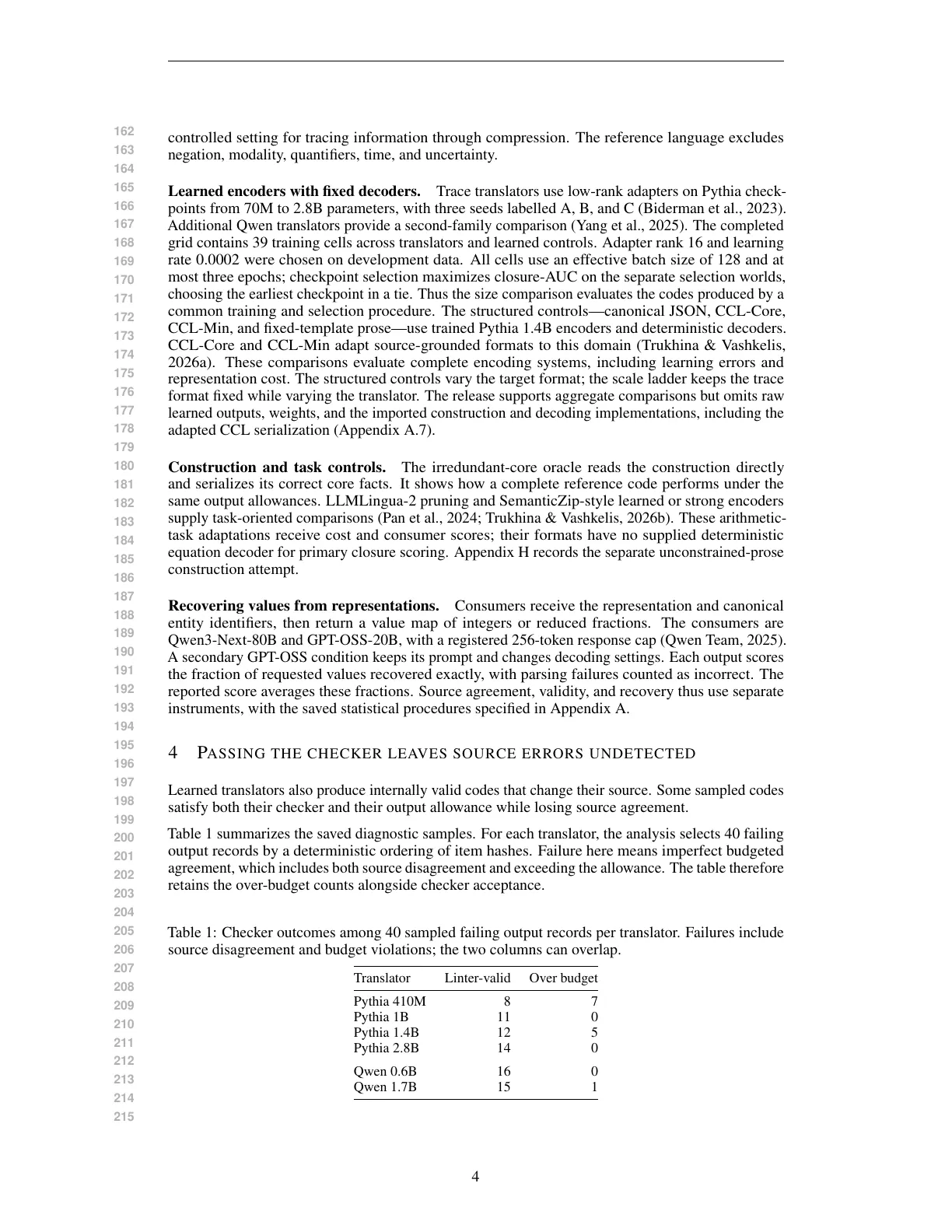
Table 1 summarizes the saved diagnostic samples. For each translator, the analysis selects 40 failing
output records by a deterministic ordering of item hashes. Failure here means imperfect budgeted
agreement, which includes both source disagreement and exceeding the allowance. The table therefore
retains the over-budget counts alongside checker acceptance.

Table 1: Checker outcomes among 40 sampled failing output records per translator. Failures include
source disagreement and budget violations; the two columns can overlap.

Translator

Linter-valid

Over budget

Pythia 410M
Pythia 1B
Pythia 1.4B
Pythia 2.8B

8
11
12
14

7
0
5
0

Qwen 0.6B
Qwen 1.7B

16
15

0
1

4
Text of page 5
The samples contain 8–16 linter-valid outputs per model. The Pythia 1B, Pythia 2.8B, and Qwen
0.6B samples contain no over-budget records; their accepted failures therefore have imperfect source
agreement. These rows establish the source-error case directly. For rows with budget violations, the
marginal counts leave their overlap with checker acceptance unresolved.

The diagnostic samples identify failure modes rather than estimate their prevalence across all outputs.
Their selection conditions on failure, and an item can contribute output records under different
evaluation conditions. Appendix F gives the sampling rule and complete taxonomy.

We next apply that source-conditioned comparison to every output, including failures, to measure
retention across budgets.

5

A COMPACT STRUCTURED CONTROL RETAINS MORE CONTENT PER BYTE

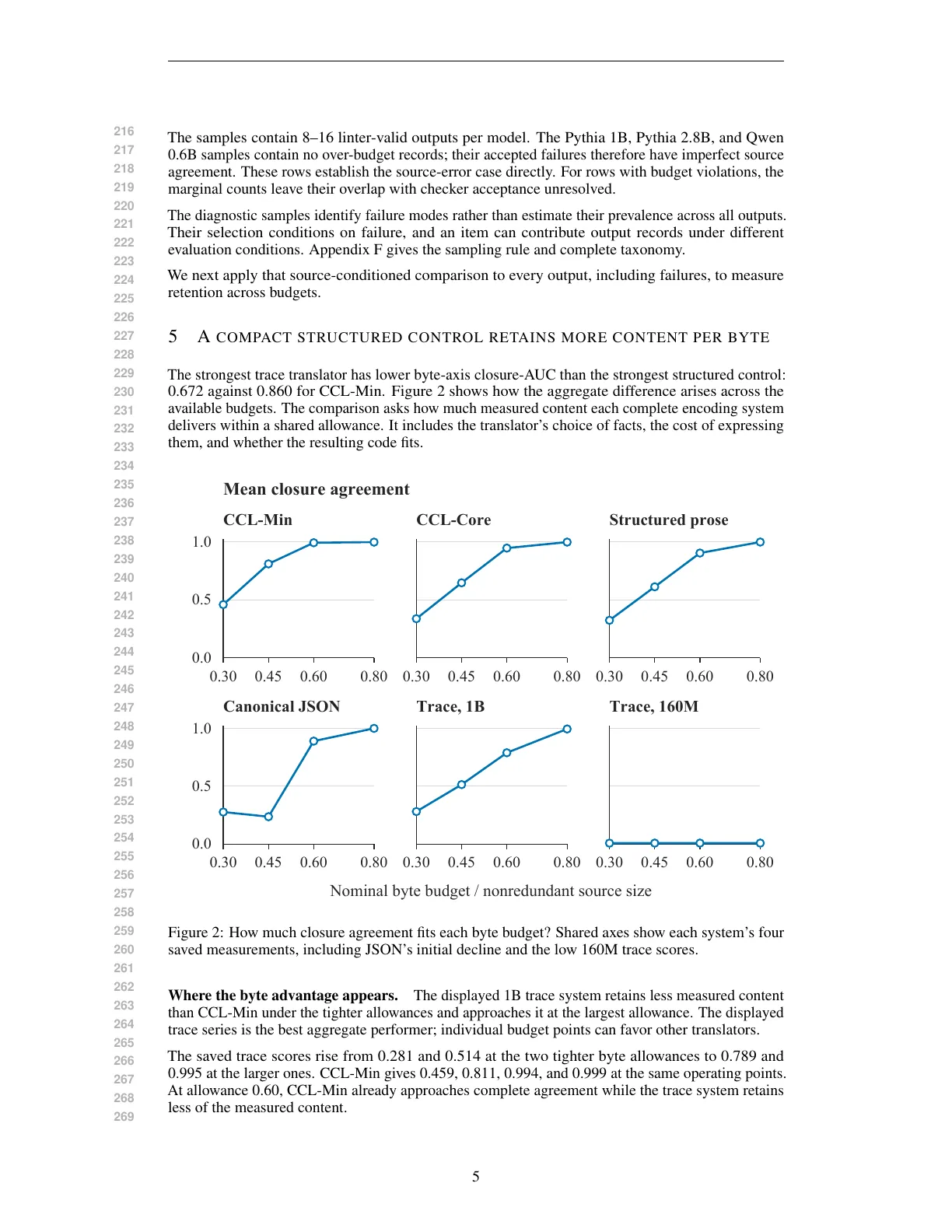
The strongest trace translator has lower byte-axis closure-AUC than the strongest structured control:
0.672 against 0.860 for CCL-Min. Figure 2 shows how the aggregate difference arises across the
available budgets. The comparison asks how much measured content each complete encoding system
delivers within a shared allowance. It includes the translator’s choice of facts, the cost of expressing
them, and whether the resulting code fits.

Mean closure agreement

CCL-Min

CCL-Core

Structured prose

1.0

0.5

0.0
0.30

0.45

0.60

0.80 0.30

Canonical JSON

0.45

0.60

Trace, 1B

0.80 0.30

0.45

0.60

0.80

Trace, 160M

1.0

0.5

0.0
0.30

0.45

0.60

0.80 0.30

0.45

0.60

0.80 0.30

0.45

0.60

0.80

Nominal byte budget / nonredundant source size

Figure 2: How much closure agreement fits each byte budget? Shared axes show each system’s four
saved measurements, including JSON’s initial decline and the low 160M trace scores.

Where the byte advantage appears. The displayed 1B trace system retains less measured content
than CCL-Min under the tighter allowances and approaches it at the largest allowance. The displayed
trace series is the best aggregate performer; individual budget points can favor other translators.

The saved trace scores rise from 0.281 and 0.514 at the two tighter byte allowances to 0.789 and
0.995 at the larger ones. CCL-Min gives 0.459, 0.811, 0.994, and 0.999 at the same operating points.
At allowance 0.60, CCL-Min already approaches complete agreement while the trace system retains
less of the measured content.

5
Text of page 6
The comparison also distinguishes structured formats from one another. Canonical JSON reaches
byte-axis closure-AUC 0.624, below the best trace result. CCL-Min’s aggregate advantage therefore
concerns the strongest compact format, rather than every structured representation.

The saved JSON curve also declines between its first two allowances before rising. Each operating
point uses a separate generated output, rather than extending the same code from the preceding
point. Accordingly, the curves report observed retention under each allowance; they need not rise
monotonically.

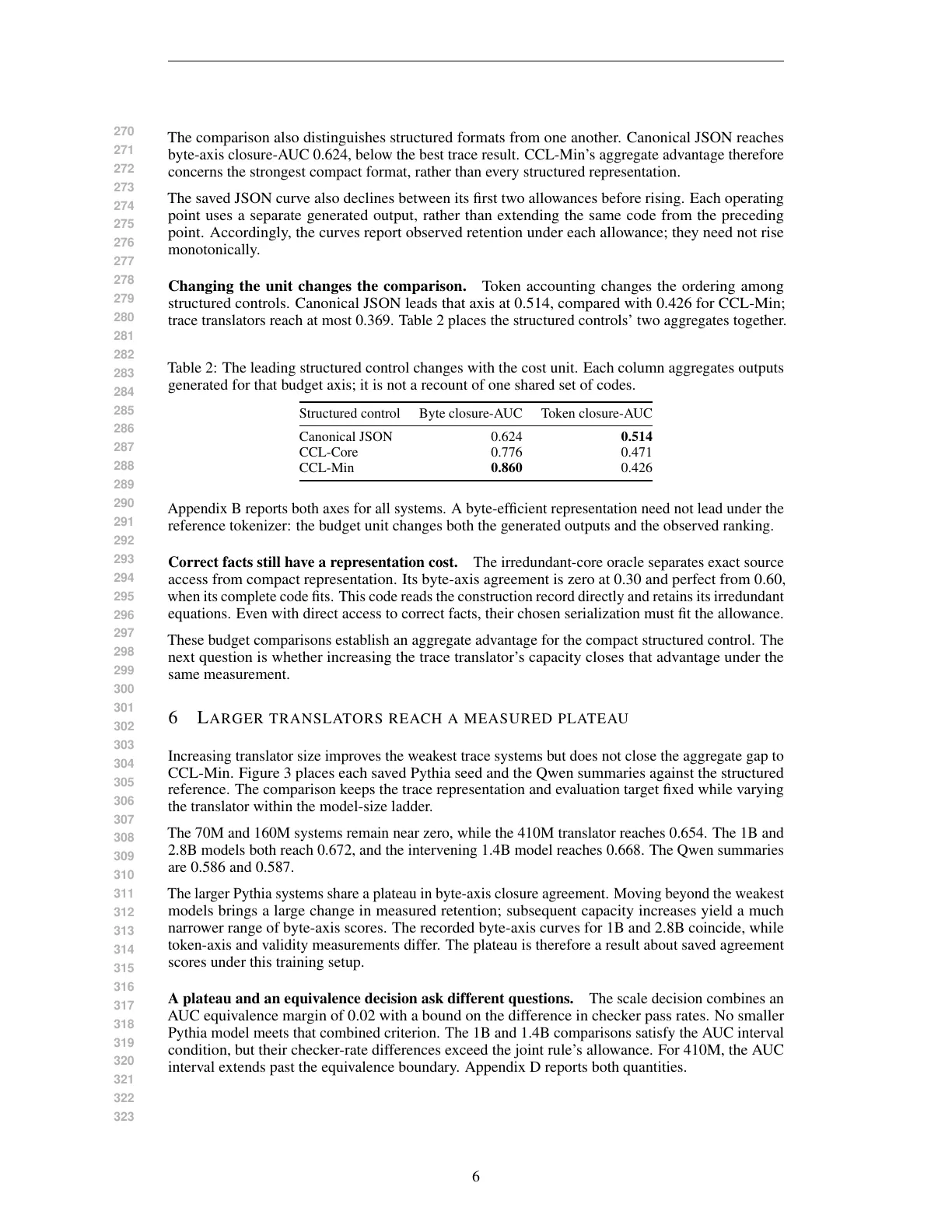
Changing the unit changes the comparison. Token accounting changes the ordering among
structured controls. Canonical JSON leads that axis at 0.514, compared with 0.426 for CCL-Min;
trace translators reach at most 0.369. Table 2 places the structured controls’ two aggregates together.

Table 2: The leading structured control changes with the cost unit. Each column aggregates outputs
generated for that budget axis; it is not a recount of one shared set of codes.

Structured control

Byte closure-AUC

Token closure-AUC

Canonical JSON
CCL-Core
CCL-Min

0.624
0.776
0.860

0.514
0.471
0.426

Appendix B reports both axes for all systems. A byte-efficient representation need not lead under the
reference tokenizer: the budget unit changes both the generated outputs and the observed ranking.

Correct facts still have a representation cost. The irredundant-core oracle separates exact source
access from compact representation. Its byte-axis agreement is zero at 0.30 and perfect from 0.60,
when its complete code fits. This code reads the construction record directly and retains its irredundant
equations. Even with direct access to correct facts, their chosen serialization must fit the allowance.

These budget comparisons establish an aggregate advantage for the compact structured control. The
next question is whether increasing the trace translator’s capacity closes that advantage under the
same measurement.

6

L ARGER TRANSLATORS REACH A MEASURED PLATEAU

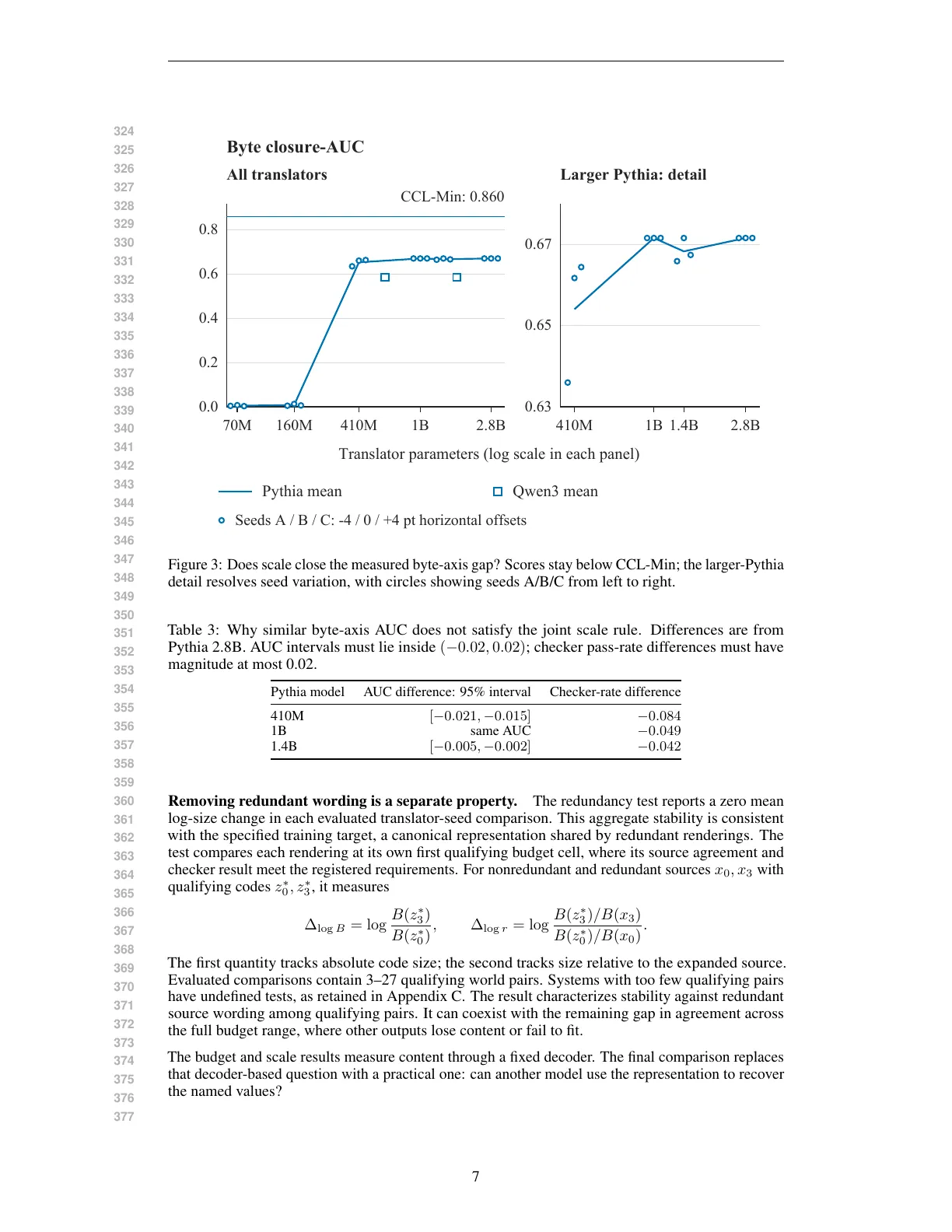
Increasing translator size improves the weakest trace systems but does not close the aggregate gap to
CCL-Min. Figure 3 places each saved Pythia seed and the Qwen summaries against the structured
reference. The comparison keeps the trace representation and evaluation target fixed while varying
the translator within the model-size ladder.

The 70M and 160M systems remain near zero, while the 410M translator reaches 0.654. The 1B and
2.8B models both reach 0.672, and the intervening 1.4B model reaches 0.668. The Qwen summaries
are 0.586 and 0.587.

The larger Pythia systems share a plateau in byte-axis closure agreement. Moving beyond the weakest
models brings a large change in measured retention; subsequent capacity increases yield a much
narrower range of byte-axis scores. The recorded byte-axis curves for 1B and 2.8B coincide, while
token-axis and validity measurements differ. The plateau is therefore a result about saved agreement
scores under this training setup.

A plateau and an equivalence decision ask different questions. The scale decision combines an
AUC equivalence margin of 0.02 with a bound on the difference in checker pass rates. No smaller
Pythia model meets that combined criterion. The 1B and 1.4B comparisons satisfy the AUC interval
condition, but their checker-rate differences exceed the joint rule’s allowance. For 410M, the AUC
interval extends past the equivalence boundary. Appendix D reports both quantities.

6
Text of page 7
Byte closure-AUC

All translators

Larger Pythia: detail

CCL-Min: 0.860

0.8

0.67

0.6

0.4

0.65

0.2

0.0

0.63

70M

160M

410M

1B

2.8B

410M

1B 1.4B

2.8B

Translator parameters (log scale in each panel)

Pythia mean

Qwen3 mean

Seeds A / B / C: -4 / 0 / +4 pt horizontal offsets

Figure 3: Does scale close the measured byte-axis gap? Scores stay below CCL-Min; the larger-Pythia
detail resolves seed variation, with circles showing seeds A/B/C from left to right.

Table 3: Why similar byte-axis AUC does not satisfy the joint scale rule. Differences are from
Pythia 2.8B. AUC intervals must lie inside (−0.02, 0.02); checker pass-rate differences must have
magnitude at most 0.02.

Pythia model

AUC difference: 95% interval

Checker-rate difference

[−0.021, −0.015]
same AUC
[−0.005, −0.002]

−0.084
−0.049
−0.042

410M
1B
1.4B

Removing redundant wording is a separate property. The redundancy test reports a zero mean
log-size change in each evaluated translator-seed comparison. This aggregate stability is consistent
with the specified training target, a canonical representation shared by redundant renderings. The
test compares each rendering at its own first qualifying budget cell, where its source agreement and
checker result meet the registered requirements. For nonredundant and redundant sources x 0 , x 3 with
qualifying codes z 0 ∗ , z 3 ∗ , it measures

∆ log B = log

B(z 3 ∗ )
,
B(z 0 ∗ )

∆ log r = log

B(z 3 ∗ )/B(x 3 )
.
B(z 0 ∗ )/B(x 0 )

The first quantity tracks absolute code size; the second tracks size relative to the expanded source.
Evaluated comparisons contain 3–27 qualifying world pairs. Systems with too few qualifying pairs
have undefined tests, as retained in Appendix C. The result characterizes stability against redundant
source wording among qualifying pairs. It can coexist with the remaining gap in agreement across
the full budget range, where other outputs lose content or fail to fit.

The budget and scale results measure content through a fixed decoder. The final comparison replaces
that decoder-based question with a practical one: can another model use the representation to recover
the named values?

7
Text of page 8
7

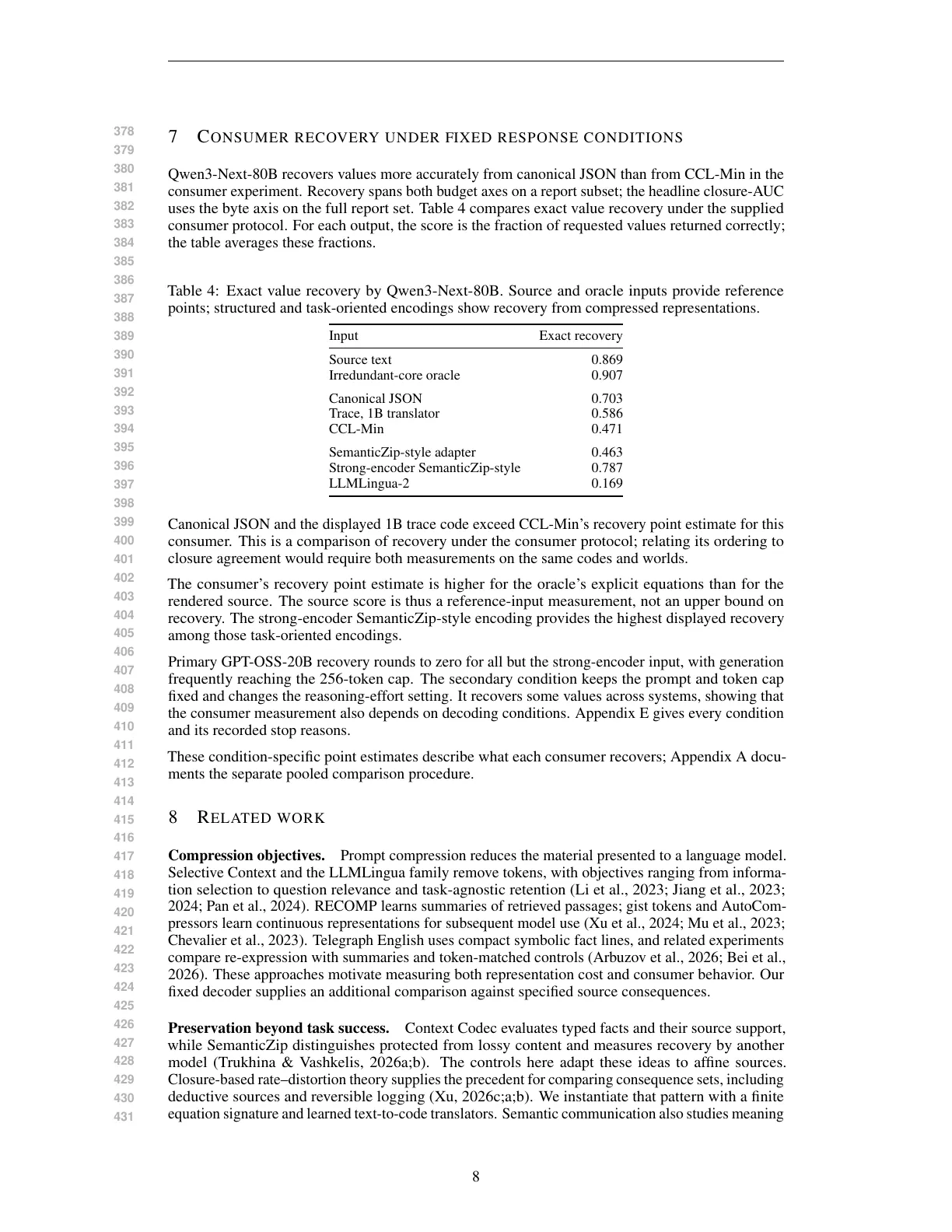
Qwen3-Next-80B recovers values more accurately from canonical JSON than from CCL-Min in the
consumer experiment. Recovery spans both budget axes on a report subset; the headline closure-AUC
uses the byte axis on the full report set. Table 4 compares exact value recovery under the supplied
consumer protocol. For each output, the score is the fraction of requested values returned correctly;
the table averages these fractions.

C ONSUMER RECOVERY UNDER FIXED RESPONSE CONDITIONS

Table 4: Exact value recovery by Qwen3-Next-80B. Source and oracle inputs provide reference
points; structured and task-oriented encodings show recovery from compressed representations.

Input

Exact recovery

Source text
Irredundant-core oracle

0.869
0.907

Canonical JSON
Trace, 1B translator
CCL-Min

0.703
0.586
0.471

SemanticZip-style adapter
Strong-encoder SemanticZip-style
LLMLingua-2

0.463
0.787
0.169

Canonical JSON and the displayed 1B trace code exceed CCL-Min’s recovery point estimate for this
consumer. This is a comparison of recovery under the consumer protocol; relating its ordering to
closure agreement would require both measurements on the same codes and worlds.

The consumer’s recovery point estimate is higher for the oracle’s explicit equations than for the
rendered source. The source score is thus a reference-input measurement, not an upper bound on
recovery. The strong-encoder SemanticZip-style encoding provides the highest displayed recovery
among those task-oriented encodings.

Primary GPT-OSS-20B recovery rounds to zero for all but the strong-encoder input, with generation
frequently reaching the 256-token cap. The secondary condition keeps the prompt and token cap
fixed and changes the reasoning-effort setting. It recovers some values across systems, showing that
the consumer measurement also depends on decoding conditions. Appendix E gives every condition
and its recorded stop reasons.

These condition-specific point estimates describe what each consumer recovers; Appendix A documents the separate pooled comparison procedure.

8

R ELATED WORK

Compression objectives. Prompt compression reduces the material presented to a language model.
Selective Context and the LLMLingua family remove tokens, with objectives ranging from information selection to question relevance and task-agnostic retention (Li et al., 2023; Jiang et al., 2023;
2024; Pan et al., 2024). RECOMP learns summaries of retrieved passages; gist tokens and AutoCompressors learn continuous representations for subsequent model use (Xu et al., 2024; Mu et al., 2023;
Chevalier et al., 2023). Telegraph English uses compact symbolic fact lines, and related experiments
compare re-expression with summaries and token-matched controls (Arbuzov et al., 2026; Bei et al.,
2026). These approaches motivate measuring both representation cost and consumer behavior. Our
fixed decoder supplies an additional comparison against specified source consequences.

Preservation beyond task success. Context Codec evaluates typed facts and their source support,
while SemanticZip distinguishes protected from lossy content and measures recovery by another
model (Trukhina & Vashkelis, 2026a;b). The controls here adapt these ideas to affine sources.
Closure-based rate–distortion theory supplies the precedent for comparing consequence sets, including
deductive sources and reversible logging (Xu, 2026c;a;b). We instantiate that pattern with a finite
equation signature and learned text-to-code translators. Semantic communication also studies meaning

8
Text of page 9
preservation under communication constraints, using learned encoders and decoders (Xie et al., 2021).
Here exact decoding makes the scored fact sets inspectable.

Faithfulness and executable meaning. Summarization studies identify unsupported generated
content; FactCC predicts source-conditioned consistency, and FActScore evaluates support at the
level of atomic facts (Maynez et al., 2020; Kryściński et al., 2020; Min et al., 2023). The constructed
arithmetic reference permits an exact comparison of both missing and added consequences. Semantic
parsing links language to executable representations, while constrained decoding enforces structural
requirements (Liang et al., 2013; Scholak et al., 2021). Our separate checker and reference comparison
distinguish these structural properties from preservation of the source.

Learned representations and scale. CommNet, DIAL, referential games, and GLC study messages
through the behavior they enable, including connections to interpretable symbols (Sukhbaatar et al.,
2016; Foerster et al., 2016; Lazaridou et al., 2017; Du et al., 2026). Consumer recovery retains that
behavioral question alongside source agreement. Language-model scaling studies and the Pythia
family motivate systematic size comparisons (Kaplan et al., 2020; Hoffmann et al., 2022; Biderman
et al., 2023). Our size ladder evaluates the resulting codes under fixed preservation rules and output
allowances, connecting translator capacity with the content retained by a complete encoding system.

9

D ISCUSSION

The learned-output errors and budget curves identify two requirements for a useful substitute:
preserving the specified source consequences and expressing them within the output allowance.

Choose what must survive. The reference projection turns preservation into an explicit set comparison. The fixtures distinguish dropping a redundant statement from losing a relation, and a
self-consistent mistranslation exposes the information missing from a code-only check. Learned
outputs exhibit the same separation between internal acceptance and source agreement. For a pipeline
that replaces its source with code, the preservation target therefore belongs in the evaluation design
alongside the code grammar.

Choose the cost that matters. The byte and token results lead to different choices among structured
controls. CCL-Min leads aggregate agreement per byte, while JSON leads under token accounting.
These are properties of complete encoding systems: a trained translator must recover the source facts
and express them within the allowance. The oracle makes the latter requirement visible even with
direct access to correct facts. An encoding comparison becomes useful when its budget matches the
resource the intended pipeline must conserve.

Evaluate the substitute where it will be used. Translator size, checker acceptance, and consumer
recovery provide complementary evidence about a code. The Pythia byte-axis plateau coexists with
differences in checker pass rates, so replacing a translator on the basis of one score can change
another property. The consumer experiment adds the model that must interpret the representation and
the decoding procedure that produces its answer. Its descriptive ordering supplies a separate view of
the compressed inputs, with the evaluation population and response conditions stated alongside the
scores.

The exact arithmetic domain makes this separation inspectable. Extending it to open text requires
a source representation and consequence family appropriate to that domain; the finite signature
already makes those choices part of the present score. The source-to-code comparison identifies
changed content; the consumer test measures what a particular reader can recover from the resulting
representation.

9
Text of page 10
R EPRODUCIBILITY S TATEMENT

The materials include measurement contracts, score tables, display scripts and data, configuration
and checkpoint hashes, and the analysis implementation. Seeds are labelled A, B, and C in the
paper; their integer values remain in the supplied configuration. Timestamps are withheld from the
anonymous version and restored at camera-ready; the artifact chain fixes the order. Appendix A.7
lists the additional artifacts required for complete replay.

E THICS S TATEMENT

The study uses constructed arithmetic sources and a restricted exact-value consumer task. Its central
safety implication is that a code’s internal acceptance should remain distinct from evidence of faithful
translation.

AI U SE S TATEMENT

In this work, generative AI tools were used to polish the manuscript prose and assist with preparing
explanatory illustrations. Generative AI tools were not used to design the model. All AI-assisted text
and visual materials were reviewed and edited by the authors. The authors take responsibility for the
final content of this paper, including all text, claims, and artifacts produced with AI assistance.

R EFERENCES

Mikhail L. Arbuzov, Sisong Bei, Ziwei Dong, Dmitri Kalaev, and Alexey A. Shvets. Telegraph
English: Semantic prompt compression via structured symbolic rewriting, 2026. URL https:
//arxiv.org/abs/2605.04426v1. Version 1.

Sisong Bei, Mikhail L. Arbuzov, Ziwei Dong, Dmitri Kalaev, and Alexey Shvets. Context compression
is not one thing: Readable symbolic re-expression vs. coherent summary at matched budget, 2026.
URL https://arxiv.org/abs/2606.14875v1. Version 1.

Stella Biderman, Hailey Schoelkopf, Quentin Gregory Anthony, Herbie Bradley, Kyle O’Brien,
Eric Hallahan, Mohammad Aflah Khan, Shivanshu Purohit, Usvsn Sai Prashanth, Edward Raff,
Aviya Skowron, Lintang Sutawika, and Oskar Van Der Wal. Pythia: A suite for analyzing large
language models across training and scaling. In Proceedings of the 40th International Conference
on Machine Learning, volume 202 of Proceedings of Machine Learning Research, pp. 2397–2430.
PMLR, 2023. URL https://proceedings.mlr.press/v202/biderman23a.html.

Alexis Chevalier, Alexander Wettig, Anirudh Ajith, and Danqi Chen. Adapting language models to compress contexts. In Proceedings of the 2023 Conference on Empirical Methods
in Natural Language Processing, pp. 3829–3846. Association for Computational Linguistics,
2023. doi: 10.18653/v1/2023.emnlp-main.232. URL https://aclanthology.org/2023.
emnlp-main.232/.

Wei Du, Benyu Wu, Yuqing Sun, Wei Guo, Yuntao Du, Zhongmin Yan, Guoxian Yu, and Lizhen
Cui. Learning efficient and interpretable multi-agent communication. In International Conference on Learning Representations, 2026. URL https://openreview.net/forum?id=
a3CUE06G5Y.

B. Efron. Bootstrap methods: Another look at the jackknife. The Annals of Statistics, 7(1):1–26, 1979.
doi: 10.1214/aos/1176344552. URL https://www.jstor.org/stable/2958830.

Jakob N. Foerster, Yannis M. Assael, Nando de Freitas, and Shimon Whiteson. Learning to communicate with deep multi-agent reinforcement learning. In Advances in Neural Information Processing
Systems, volume 29, 2016. URL https://proceedings.neurips.cc/paper_files/
paper/2016/file/c7635bfd99248a2cdef8249ef7bfbef4-Paper.pdf.

Jordan Hoffmann, Sebastian Borgeaud, Arthur Mensch, Elena Buchatskaya, Trevor Cai, Eliza
Rutherford, Diego de Las Casas, Lisa Anne Hendricks, Johannes Welbl, Aidan Clark, Tom

10
Text of page 11
Hennigan, Eric Noland, Katie Millican, George van den Driessche, Bogdan Damoc, Aurelia Guy,
Simon Osindero, Karen Simonyan, Erich Elsen, Jack W. Rae, Oriol Vinyals, and Laurent Sifre.
Training compute-optimal large language models, 2022. URL https://arxiv.org/abs/
2203.15556.

Sture Holm. A simple sequentially rejective multiple test procedure. Scandinavian Journal of
Statistics, 6(2):65–70, 1979. URL https://www.jstor.org/stable/4615733.

Huiqiang Jiang, Qianhui Wu, Chin-Yew Lin, Yuqing Yang, and Lili Qiu. LLMLingua: Compressing prompts for accelerated inference of large language models. In Proceedings of the 2023
Conference on Empirical Methods in Natural Language Processing, pp. 13358–13376. Association for Computational Linguistics, 2023. doi: 10.18653/v1/2023.emnlp-main.825. URL
https://aclanthology.org/2023.emnlp-main.825/.

Huiqiang Jiang, Qianhui Wu, Xufang Luo, Dongsheng Li, Chin-Yew Lin, Yuqing Yang, and Lili
Qiu. LongLLMLingua: Accelerating and enhancing LLMs in long context scenarios via prompt
compression. In Proceedings of the 62nd Annual Meeting of the Association for Computational
Linguistics (Volume 1: Long Papers), pp. 1658–1677. Association for Computational Linguistics,
2024. doi: 10.18653/v1/2024.acl-long.91. URL https://aclanthology.org/2024.
acl-long.91/.

Jared Kaplan, Sam McCandlish, Tom Henighan, Tom B. Brown, Benjamin Chess, Rewon Child,
Scott Gray, Alec Radford, Jeffrey Wu, and Dario Amodei. Scaling laws for neural language models,
2020. URL https://arxiv.org/abs/2001.08361.

Wojciech Kryściński, Bryan McCann, Caiming Xiong, and Richard Socher. Evaluating the factual consistency of abstractive text summarization. In Proceedings of the 2020 Conference
on Empirical Methods in Natural Language Processing (EMNLP), pp. 9332–9346. Association for Computational Linguistics, 2020. doi: 10.18653/v1/2020.emnlp-main.750. URL
https://aclanthology.org/2020.emnlp-main.750/.

Daniël Lakens. Equivalence tests: A practical primer for t tests, correlations, and meta-analyses. Social Psychological and Personality Science, 8(4):355–362, 2017. doi: 10.1177/1948550617697177.
URL https://journals.sagepub.com/doi/10.1177/1948550617697177.

Angeliki Lazaridou, Alexander Peysakhovich, and Marco Baroni. Multi-agent cooperation and the
emergence of (natural) language. In International Conference on Learning Representations, 2017.
URL https://arxiv.org/abs/1612.07182v2.

Yucheng Li, Bo Dong, Frank Guerin, and Chenghua Lin. Compressing context to enhance inference
efficiency of large language models. In Proceedings of the 2023 Conference on Empirical Methods
in Natural Language Processing, pp. 6342–6353. Association for Computational Linguistics,
2023. doi: 10.18653/v1/2023.emnlp-main.391. URL https://aclanthology.org/2023.
emnlp-main.391/.

Percy Liang, Michael I. Jordan, and Dan Klein. Learning dependency-based compositional semantics.
Computational Linguistics, 39(2):389–446, 2013. doi: 10.1162/COLI_a_00127. URL https:
//aclanthology.org/J13-2005/.

Joshua Maynez, Shashi Narayan, Bernd Bohnet, and Ryan McDonald. On faithfulness and factuality
in abstractive summarization. In Proceedings of the 58th Annual Meeting of the Association for
Computational Linguistics, pp. 1906–1919. Association for Computational Linguistics, 2020. doi:
10.18653/v1/2020.acl-main.173. URL https://aclanthology.org/2020.acl-main.
173/.

Sewon Min, Kalpesh Krishna, Xinxi Lyu, Mike Lewis, Wen-tau Yih, Pang Wei Koh, Mohit Iyyer,
Luke Zettlemoyer, and Hannaneh Hajishirzi. FActScore: Fine-grained atomic evaluation of factual
precision in long form text generation. In Proceedings of the 2023 Conference on Empirical
Methods in Natural Language Processing, pp. 12076–12100. Association for Computational
Linguistics, 2023. doi: 10.18653/v1/2023.emnlp-main.741. URL https://aclanthology.
org/2023.emnlp-main.741/.

11
Text of page 12
Jesse Mu, Xiang Lisa Li, and Noah Goodman. Learning to compress prompts with gist tokens. In Advances in Neural Information Processing Systems, volume 36, 2023. doi:
10.52202/075280-0848. URL https://proceedings.neurips.cc/paper_files/
paper/2023/hash/3d77c6dcc7f143aa2154e7f4d5e22d68-Abstract.html.

Brian A. Nosek, Charles R. Ebersole, Alexander C. DeHaven, and David T. Mellor. The preregistration revolution. Proceedings of the National Academy of Sciences, 115(11):2600–2606, 2018.
doi: 10.1073/pnas.1708274114. URL https://www.pnas.org/doi/10.1073/pnas.
1708274114.

Zhuoshi Pan, Qianhui Wu, Huiqiang Jiang, Menglin Xia, Xufang Luo, Jue Zhang, Qingwei Lin, Victor
Rühle, Yuqing Yang, Chin-Yew Lin, H. Vicky Zhao, Lili Qiu, and Dongmei Zhang. LLMLingua-2:
Data distillation for efficient and faithful task-agnostic prompt compression. In Findings of the
Association for Computational Linguistics: ACL 2024, pp. 963–981. Association for Computational
Linguistics, 2024. doi: 10.18653/v1/2024.findings-acl.57. URL https://aclanthology.
org/2024.findings-acl.57/.

Qwen Team. Qwen3-Next-80B-A3B-Instruct. Model card, 2025. URL https://huggingface.
co/Qwen/Qwen3-Next-80B-A3B-Instruct.

Torsten Scholak, Nathan Schucher, and Dzmitry Bahdanau. PICARD: Parsing incrementally
for constrained auto-regressive decoding from language models. In Proceedings of the 2021
Conference on Empirical Methods in Natural Language Processing, pp. 9895–9901. Association for Computational Linguistics, 2021. doi: 10.18653/v1/2021.emnlp-main.779. URL
https://aclanthology.org/2021.emnlp-main.779/.

Sainbayar Sukhbaatar, Arthur Szlam, and Rob Fergus. Learning multiagent communication with backpropagation. In Advances in Neural Information Processing Systems, volume 29, 2016. URL https://papers.nips.cc/paper_files/paper/2016/hash/
55b1927fdafef39c48e5b73b5d61ea60-Abstract.html.

Natalia Trukhina and Vadim Vashkelis. Compress the context, keep the commitments: A formal
framework for verifiable LLM context compression, 2026a. URL https://arxiv.org/abs/
2605.17304v1. Version 1.

Natalia Trukhina and Vadim Vashkelis. SemanticZip: A pilot framework for lossy text compression
with LLMs as semantic decompressors, 2026b. URL https://arxiv.org/abs/2605.
24541v1. Version 1.

Huiqiang Xie, Zhijin Qin, Geoffrey Ye Li, and Biing-Hwang Juang. Deep learning enabled semantic
communication systems. IEEE Transactions on Signal Processing, 2021. doi: 10.1109/TSP.2021.
3071210. URL https://arxiv.org/abs/2006.10685v3.

Fangyuan Xu, Weijia Shi, and Eunsol Choi. RECOMP: Improving retrieval-augmented LMs with
compression and selective augmentation. In International Conference on Learning Representations,
2024. URL https://proceedings.iclr.cc/paper_files/paper/2024/file/
bda88ed2892f5e61c9a9bf215c566913-Paper-Conference.pdf.

Jianfeng Xu. Rate-distortion theory for deductive sources under closure fidelity, 2026a. URL
https://arxiv.org/abs/2604.15698v4. Version 4.

Jianfeng Xu. Closure-preserving rate-distortion for reversible logging, 2026b. URL https:
//arxiv.org/abs/2606.16592v2. Version 2.

Jianfeng Xu. Semantic rate-distortion theory: Deductive compression and closure fidelity, 2026c.
URL https://arxiv.org/abs/2604.11204v1. Version 1.

An Yang, Anfeng Li, Baosong Yang, Beichen Zhang, Binyuan Hui, Bo Zheng, Bowen Yu, Chang
Gao, Chengen Huang, Chenxu Lv, Chujie Zheng, Dayiheng Liu, Fan Zhou, Fei Huang, Feng Hu,
Hao Ge, Haoran Wei, Huan Lin, Jialong Tang, Jian Yang, Jianhong Tu, Jianwei Zhang, Jianxin
Yang, Jiaxi Yang, Jing Zhou, Jingren Zhou, Junyang Lin, Kai Dang, Keqin Bao, Kexin Yang,
Le Yu, Lianghao Deng, Mei Li, Mingfeng Xue, Mingze Li, Pei Zhang, Peng Wang, Qin Zhu, Rui
Men, Ruize Gao, Shixuan Liu, Shuang Luo, Tianhao Li, Tianyi Tang, Wenbiao Yin, Xingzhang

12

Text of page 13
Ren, Xinyu Wang, Xinyu Zhang, Xuancheng Ren, Yang Fan, Yang Su, Yichang Zhang, Yinger
Zhang, Yu Wan, Yuqiong Liu, Zekun Wang, Zeyu Cui, Zhenru Zhang, Zhipeng Zhou, and Zihan
Qiu. Qwen3 technical report, 2025. URL https://arxiv.org/abs/2505.09388.

13
Text of page 14
A

S TATISTICAL PROCEDURE AND IMPLEMENTATION

A.1

R EFERENCE FACTS AND FINITE CLOSURE

Canonical equations combine repeated variables, sort identifiers, clear denominators, divide by the
positive greatest common divisor, and orient the first nonzero coefficient positively. Exact rational
row reduction tests entailment over the union of source and decoded variables.

For a consistent equation set S, the scored set contains its explicit canonical equations, all uniquely
entailed entity values, and all uniquely entailed pairwise differences. Explicit affine equations remain
members even when they fall outside the value and difference templates. Consequently, logically
equivalent affine bases can have different scored sets.

Redundant source additions are restricted to entailed values and pairwise differences, keeping the
scored reference set fixed across the four source renderings. An inconsistent side, or an empty
decoded set, receives zero agreement. Unsupported text remains visible in parsing diagnostics.

A.2

R ATES AND AGGREGATION

Let B count UTF-8 bytes and T count reference tokens. Raw outputs retain whitespace, fences,
explanations, and malformed material. The reference tokenizer is Qwen/Qwen3.8-27B, revision
1d4bf0f2ff6012fd82039f2fa52739d0dd7c60c0, with special tokens disabled. For the
rendering x 0 without added redundancy, the absolute allowances are

b B (r) = max{128, ⌊rB(x 0 )⌋},
r ∈ {0.30, 0.45, 0.60, 0.80}.

b T (r) = max{48, ⌊rT (x 0 )⌋},

(1)
(2)

Realized rates use the corresponding source rendering in the denominator. An over-budget output
receives zero matched-budget agreement while its raw output and diagnostics remain recorded. Each
budget cell contributes an item-level agreement score.

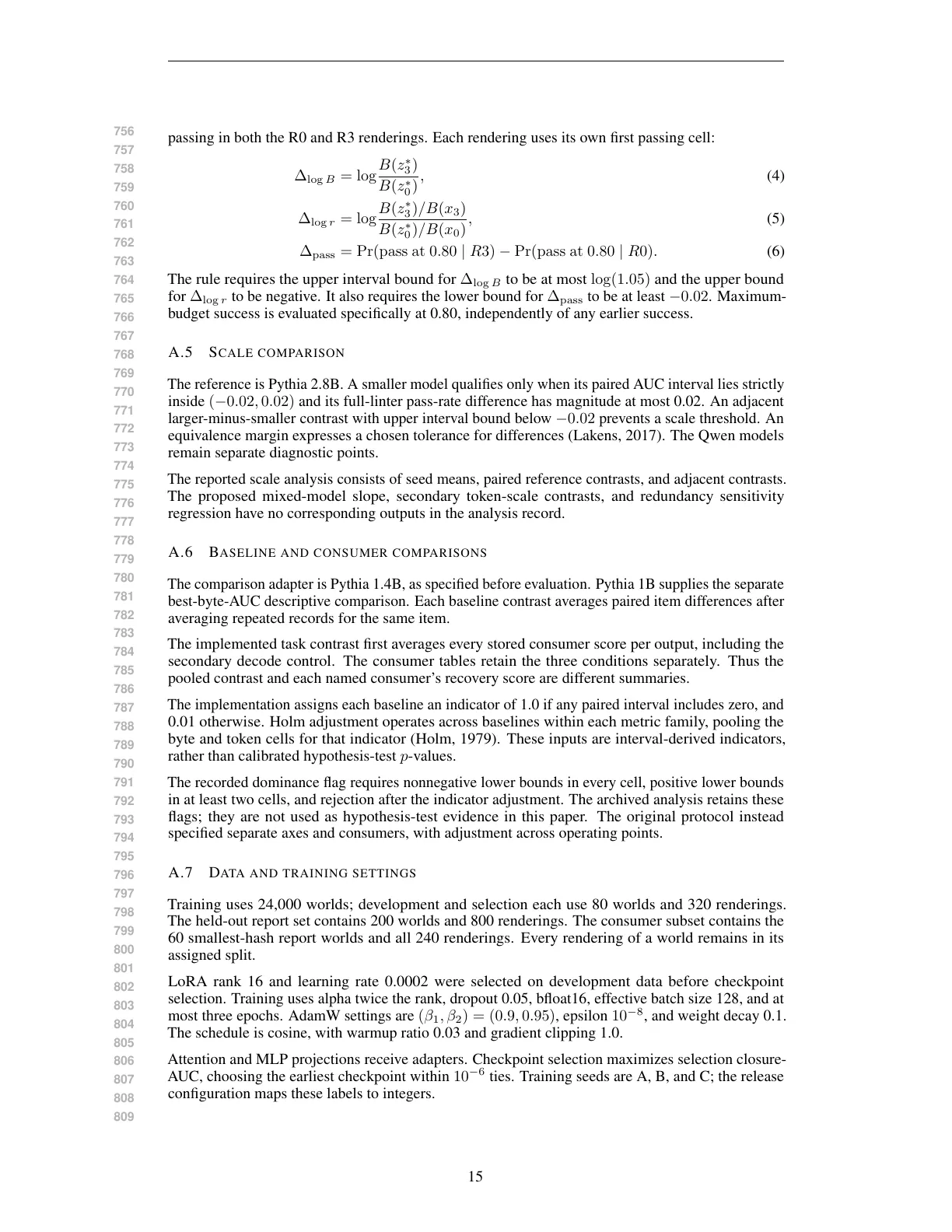
For mean scores F̄ j at ordered budgets r j , normalized closure-AUC is

AUC =

3
X
F̄ j + F̄ j+1
1
(r j+1 − r j )
.
0.80 − 0.30 j=1
2

(3)

The analysis requires every budget point. Scale summaries retain separate seed results and their
equal-weight mean.

A.3

W ORLD RESAMPLING

The resampling unit is the latent world. All associated renderings, budgets, systems, and seeds move
together. The percentile interval uses the ordered replicate positions at 0.025 and 0.975, with linear
interpolation between neighboring positions (Efron, 1979).

Scale contrasts and the designated Pythia 1.4B redundancy analysis use 10,000 resamples. The allmodel redundancy summaries and baseline contrasts use 1,000 resamples. The numerical bootstrap
seed is retained in the configuration.

Scale and redundancy computations retain the multiplicity of sampled worlds. Baseline contrasts first
collapse records by item identifier, so repeated selections of a world contribute once per replicate.
These baseline intervals therefore use the implemented deduplicated-world procedure.

A.4

R EDUNDANCY COMPARISON

The first passing budget requires closure precision and recall of at least 0.95 and a full-linter pass. A
rendering without a passing cell receives ordinal code 5. Size and rate comparisons use only worlds

14
Text of page 15
passing in both the R0 and R3 renderings. Each rendering uses its own first passing cell:

B(z 3 ∗ )
,
B(z 0 ∗ )
B(z 3 ∗ )/B(x 3 )
∆ log r = log
,
B(z 0 ∗ )/B(x 0 )
∆ pass = Pr(pass at 0.80 | R3) − Pr(pass at 0.80 | R0).

∆ log B = log

(4)

(5)

(6)

The rule requires the upper interval bound for ∆ log B to be at most log(1.05) and the upper bound
for ∆ log r to be negative. It also requires the lower bound for ∆ pass to be at least −0.02. Maximumbudget success is evaluated specifically at 0.80, independently of any earlier success.

A.5

S CALE COMPARISON

The reference is Pythia 2.8B. A smaller model qualifies only when its paired AUC interval lies strictly
inside (−0.02, 0.02) and its full-linter pass-rate difference has magnitude at most 0.02. An adjacent
larger-minus-smaller contrast with upper interval bound below −0.02 prevents a scale threshold. An
equivalence margin expresses a chosen tolerance for differences (Lakens, 2017). The Qwen models
remain separate diagnostic points.

The reported scale analysis consists of seed means, paired reference contrasts, and adjacent contrasts.
The proposed mixed-model slope, secondary token-scale contrasts, and redundancy sensitivity
regression have no corresponding outputs in the analysis record.

A.6

B ASELINE AND CONSUMER COMPARISONS

The comparison adapter is Pythia 1.4B, as specified before evaluation. Pythia 1B supplies the separate
best-byte-AUC descriptive comparison. Each baseline contrast averages paired item differences after
averaging repeated records for the same item.

The implemented task contrast first averages every stored consumer score per output, including the
secondary decode control. The consumer tables retain the three conditions separately. Thus the
pooled contrast and each named consumer’s recovery score are different summaries.

The implementation assigns each baseline an indicator of 1.0 if any paired interval includes zero, and
0.01 otherwise. Holm adjustment operates across baselines within each metric family, pooling the
byte and token cells for that indicator (Holm, 1979). These inputs are interval-derived indicators,
rather than calibrated hypothesis-test p-values.

The recorded dominance flag requires nonnegative lower bounds in every cell, positive lower bounds
in at least two cells, and rejection after the indicator adjustment. The archived analysis retains these
flags; they are not used as hypothesis-test evidence in this paper. The original protocol instead
specified separate axes and consumers, with adjustment across operating points.

A.7

D ATA AND TRAINING SETTINGS

Training uses 24,000 worlds; development and selection each use 80 worlds and 320 renderings.
The held-out report set contains 200 worlds and 800 renderings. The consumer subset contains the
60 smallest-hash report worlds and all 240 renderings. Every rendering of a world remains in its
assigned split.

LoRA rank 16 and learning rate 0.0002 were selected on development data before checkpoint
selection. Training uses alpha twice the rank, dropout 0.05, bfloat16, effective batch size 128, and at
most three epochs. AdamW settings are (β 1 , β 2 ) = (0.9, 0.95), epsilon 10 −8 , and weight decay 0.1.
The schedule is cosine, with warmup ratio 0.03 and gradient clipping 1.0.

Attention and MLP projections receive adapters. Checkpoint selection maximizes selection closure-
AUC, choosing the earliest checkpoint within 10 −6 ties. Training seeds are A, B, and C; the release
configuration maps these labels to integers.

15
Text of page 16
The checkpoint record includes matched Pythia 1.4B adapters for JSON, CCL-Core, CCL-Min,
structured prose, and SemanticZip-style packets. The structured formats have deterministic decoders.
The aggregate tables identify the output format of each control.

Each translator produces one greedy completion with temperature zero, repetition penalty one,
and EOS enabled. The generation allowance adds 32 tokens for byte-controlled cells and 8 for
token-controlled cells. All returned tokens remain in rate accounting.

Available artifacts comprise aggregate score tables, the analysis driver, and configuration and checkpoint hashes. Raw scorecards, learned output texts, fitted weights, and the imported estimator,
decoder, target-builder, and construction implementations are absent from this record. The exact
adapted CCL serialization is therefore unavailable for independent inspection. Aggregate results
can be inspected, while complete row-to-checkpoint attribution and raw-output equality remain
unverified.

B

R ATE – DISTORTION RESULTS

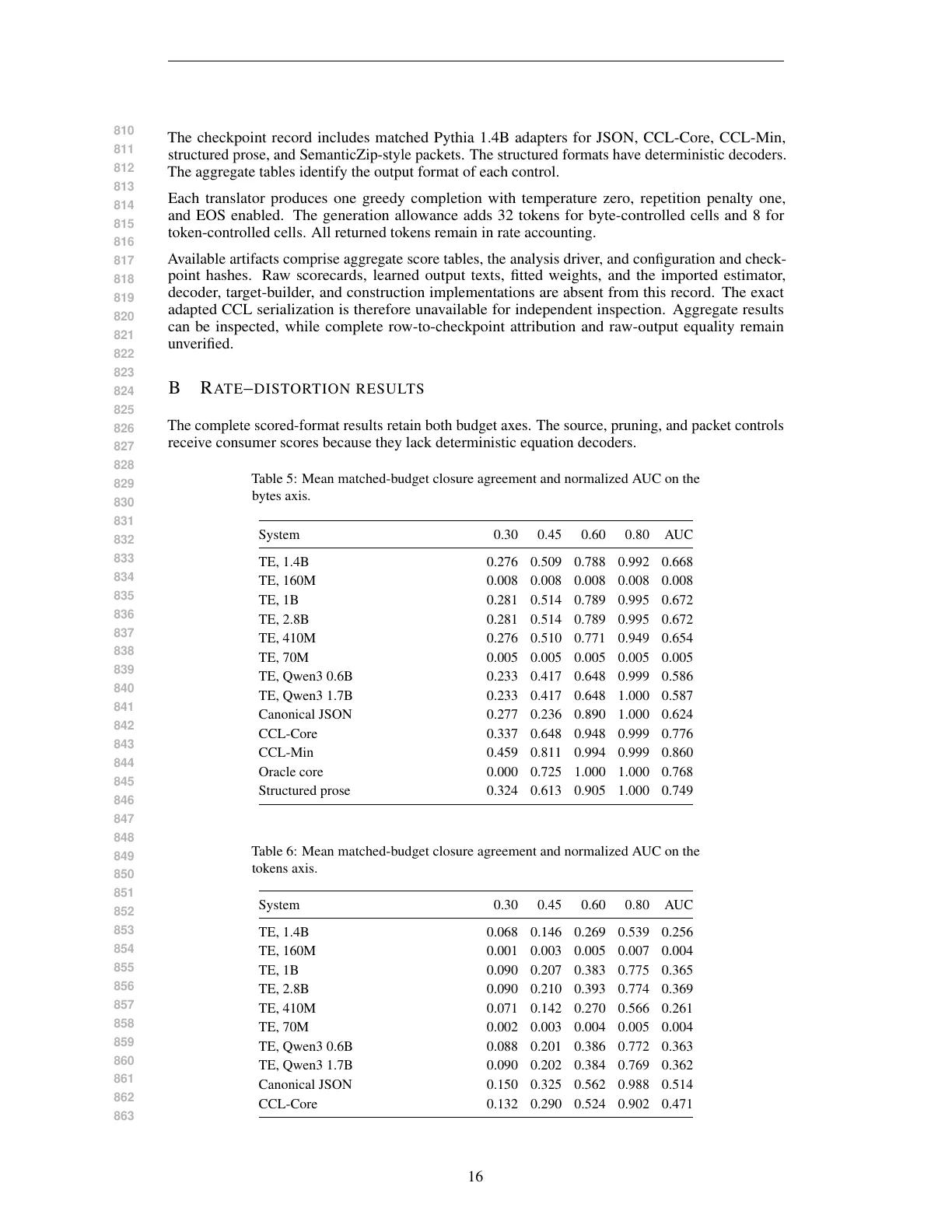
The complete scored-format results retain both budget axes. The source, pruning, and packet controls
receive consumer scores because they lack deterministic equation decoders.

Table 5: Mean matched-budget closure agreement and normalized AUC on the
bytes axis.

System

0.30

0.45

0.60

0.80

AUC

TE, 1.4B
TE, 160M
TE, 1B
TE, 2.8B
TE, 410M
TE, 70M
TE, Qwen3 0.6B
TE, Qwen3 1.7B
Canonical JSON
CCL-Core
CCL-Min
Oracle core
Structured prose

0.276
0.008
0.281
0.281
0.276
0.005
0.233
0.233
0.277
0.337
0.459
0.000
0.324

0.509
0.008
0.514
0.514
0.510
0.005
0.417
0.417
0.236
0.648
0.811
0.725
0.613

0.788
0.008
0.789
0.789
0.771
0.005
0.648
0.648
0.890
0.948
0.994
1.000
0.905

0.992
0.008
0.995
0.995
0.949
0.005
0.999
1.000
1.000
0.999
0.999
1.000
1.000

0.668
0.008
0.672
0.672
0.654
0.005
0.586
0.587
0.624
0.776
0.860
0.768
0.749

Table 6: Mean matched-budget closure agreement and normalized AUC on the
tokens axis.

System

0.30

0.45

0.60

0.80

AUC

TE, 1.4B
TE, 160M
TE, 1B
TE, 2.8B
TE, 410M
TE, 70M
TE, Qwen3 0.6B
TE, Qwen3 1.7B
Canonical JSON
CCL-Core

0.068
0.001
0.090
0.090
0.071
0.002
0.088
0.090
0.150
0.132

0.146
0.003
0.207
0.210
0.142
0.003
0.201
0.202
0.325
0.290

0.269
0.005
0.383
0.393
0.270
0.004
0.386
0.384
0.562
0.524

0.539
0.007
0.775
0.774
0.566
0.005
0.772
0.769
0.988
0.902

0.256
0.004
0.365
0.369
0.261
0.004
0.363
0.362
0.514
0.471

16
Text of page 17
Continued from previous page

C

CCL-Min
Oracle core
Structured prose

0.113 0.230 0.403 0.994 0.426
0.000 0.000 0.005 1.000 0.202
0.143 0.279 0.453 0.781 0.420

0.60

0.80

AUC

R EDUNDANCY RESULTS

∆ log B

Model Seed Paired Status

1.4B
1.4B
1.4B
160M
160M
160M
1B
1B
1B
2.8B
2.8B
2.8B
410M
410M
410M
70M
70M
70M

0.45

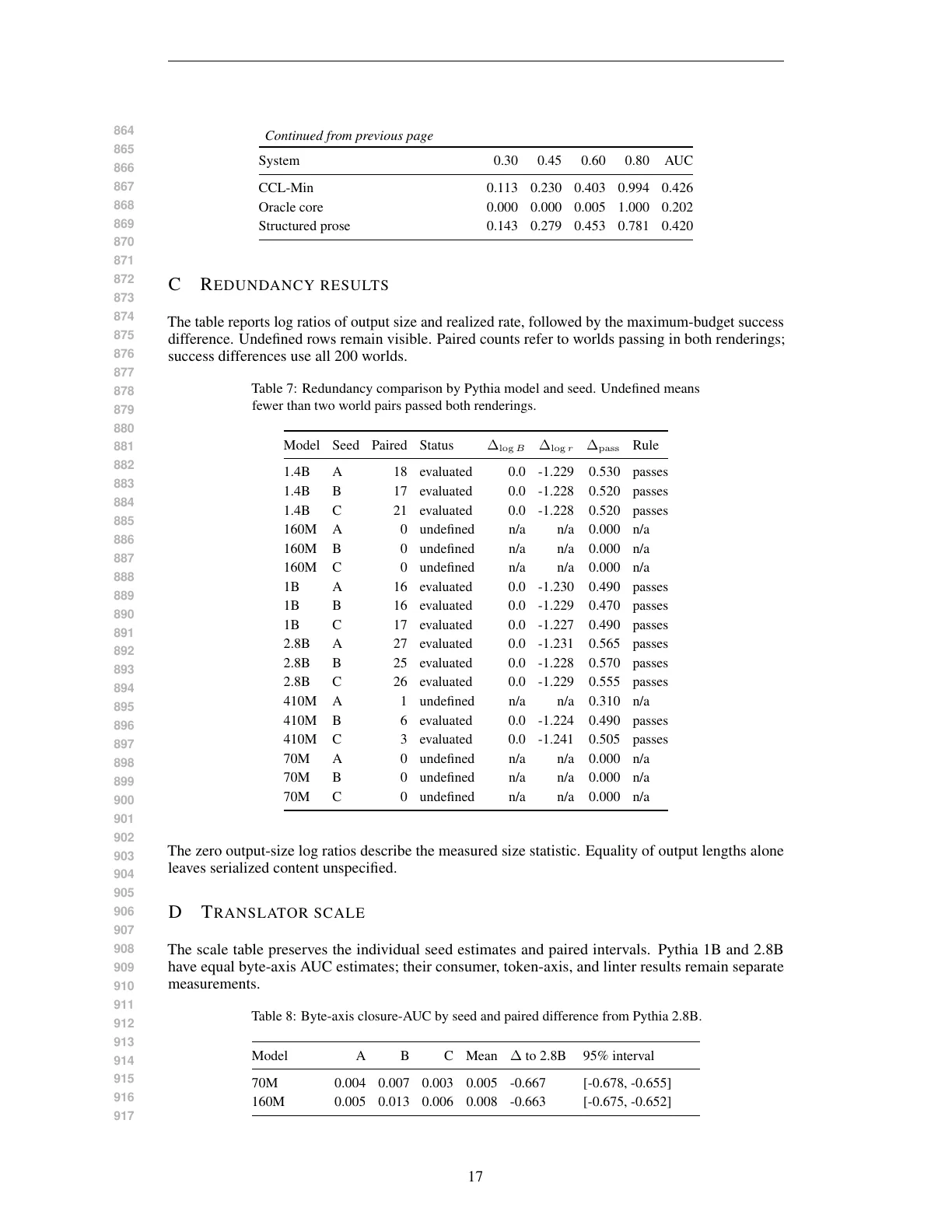
Table 7: Redundancy comparison by Pythia model and seed. Undefined means
fewer than two world pairs passed both renderings.

0.30

The table reports log ratios of output size and realized rate, followed by the maximum-budget success
difference. Undefined rows remain visible. Paired counts refer to worlds passing in both renderings;
success differences use all 200 worlds.

System

A
B
C
A
B
C
A
B
C
A
B
C
A
B
C
A
B
C

18
17
21
0
0
0
16
16
17
27
25
26
1
6
3
0
0
0

evaluated
evaluated
evaluated
undefined
undefined
undefined
evaluated
evaluated
evaluated
evaluated
evaluated
evaluated
undefined
evaluated
evaluated
undefined
undefined
undefined

0.0
0.0
0.0
n/a
n/a
n/a
0.0
0.0
0.0
0.0
0.0
0.0
n/a
0.0
0.0
n/a
n/a
n/a

∆ log r ∆ pass Rule

-1.229
-1.228
-1.228
n/a
n/a
n/a
-1.230
-1.229
-1.227
-1.231
-1.228
-1.229
n/a
-1.224
-1.241
n/a
n/a
n/a

0.530
0.520
0.520
0.000
0.000
0.000
0.490
0.470
0.490
0.565
0.570
0.555
0.310
0.490
0.505
0.000
0.000
0.000

passes
passes
passes
n/a
n/a
n/a
passes
passes
passes
passes
passes
passes
n/a
passes
passes
n/a
n/a
n/a

The zero output-size log ratios describe the measured size statistic. Equality of output lengths alone
leaves serialized content unspecified.

D

T RANSLATOR SCALE

The scale table preserves the individual seed estimates and paired intervals. Pythia 1B and 2.8B
have equal byte-axis AUC estimates; their consumer, token-axis, and linter results remain separate
measurements.

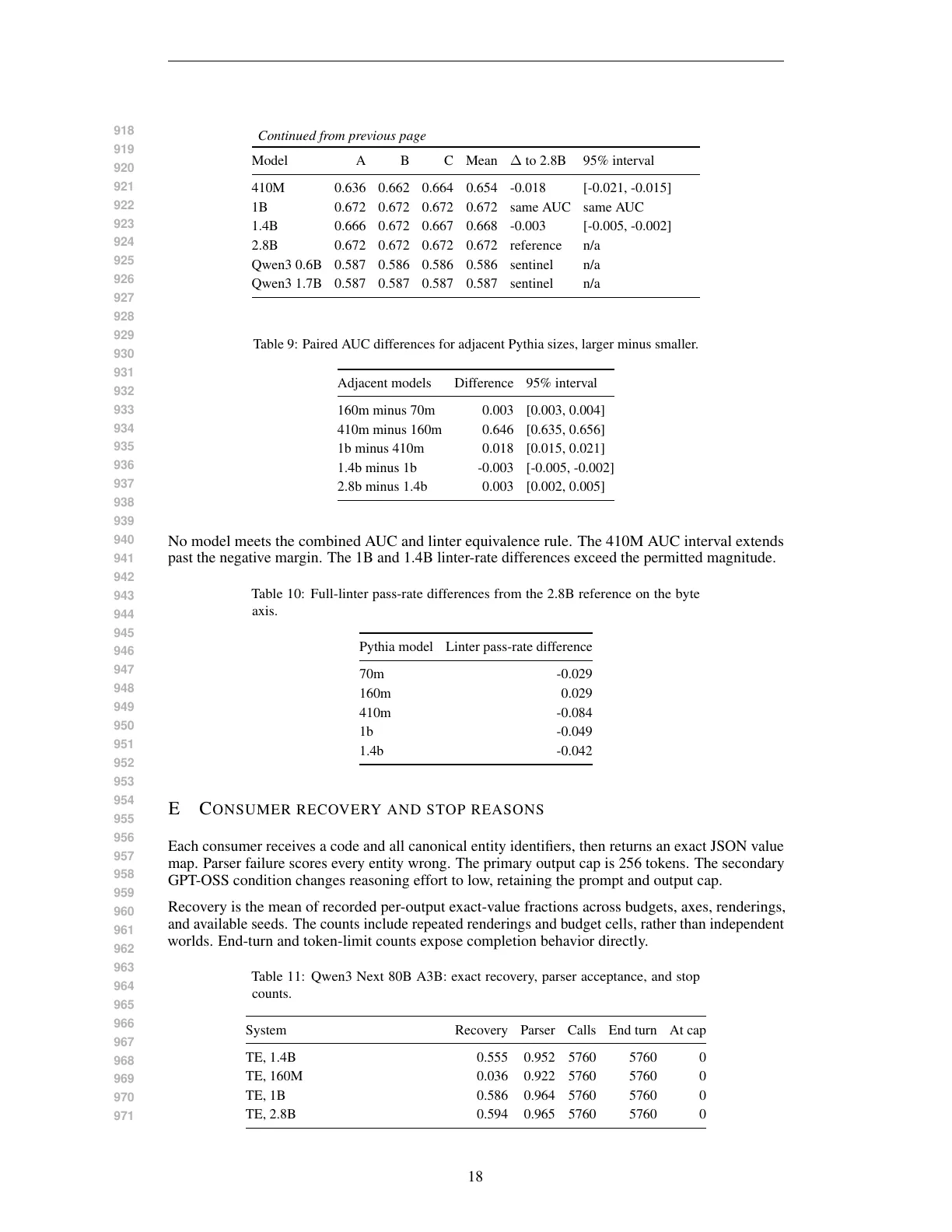
Table 8: Byte-axis closure-AUC by seed and paired difference from Pythia 2.8B.

Model

70M
160M

A

B

C Mean ∆ to 2.8B

0.004 0.007 0.003 0.005 -0.667
0.005 0.013 0.006 0.008 -0.663

17

95% interval

[-0.678, -0.655]
[-0.675, -0.652]
Text of page 18
Continued from previous page

Model

410M
1B
1.4B
2.8B
Qwen3 0.6B
Qwen3 1.7B

0.636
0.672
0.666
0.672
0.587
0.587

0.662
0.672
0.672
0.672
0.586
0.587

C Mean ∆ to 2.8B

0.664
0.672
0.667
0.672
0.586
0.587

Adjacent models

160m minus 70m
410m minus 160m
1b minus 410m
1.4b minus 1b
2.8b minus 1.4b

0.654
0.672
0.668
0.672
0.586
0.587

95% interval

-0.018
same AUC
-0.003
reference
sentinel
sentinel

[-0.021, -0.015]
same AUC
[-0.005, -0.002]
n/a
n/a
n/a

Difference 95% interval

0.003
0.646
0.018
-0.003
0.003

[0.003, 0.004]
[0.635, 0.656]
[0.015, 0.021]
[-0.005, -0.002]
[0.002, 0.005]

No model meets the combined AUC and linter equivalence rule. The 410M AUC interval extends
past the negative margin. The 1B and 1.4B linter-rate differences exceed the permitted magnitude.

Table 10: Full-linter pass-rate differences from the 2.8B reference on the byte
axis.

B

Table 9: Paired AUC differences for adjacent Pythia sizes, larger minus smaller.

A

Pythia model Linter pass-rate difference

70m
160m
410m
1b
1.4b

E

-0.029
0.029
-0.084
-0.049
-0.042

C ONSUMER RECOVERY AND STOP REASONS

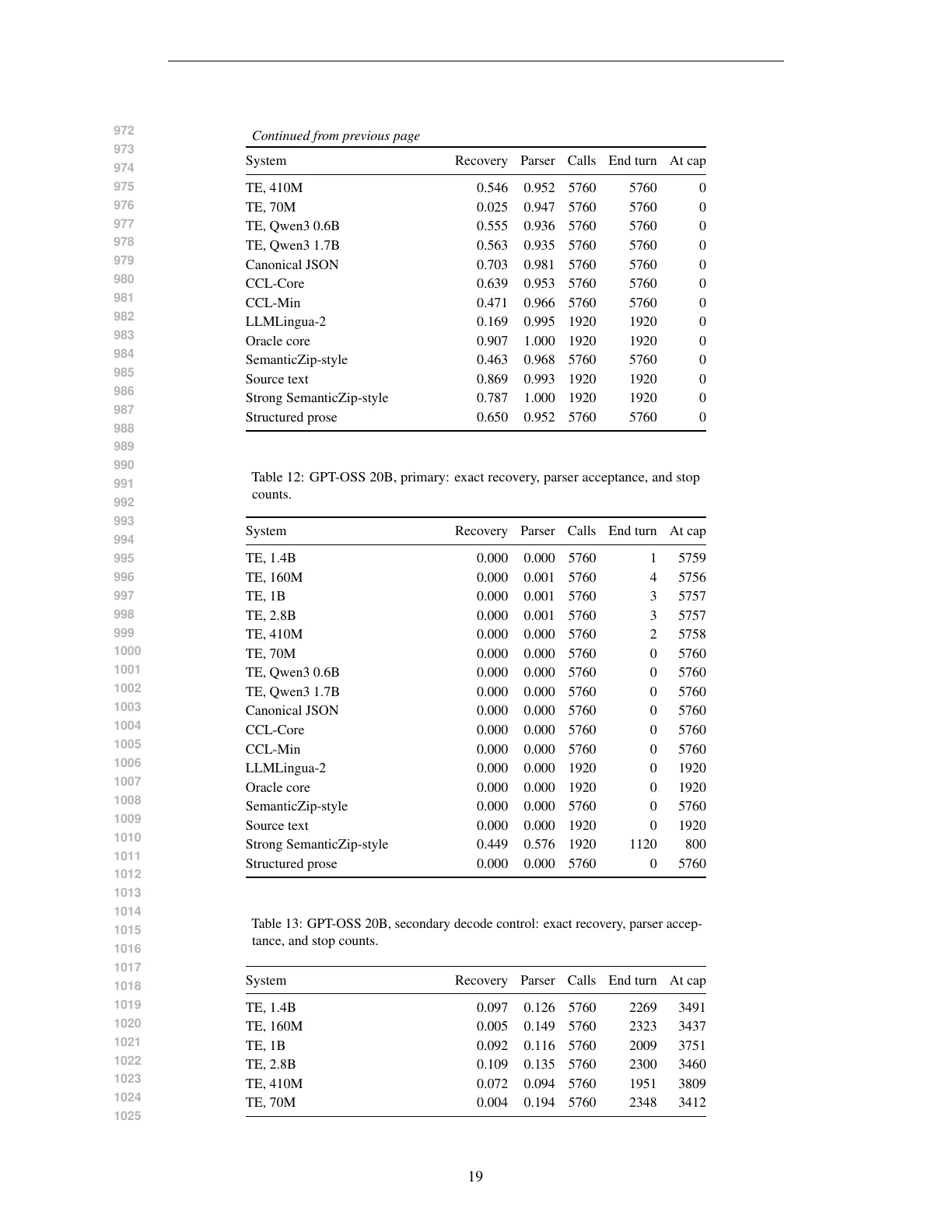
Each consumer receives a code and all canonical entity identifiers, then returns an exact JSON value
map. Parser failure scores every entity wrong. The primary output cap is 256 tokens. The secondary
GPT-OSS condition changes reasoning effort to low, retaining the prompt and output cap.

Recovery is the mean of recorded per-output exact-value fractions across budgets, axes, renderings,
and available seeds. The counts include repeated renderings and budget cells, rather than independent
worlds. End-turn and token-limit counts expose completion behavior directly.

Table 11: Qwen3 Next 80B A3B: exact recovery, parser acceptance, and stop
counts.

System

TE, 1.4B
TE, 160M
TE, 1B
TE, 2.8B

Recovery Parser Calls End turn At cap

0.555
0.036
0.586
0.594

18

0.952
0.922
0.964
0.965

5760
5760
5760
5760

5760
5760
5760
5760

0
0
0
0
Text of page 19
Continued from previous page

System

TE, 410M
TE, 70M
TE, Qwen3 0.6B
TE, Qwen3 1.7B
Canonical JSON
CCL-Core
CCL-Min
LLMLingua-2
Oracle core
SemanticZip-style
Source text
Strong SemanticZip-style
Structured prose

Recovery Parser Calls End turn At cap

0.546
0.025
0.555
0.563
0.703
0.639
0.471
0.169
0.907
0.463
0.869
0.787
0.650

0.952
0.947
0.936
0.935
0.981
0.953
0.966
0.995
1.000
0.968
0.993
1.000
0.952

5760
5760
5760
5760
5760
5760
5760
1920
1920
5760
1920
1920
5760

5760
5760
5760
5760
5760
5760
5760
1920
1920
5760
1920
1920
5760

0
0
0
0
0
0
0
0
0
0
0
0
0

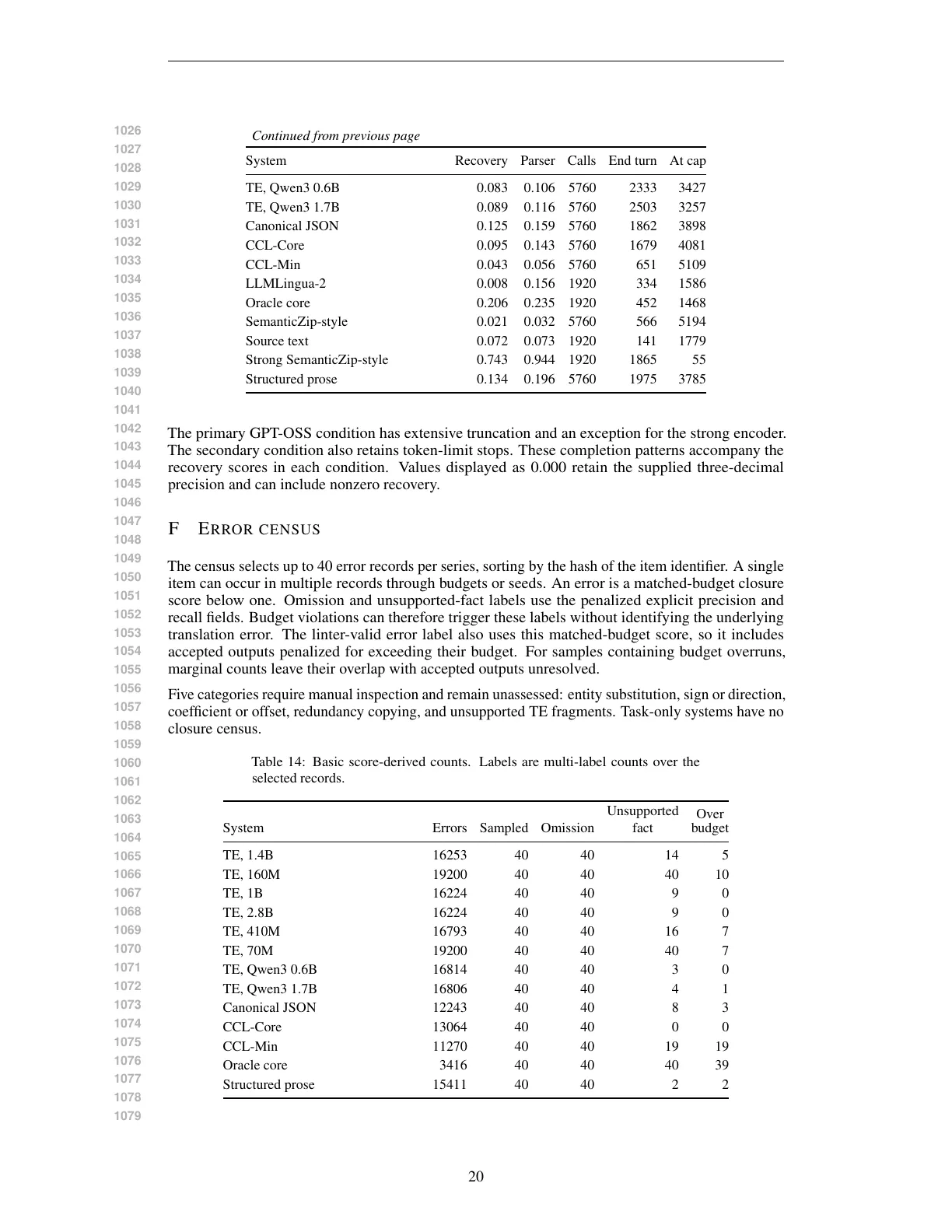
Table 12: GPT-OSS 20B, primary: exact recovery, parser acceptance, and stop
counts.

System

TE, 1.4B
TE, 160M
TE, 1B
TE, 2.8B
TE, 410M
TE, 70M
TE, Qwen3 0.6B
TE, Qwen3 1.7B
Canonical JSON
CCL-Core
CCL-Min
LLMLingua-2
Oracle core
SemanticZip-style
Source text
Strong SemanticZip-style
Structured prose

Recovery Parser Calls End turn At cap

0.000
0.000
0.000
0.000
0.000
0.000
0.000
0.000
0.000
0.000
0.000
0.000
0.000
0.000
0.000
0.449
0.000

0.000
0.001
0.001
0.001
0.000
0.000
0.000
0.000
0.000
0.000
0.000
0.000
0.000
0.000
0.000
0.576
0.000

5760
5760
5760
5760
5760
5760
5760
5760
5760
5760
5760
1920
1920
5760
1920
1920
5760

1
4
3
3
2
0
0
0
0
0
0
0
0
0
0
1120
0

5759
5756
5757
5757
5758
5760
5760
5760
5760
5760
5760
1920
1920
5760
1920
800
5760

Table 13: GPT-OSS 20B, secondary decode control: exact recovery, parser acceptance, and stop counts.

System

TE, 1.4B
TE, 160M
TE, 1B
TE, 2.8B
TE, 410M
TE, 70M

Recovery Parser Calls End turn At cap

0.097
0.005
0.092
0.109
0.072
0.004

19

0.126
0.149
0.116
0.135
0.094
0.194

5760
5760
5760
5760
5760
5760

2269
2323
2009
2300
1951
2348

3491
3437
3751
3460
3809
3412
Text of page 20
Continued from previous page

System

TE, Qwen3 0.6B
TE, Qwen3 1.7B
Canonical JSON
CCL-Core
CCL-Min
LLMLingua-2
Oracle core
SemanticZip-style
Source text
Strong SemanticZip-style
Structured prose

Recovery Parser Calls End turn At cap

0.083
0.089
0.125
0.095
0.043
0.008
0.206
0.021
0.072
0.743
0.134

0.106
0.116
0.159
0.143
0.056
0.156
0.235
0.032
0.073
0.944
0.196

5760
5760
5760
5760
5760
1920
1920
5760
1920
1920
5760

2333
2503
1862
1679
651
334
452
566
141
1865
1975

3427
3257
3898
4081
5109
1586
1468
5194
1779
55
3785

The primary GPT-OSS condition has extensive truncation and an exception for the strong encoder.
The secondary condition also retains token-limit stops. These completion patterns accompany the
recovery scores in each condition. Values displayed as 0.000 retain the supplied three-decimal
precision and can include nonzero recovery.

F

E RROR CENSUS

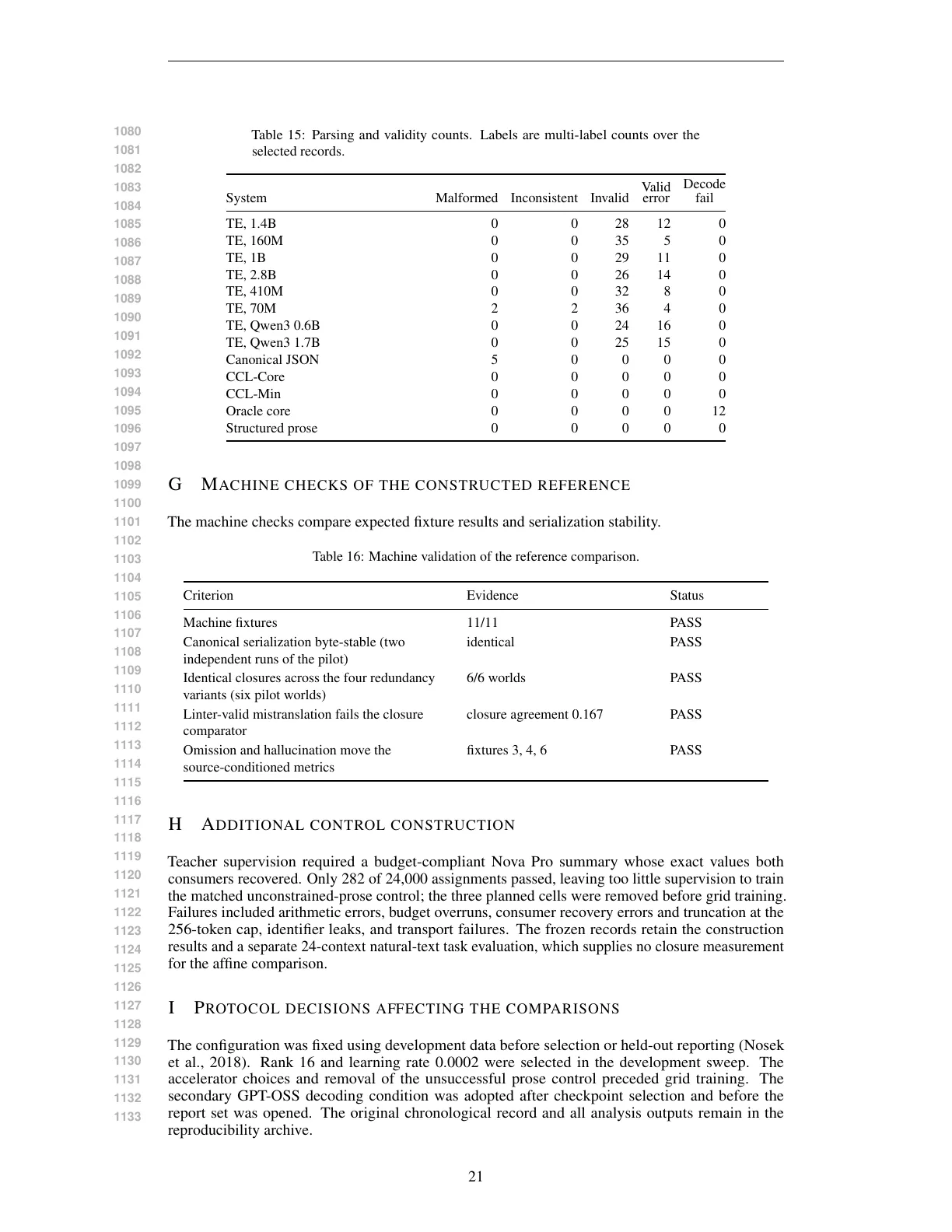
The census selects up to 40 error records per series, sorting by the hash of the item identifier. A single
item can occur in multiple records through budgets or seeds. An error is a matched-budget closure
score below one. Omission and unsupported-fact labels use the penalized explicit precision and
recall fields. Budget violations can therefore trigger these labels without identifying the underlying
translation error. The linter-valid error label also uses this matched-budget score, so it includes
accepted outputs penalized for exceeding their budget. For samples containing budget overruns,
marginal counts leave their overlap with accepted outputs unresolved.

Five categories require manual inspection and remain unassessed: entity substitution, sign or direction,
coefficient or offset, redundancy copying, and unsupported TE fragments. Task-only systems have no
closure census.

Table 14: Basic score-derived counts. Labels are multi-label counts over the
selected records.

System

Errors Sampled Omission

TE, 1.4B
TE, 160M
TE, 1B
TE, 2.8B
TE, 410M
TE, 70M
TE, Qwen3 0.6B
TE, Qwen3 1.7B
Canonical JSON
CCL-Core
CCL-Min
Oracle core
Structured prose

16253
19200
16224
16224
16793
19200
16814
16806
12243
13064
11270
3416
15411

40
40
40
40
40
40
40
40
40
40
40
40
40

20

40
40
40
40
40
40
40
40
40
40
40
40
40

Unsupported Over
fact
budget

14
40
9
9
16
40
3
4
8
0
19
40
2

5
10
0
0
7
7
0
1
3
0
19
39
2
Text of page 21
Table 15: Parsing and validity counts. Labels are multi-label counts over the
selected records.

TE, 1.4B
TE, 160M
TE, 1B
TE, 2.8B
TE, 410M
TE, 70M
TE, Qwen3 0.6B
TE, Qwen3 1.7B
Canonical JSON
CCL-Core
CCL-Min
Oracle core
Structured prose

G

0
0
0
0
0
2
0
0
0
0
0
0
0

28
35
29
26
32
36
24
25
0
0
0
0
0

12
5
11
14
8
4
16
15
0
0
0
0
0

0
0
0
0
0
0
0
0
0
0
0
12
0

M ACHINE CHECKS OF THE CONSTRUCTED REFERENCE

Table 16: Machine validation of the reference comparison.

0
0
0
0
0
2
0
0
5
0
0
0
0

The machine checks compare expected fixture results and serialization stability.

Valid Decode
Malformed Inconsistent Invalid error
fail

System

H

Criterion

Evidence

Status

Machine fixtures
Canonical serialization byte-stable (two
independent runs of the pilot)
Identical closures across the four redundancy
variants (six pilot worlds)
Linter-valid mistranslation fails the closure
comparator
Omission and hallucination move the
source-conditioned metrics

11/11
identical

PASS
PASS

6/6 worlds

PASS

closure agreement 0.167

PASS

fixtures 3, 4, 6

PASS

A DDITIONAL CONTROL CONSTRUCTION

Teacher supervision required a budget-compliant Nova Pro summary whose exact values both
consumers recovered. Only 282 of 24,000 assignments passed, leaving too little supervision to train
the matched unconstrained-prose control; the three planned cells were removed before grid training.
Failures included arithmetic errors, budget overruns, consumer recovery errors and truncation at the
256-token cap, identifier leaks, and transport failures. The frozen records retain the construction
results and a separate 24-context natural-text task evaluation, which supplies no closure measurement
for the affine comparison.

I

P ROTOCOL DECISIONS AFFECTING THE COMPARISONS

The configuration was fixed using development data before selection or held-out reporting (Nosek
et al., 2018). Rank 16 and learning rate 0.0002 were selected in the development sweep. The
accelerator choices and removal of the unsuccessful prose control preceded grid training. The
secondary GPT-OSS decoding condition was adopted after checkpoint selection and before the
report set was opened. The original chronological record and all analysis outputs remain in the
reproducibility archive.

21

Text of page 22
J

The TE grammar, structural checker, full checker, and training-harness patterns are reused infrastructure. This study adds source-conditioned closure agreement, redundancy response, and translatorscale measurements; related benchmark and consumer-adaptation results contribute no observations
to these tables. The independent closure comparator uses decoded equations and exact rational
arithmetic to compare source content, including in the linter-valid mistranslation fixture.

R EUSED INFRASTRUCTURE

22