The Same-Family Halo: A Gold-Free Audit of Source-Dependent Agreement in LLM Silver Labeling
Back to the paper page. ICLR 2027 submission, September 2026.
All 17 pages are shown below.
Text of page 1
Under review as a conference paper at ICLR 2027

T HE S AME -F AMILY H ALO :
A G OLD -F REE A UDIT OF S OURCE -D EPENDENT
A GREEMENT IN LLM S ILVER L ABELING

Anonymous authors
Paper under double-blind review

A BSTRACT

Scalable analysis of long-form human–human, human–agent, and agent–agent interactions requires reliable supervision. Large language models (LLMs) provide
a practical source of silver labels, but agreement among models can reflect shared
labeling preferences rather than independent confirmation. We investigate this
dependence in an enterprise pipeline that uses 76,000 silver-labeled customerservice interactions to train classifiers operating over tens of millions of conversations, with a separate human-labeled holdout of 924 examples. We introduce a
gold-free audit: holding each labeler’s predictions fixed, we vary the model supplying the reference labels and measure changes in agreement without consulting
human annotations. Across 48 model–prompt–rendering configurations, we observe source-dependent agreement that extends beyond exact self-comparisons to
sibling models. In a representative comparison, agreement with sibling-model
labels exceeds agreement with three cross-family sources by 3.7–3.9 percentage
points. To mitigate this effect, we propose combinatorial silver-label construction, assigning each example to a randomly selected model–prompt tuple — randomizing the prompt as well, since prompt choice is itself a first-order driver of
label quality. Under this construction, the source-specific agreement advantage
seen with fixed-source labels is directionally reduced in our evaluation, though
not to statistical significance at our sample size. The method distributes supervision across configurations while preserving exactly one inference call per example. Our central — and demonstrated — finding is that same-family consensus can
reflect a source-dependent agreement pattern that resembles independent confirmation while not providing it. The gold-free audit makes this dependence measurable even where human reference labels are scarce, and randomized construction
offers a practical, single-call route toward mitigating it in scalable conversation
analytics.

1

I NTRODUCTION

The conversational data an operator must make sense of — human–human call transcripts, and
increasingly human–agent and agent–agent interactions — now arrives at a scale no annotation
team can label directly, yet the classifiers that analyze it still need supervision. When gold-standard
annotation from humans is too slow or too expensive to cover the data a model needs, a common
substitute is to let one or more large language models (LLMs) label the data instead, producing what
are often called silver labels. Those silver labels then train a downstream classifier, benchmark a
system, or decide which examples a human ever reviews. As this practice spreads, a single question
governs whether the resulting system is trustworthy: how does a practitioner know the silver labels
are right, when there is, by definition, little or no gold to check them against?

The field’s default answer is agreement. If several models, prompts, or runs converge on the same
label, that convergence is read as a sign of correctness, and disagreement is read as a sign of difficulty or ambiguity. This intuition borrows from a long tradition in which individual voters, when
aggregated, are more reliable than any single voter. The intuition has a hidden premise: that the
voters are, in fact, independent. When the voters are large language models trained on overlapping
corpora with overlapping objectives, that premise is exactly what is in doubt.

1

Reviewers: please read the Reviewer Guidelines (iclr.cc/Conferences/2027/ReviewerGuidelines) and the AI Policy for Reviewers (iclr.cc/Conferences/2027/AIPolicyForReviewers).
If you used AI to expand, edit, or polish your review, please provide the input text to the LLM. Better still, consider skipping the LLM and submitting your original text: we,
and the authors, are much more interested in your unedited thoughts than in what an LLM has to say. AI-assisted or not, you are putting your name and reputation behind
your review: LLM-generated falsehoods, hallucinations or misrepresentations are subject to disciplinary action, which may include desk-rejecting all papers you have authored.
Text of page 2
Under review as a conference paper at ICLR 2027

This paper asks whether agreement among LLM labelers means what practitioners assume it means,
and finds that it does not — at least not uniformly. Agreement is inflated in a structured, predictable
way that depends on the relationship between a labeler and the source of the silver label its output
is checked against. When a model’s label output is compared to a silver label produced by a model
of its own family, the two agree more than that same labeler’s agreement with cross-family silver
sources would imply under an independence interpretation. The effect is not merely that strong
models resemble each other; it is that the resemblance is organized along family lines — most
clearly between sibling models — and that it contaminates the very agreement signal practitioners
rely on to certify silver labels.

Establishing this cleanly is harder than it sounds. The obvious way to measure labeler bias is to
compare a labeler’s agreement with model-written labels against its agreement with gold labels.
But if the gold labels are themselves wrong on some fraction of cases — and we find that they
are, sometimes flatly so — then this comparison is made against a broken ruler, and a labeler that
“beats” the gold could be either sharing a human-invisible blind spot or simply being more correct
than a fallible annotator. No amount of care with that comparison can separate the two. Our central
move is not to discard the human comparison but to make the bias claim independent of it: we hold
a single labeler fixed and vary only whose labels it is scored against, so that within this contrast
the labeler’s own competence — and any dependence on gold — cancels. The residual therefore
measures source-dependent agreement: how the same labeler’s agreement changes with the identity
and relationship of the silver-label source. We still report each labeler’s agreement with gold labels,
but treat it as motivation, not as evidence of bias. That residual — the observed excess agreement
between a labeler and a distinct same-family silver source relative to cross-family sources — is what
we call the same-family halo.

Claims and non-claims. We make two positive claims — (i) a gold-free same-family halo exists
and is significant, and (ii) in our setting, model-family diversity provides more error decorrelation
than prompt diversity — with a direct and, we hope, immediately usable consequence: a team
assembling a panel of LLM labelers to vet silver labels should allocate more of its diversity budget
toward model families than toward prompt engineering on a single model. Prompt variations of one
model tend to fail the same calls, adding less independent signal than variation across families even
when they differ in overall accuracy, while same-family agreement carries a halo precisely where a
practitioner might otherwise interpret consensus as independent confirmation. We do not claim that
the halo’s cause is lineage per se rather than the capability proximity siblings tend to share, that the
general silver–gold divergence is bias (the broken-ruler problem), or that a de-biased panel raises
downstream accuracy (untested). Nor is this a claim that prompt quality does not matter: prompt
choice is a first-order determinant of a single labeler’s accuracy (Finding 3), and the family-over-prompt guidance concerns only how to spend a decorrelation budget — not whether getting the
prompt right is worth the effort.

2

B ACKGROUND & M OTIVATION

The label taxonomy. Our setting is the categorization of inbound customer-service calls in a
telecommunications business. Call reasons are organized as a multi-layer nested hierarchy, running
from a few coarse intent families down to fine-grained leaf categories that name the specific reason
a customer called. The finest level contains hundreds of fine-grained call-reason categories, and
it is where operational decisions are made and where the task studied here operates. This cardinality
matters for everything that follows. With hundreds of near-neighboring categories, many of them
semantically adjacent (e.g., a payment vs. a payment extension), the labeling problem is genuinely
hard for humans and models alike, disagreement is common, and consensus is scarce enough that
practitioners are tempted to trust it wherever it appears.

Why silver labels, and why their trustworthiness is the bottleneck. Human annotation at this
granularity is slow and expensive, and the label space drifts as products change, so covering production volume with gold labels is infeasible. LLM-generated silver labels are the practical alternative:
in the pipeline we study, roughly 76,000 silver-labeled interactions train a downstream classifier
that then operates over tens of millions of conversations, with only a small human-labeled holdout

2
Text of page 3
Under review as a conference paper at ICLR 2027

(N = 924) available to check the silver against. The downstream system inherits any bias in the
agreement signal used to accept its silver labels.

Related work. The closest prior result establishes that, across a very large model population,
stronger language models make more correlated errors, and that they do so even across distinct
architectures and providers — shared vendor lineage alone does not explain the effect (Kim et al.,
2025). We build directly on that finding while distinguishing our contribution from it: that work
explains the cause of error correlation in general model behavior, whereas we identify a specific,
actionable consequence of correlation in the silver-labeling workflow — the same-family halo —
and, crucially, we detect it without reference to gold, which its strength-driven account (measured
against reference answers) does not require and our broken-ruler analysis shows is unsafe in our
setting. The same-family halo is a concrete mechanism by which algorithmic monoculture surfaces
in a labeling pipeline (Kleinberg & Raghavan, 2021; Bommasani et al., 2022; Hedden & Raghavan,
2026). Ensembles benefit from decorrelated errors rather than member count (Krogh & Vedelsby,
1994; Breiman, 2001). We operationalize this principle with M eff and test directly whether family
or prompt diversity supplies more independence.

A parallel literature on LLM-as-a-judge documents that models prefer their own or their family’s
generations (Panickssery et al., 2024; Wataoka et al., 2024), part of a broader account of biases
in LLM evaluators (Zheng et al., 2023; Liu et al., 2023; Koo et al., 2023; Wang et al., 2024b).
Our setting is adjacent but differs in a way worth stating: rather than prompting a model to rate a
candidate answer, we have each model label the call independently and read its agreement with a
silver label as an implicit endorsement — so the models we study act as labelers whose concordance
we interpret, not as judges issuing an elicited verdict. Our halo is thus that self-preference relocated
to the silver-labeling task and identified gold-free.

Finally, our finding is a caution for methods that consume LLM labels. Weak supervision and consensus label models estimate latent truth from multiple noisy sources, classically under conditionalindependence assumptions (Dawid & Skene, 1979; Ratner et al., 2016; 2017); because LLM sources
violate independence in a structured, family-indexed way, a same-family consensus is over-confident
by a quantifiable margin. The practice of training downstream models on LLM-generated labels (Gilardi et al., 2023; Hinton et al., 2015; West et al., 2022; Burns et al., 2024; Bansal et al., 2025) inherits
any bias in those labels, and cost-aware and encoder–LLM cascade labeling (Valdes Gonzalez, 2026;
Chen et al., 2023) optimizes the price of producing them; we sit upstream, asking whether the labels
such pipelines agree on can be trusted at all. For more detail on each cited work, see Appendix B.

Problem statement. We study a panel of LLM labelers evaluating silver labels for a categorization
task over hundreds of fine-grained call reasons. We ask three questions. (1) Is model agreement a
trustworthy signal of silver-label correctness, or is it biased by the relationship between the labeler
and the label’s source? (2) If biased, can that bias be identified in a way that survives the fact
that the gold labels are themselves imperfect? (3) What should a practitioner do differently when
constructing a panel to vet silver labels?

3

P ROBLEM F ORMULATION

Task and data. Each call x has a latent true leaf category y ⋆ ∈ Y, where Y is the finest level of the
taxonomy and |Y| = K runs to the hundreds. We observe a human “gold” label g(x), an imperfect
estimate of y ⋆ , on N = 924 calls. A labeler L = (m, p, r) is specified by a model m, a prompt
p, and a rendering r (see Appendix C and §4), mapping a call to a predicted category L(x) ∈ Y.
Labelers belong to model families; write fam(L) for the family of L.

Silver sources and the answer-key relation. To score a labeler’s accuracy we compare its predicted labels against a reference set of labels treated as correct — an answer key, in the grading
sense. When that answer key is the gold labels, we recover the usual accuracy; when it is instead a
set of model-generated labels, we call it a silver answer key. Formally, both kinds of reference are
label-assigning functions: gold g maps each call x to its human label g(x), and a silver source S —
a single model under one prompt, or a panel vote — maps x to a model-generated label S(x). A
single reference function R ∈ {g} ∪ {S} — gold, or one silver source — supplies the answer key

3
Text of page 4
Under review as a conference paper at ICLR 2027

{R(x)}, and a labeler L’s accuracy against it is
1 ∑︂
acc R (L) =
1[L(x) = R(x)] .
N x

(1)

acc g measures agreement with g(x); acc S measures agreement with another model’s output. Thus
L(x) is the prediction under audit, while S(x) is only the silver answer key used to score it.

The silver–gold gap, and why zero is not the neutral point. Define ∆(L, S) = acc S (L) −
acc g (L). Partitioning on whether the labeler matches gold gives the exact decomposition

∆(L, S) = P (L = S ̸ = g) − P (L = g, S ̸ = g) ,
⏟⏟
⏞
⏞
⏟⏟
⏞
⏞

correlated error

(2)

silver-only error

verified to residual 1.3 × 10 −16 on our data. The first term — labeler and silver make the same
departure from gold — is what a bias account cares about. But ∆ = 0 arises whenever the two
terms merely balance, so the sign of the gap says nothing directly about bias; and because g is
imperfect, P (L = S ̸ = g) conflates shared model bias with cases where the model pair is right
and g is wrong. This is the broken-ruler problem: ∆ measured against gold can motivate a bias
hypothesis but cannot establish it.

The halo: a within-labeler, gold-free contrast. Fix a labeler L and compare its accuracy against
a silver source S same , where fam(S same ) = fam(L), versus a cross-family source S cross :

H(L) = acc S same (L) − acc S cross (L).

(3)

⋆

Both terms use the same labeler, so its competence against y and any dependence on g are differenced away. Instead, H(L) measures source-dependent agreement: the same labeler agrees
differently depending on the source of the silver answer key, and a positive same-family contrast
establishes that this dependence is organized along family lines. Accordingly, the quantity we report
with “show” is the existence of source-dependent agreement associated with model family, not a
claim about its underlying cause.

Decorrelation as a second lens. Independent of accuracy, we quantify how jointly labelers err.
For a set of labelers let ρ̄ be the mean pairwise error correlation and
n
M eff =
(4)
1 + (n − 1) ρ̄

a design-effect proxy for the effective number of independent labelers in an n-labeler panel (an
approximation for correlated binary error indicators, not an exact count; we lean on it for intuition).
A halo predicts same-family pairs have higher ρ̄ (lower M eff ) than cross-family pairs — a prediction
on a different statistic than H, so agreement between the two is corroboration, not restatement.

4

M ETHODOLOGY & A NALYSIS

Combinatorial labeler grid. We evaluate a grid of (model, prompt, rendering) configurations on
the same 924 gold-labeled calls. The grid spans 6 model families and 5 prompts under 2 rendering
settings (full vs. no category definitions; see Appendix C). The prompt×rendering crossing is incomplete: 3 definition-based prompts (best-explains, own-words, taxonomic) take both
renderings (6 configurations), while 2 name-only prompts (clue-hunt, distinctive-ev.)
have no definitions to render and take a single setting (2 configurations), giving 8 configurations
per family and 48 labelers in total. A separately served arm contributes three further model families
that appear only as answer-key sources in the bias grid (below), not as labelers in the panel.

Bias grid (the halo design). Beyond scoring labelers against gold, each model uses a prompt
that performs best when compared against the gold labels to generate output that is used in turn as
the silver answer key, and every labeler’s accuracy is measured against every such key (Figure 1).
Because the halo H(L) is a within-labeler contrast — the same labeler graded against different
silver sources — this choice fixes the reference set but is not what creates the family-indexed pattern

4
Text of page 5
Under review as a conference paper at ICLR 2027

2 • Audit agreement

1 • Produce labels

924
calls

48 labelers
→ L(x)

L(x)

compare L(x)
to silver S(x) ⇒ acc S (L)

3 • Index by family

split (L, S) by family
same- vs. cross-family ⇒
same-family halo; M eff

optional human gold check

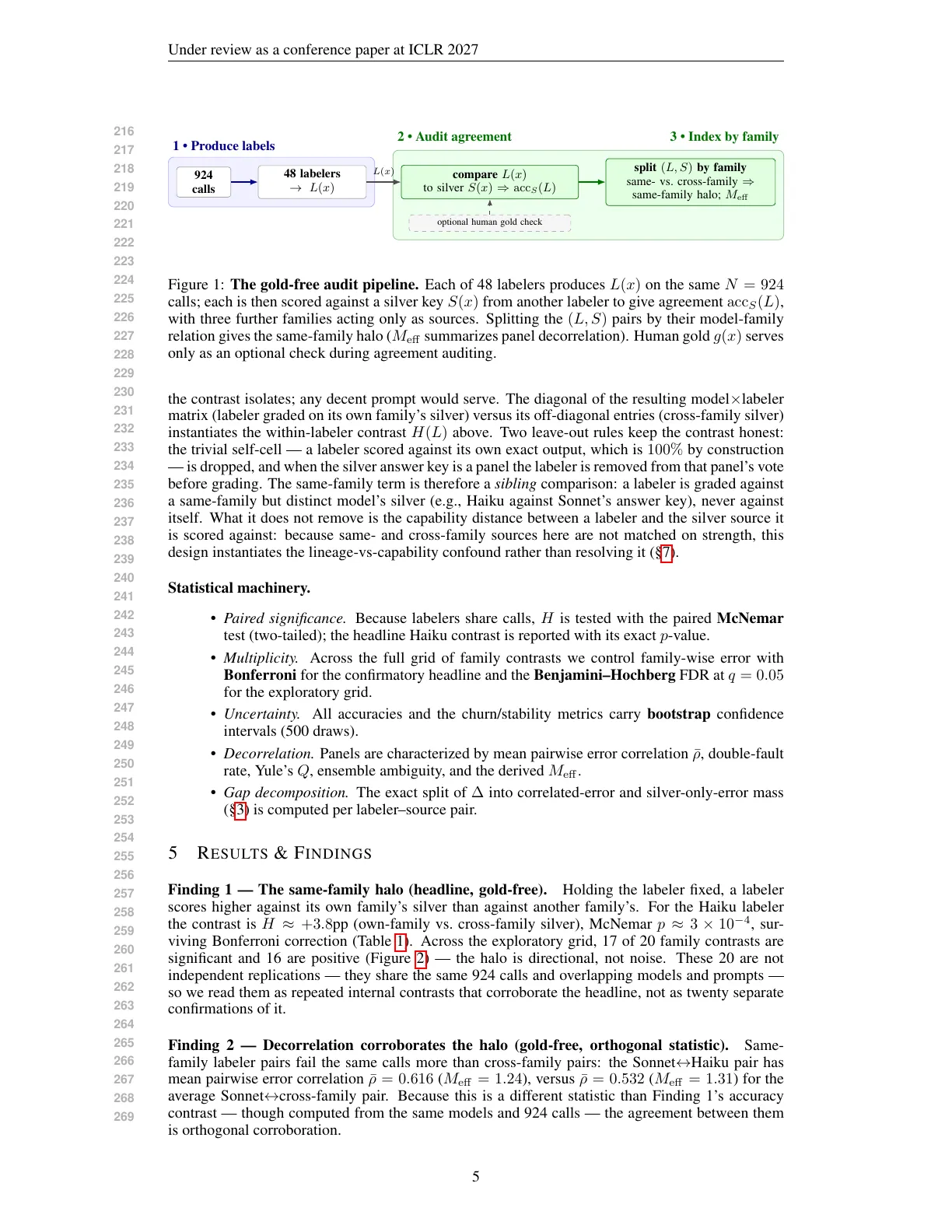
Figure 1: The gold-free audit pipeline. Each of 48 labelers produces L(x) on the same N = 924
calls; each is then scored against a silver key S(x) from another labeler to give agreement acc S (L),
with three further families acting only as sources. Splitting the (L, S) pairs by their model-family
relation gives the same-family halo (M eff summarizes panel decorrelation). Human gold g(x) serves
only as an optional check during agreement auditing.

the contrast isolates; any decent prompt would serve. The diagonal of the resulting model×labeler
matrix (labeler graded on its own family’s silver) versus its off-diagonal entries (cross-family silver)
instantiates the within-labeler contrast H(L) above. Two leave-out rules keep the contrast honest:
the trivial self-cell — a labeler scored against its own exact output, which is 100% by construction
— is dropped, and when the silver answer key is a panel the labeler is removed from that panel’s vote
before grading. The same-family term is therefore a sibling comparison: a labeler is graded against
a same-family but distinct model’s silver (e.g., Haiku against Sonnet’s answer key), never against
itself. What it does not remove is the capability distance between a labeler and the silver source it
is scored against: because same- and cross-family sources here are not matched on strength, this
design instantiates the lineage-vs-capability confound rather than resolving it (§7).

Statistical machinery.

• Paired significance. Because labelers share calls, H is tested with the paired McNemar
test (two-tailed); the headline Haiku contrast is reported with its exact p-value.
• Multiplicity. Across the full grid of family contrasts we control family-wise error with
Bonferroni for the confirmatory headline and the Benjamini–Hochberg FDR at q = 0.05
for the exploratory grid.
• Uncertainty. All accuracies and the churn/stability metrics carry bootstrap confidence
intervals (500 draws).
• Decorrelation. Panels are characterized by mean pairwise error correlation ρ̄, double-fault
rate, Yule’s Q, ensemble ambiguity, and the derived M eff .
• Gap decomposition. The exact split of ∆ into correlated-error and silver-only-error mass
(§3) is computed per labeler–source pair.

5

R ESULTS & F INDINGS

Finding 1 — The same-family halo (headline, gold-free). Holding the labeler fixed, a labeler
scores higher against its own family’s silver than against another family’s. For the Haiku labeler
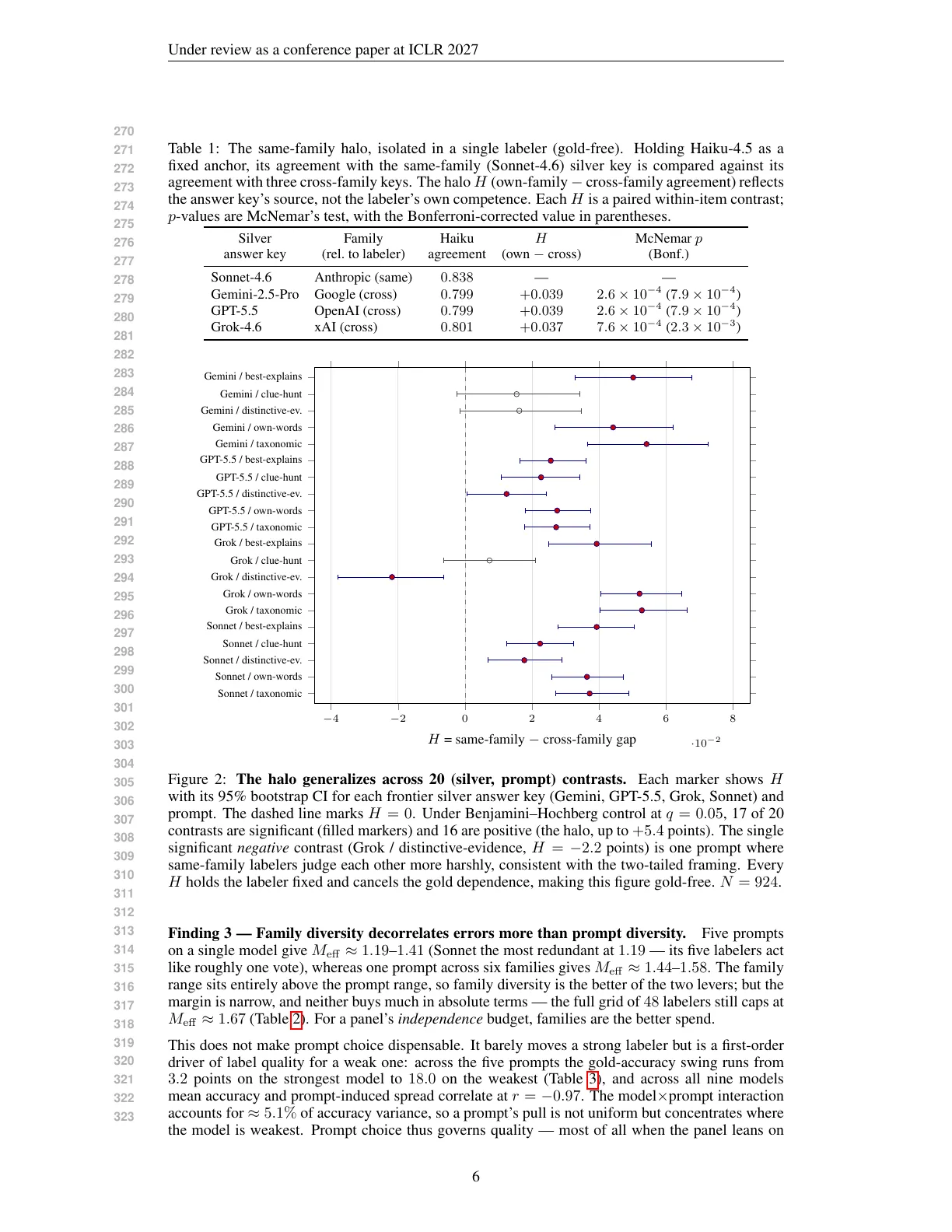
the contrast is H ≈ +3.8pp (own-family vs. cross-family silver), McNemar p ≈ 3 × 10 −4 , surviving Bonferroni correction (Table 1). Across the exploratory grid, 17 of 20 family contrasts are
significant and 16 are positive (Figure 2) — the halo is directional, not noise. These 20 are not
independent replications — they share the same 924 calls and overlapping models and prompts —
so we read them as repeated internal contrasts that corroborate the headline, not as twenty separate
confirmations of it.

Finding 2 — Decorrelation corroborates the halo (gold-free, orthogonal statistic). Samefamily labeler pairs fail the same calls more than cross-family pairs: the Sonnet↔Haiku pair has
mean pairwise error correlation ρ̄ = 0.616 (M eff = 1.24), versus ρ̄ = 0.532 (M eff = 1.31) for the
average Sonnet↔cross-family pair. Because this is a different statistic than Finding 1’s accuracy
contrast — though computed from the same models and 924 calls — the agreement between them
is orthogonal corroboration.

5
Text of page 6
Under review as a conference paper at ICLR 2027

Table 1: The same-family halo, isolated in a single labeler (gold-free). Holding Haiku-4.5 as a
fixed anchor, its agreement with the same-family (Sonnet-4.6) silver key is compared against its
agreement with three cross-family keys. The halo H (own-family − cross-family agreement) reflects
the answer key’s source, not the labeler’s own competence. Each H is a paired within-item contrast;
p-values are McNemar’s test, with the Bonferroni-corrected value in parentheses.

Silver
answer key

Family
(rel. to labeler)

Haiku
agreement

H
(own − cross)

McNemar p
(Bonf.)

Sonnet-4.6
Gemini-2.5-Pro
GPT-5.5
Grok-4.6

Anthropic (same)
Google (cross)
OpenAI (cross)
xAI (cross)

0.838
0.799
0.799
0.801

—
+0.039
+0.039
+0.037

—
2.6 × 10 −4 (7.9 × 10 −4 )
2.6 × 10 −4 (7.9 × 10 −4 )
7.6 × 10 −4 (2.3 × 10 −3 )

Gemini / best-explains

Gemini / clue-hunt

Gemini / distinctive-ev.

Gemini / own-words

Gemini / taxonomic
GPT-5.5 / best-explains

GPT-5.5 / clue-hunt

GPT-5.5 / distinctive-ev.

GPT-5.5 / own-words

GPT-5.5 / taxonomic
Grok / best-explains

Grok / clue-hunt

Grok / distinctive-ev.

Grok / own-words

Grok / taxonomic
Sonnet / best-explains

Sonnet / clue-hunt

Sonnet / distinctive-ev.

Sonnet / own-words

Sonnet / taxonomic

−4

−2

0

2

4

H = same-family − cross-family gap

6

8

−2

·10

Figure 2: The halo generalizes across 20 (silver, prompt) contrasts. Each marker shows H
with its 95% bootstrap CI for each frontier silver answer key (Gemini, GPT-5.5, Grok, Sonnet) and
prompt. The dashed line marks H = 0. Under Benjamini–Hochberg control at q = 0.05, 17 of 20
contrasts are significant (filled markers) and 16 are positive (the halo, up to +5.4 points). The single
significant negative contrast (Grok / distinctive-evidence, H = −2.2 points) is one prompt where
same-family labelers judge each other more harshly, consistent with the two-tailed framing. Every
H holds the labeler fixed and cancels the gold dependence, making this figure gold-free. N = 924.

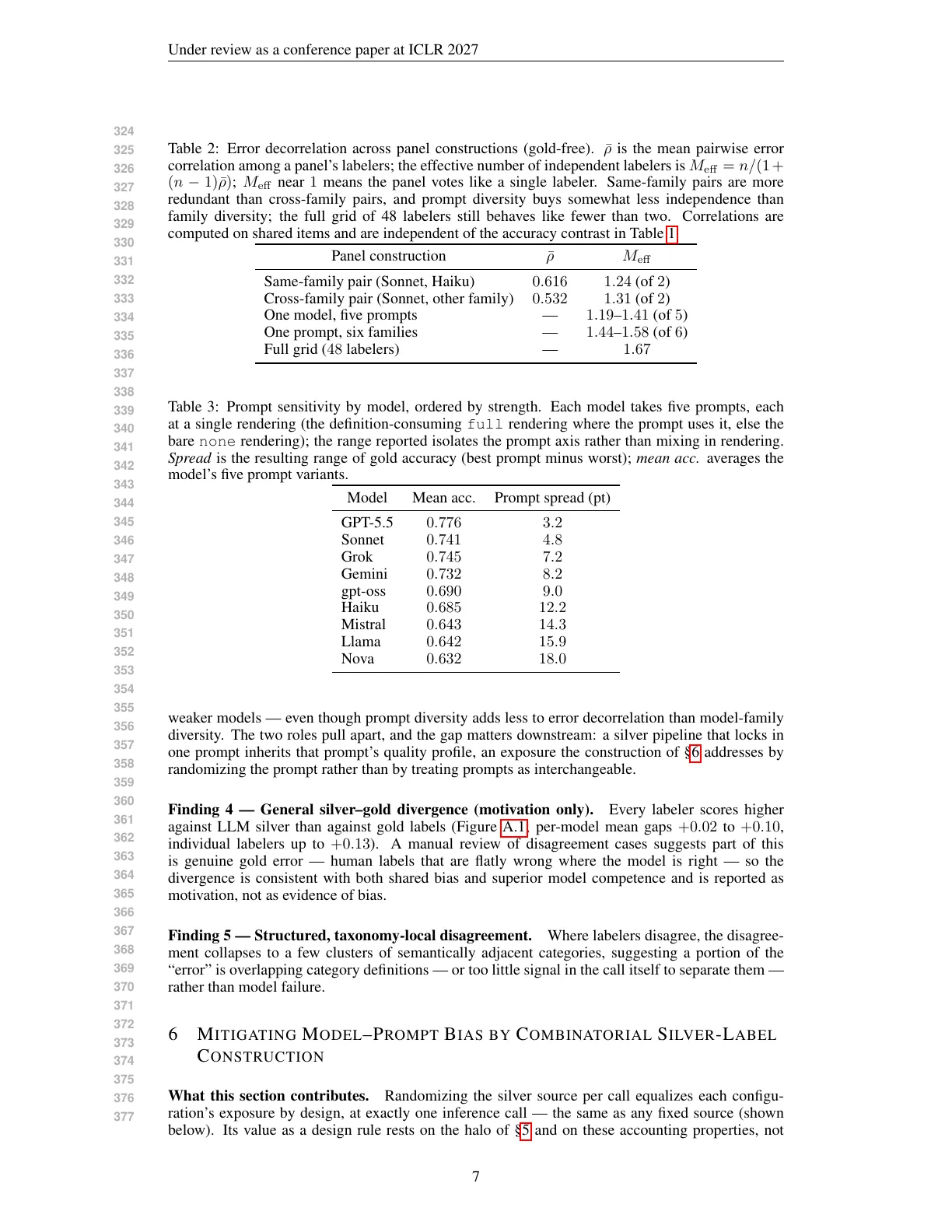
Finding 3 — Family diversity decorrelates errors more than prompt diversity. Five prompts
on a single model give M eff ≈ 1.19–1.41 (Sonnet the most redundant at 1.19 — its five labelers act
like roughly one vote), whereas one prompt across six families gives M eff ≈ 1.44–1.58. The family
range sits entirely above the prompt range, so family diversity is the better of the two levers; but the
margin is narrow, and neither buys much in absolute terms — the full grid of 48 labelers still caps at
M eff ≈ 1.67 (Table 2). For a panel’s independence budget, families are the better spend.

This does not make prompt choice dispensable. It barely moves a strong labeler but is a first-order
driver of label quality for a weak one: across the five prompts the gold-accuracy swing runs from
3.2 points on the strongest model to 18.0 on the weakest (Table 3), and across all nine models
mean accuracy and prompt-induced spread correlate at r = −0.97. The model×prompt interaction
accounts for ≈ 5.1% of accuracy variance, so a prompt’s pull is not uniform but concentrates where
the model is weakest. Prompt choice thus governs quality — most of all when the panel leans on

6
Text of page 7
Under review as a conference paper at ICLR 2027

Table 2: Error decorrelation across panel constructions (gold-free). ρ̄ is the mean pairwise error
correlation among a panel’s labelers; the effective number of independent labelers is M eff = n/(1 +
(n − 1)ρ̄); M eff near 1 means the panel votes like a single labeler. Same-family pairs are more
redundant than cross-family pairs, and prompt diversity buys somewhat less independence than
family diversity; the full grid of 48 labelers still behaves like fewer than two. Correlations are
computed on shared items and are independent of the accuracy contrast in Table 1.
Panel construction
ρ̄
M eff

Same-family pair (Sonnet, Haiku)
Cross-family pair (Sonnet, other family)
One model, five prompts
One prompt, six families
Full grid (48 labelers)

1.24 (of 2)
1.31 (of 2)
1.19–1.41 (of 5)
1.44–1.58 (of 6)
1.67

Table 3: Prompt sensitivity by model, ordered by strength. Each model takes five prompts, each
at a single rendering (the definition-consuming full rendering where the prompt uses it, else the
bare none rendering); the range reported isolates the prompt axis rather than mixing in rendering.
Spread is the resulting range of gold accuracy (best prompt minus worst); mean acc. averages the
model’s five prompt variants.
Model
Mean acc. Prompt spread (pt)

GPT-5.5
Sonnet
Grok
Gemini
gpt-oss
Haiku
Mistral
Llama
Nova

0.616
0.532
—
—
—

0.776
0.741
0.745
0.732
0.690
0.685
0.643
0.642
0.632

3.2
4.8
7.2
8.2
9.0
12.2
14.3
15.9
18.0

weaker models — even though prompt diversity adds less to error decorrelation than model-family
diversity. The two roles pull apart, and the gap matters downstream: a silver pipeline that locks in
one prompt inherits that prompt’s quality profile, an exposure the construction of §6 addresses by
randomizing the prompt rather than by treating prompts as interchangeable.

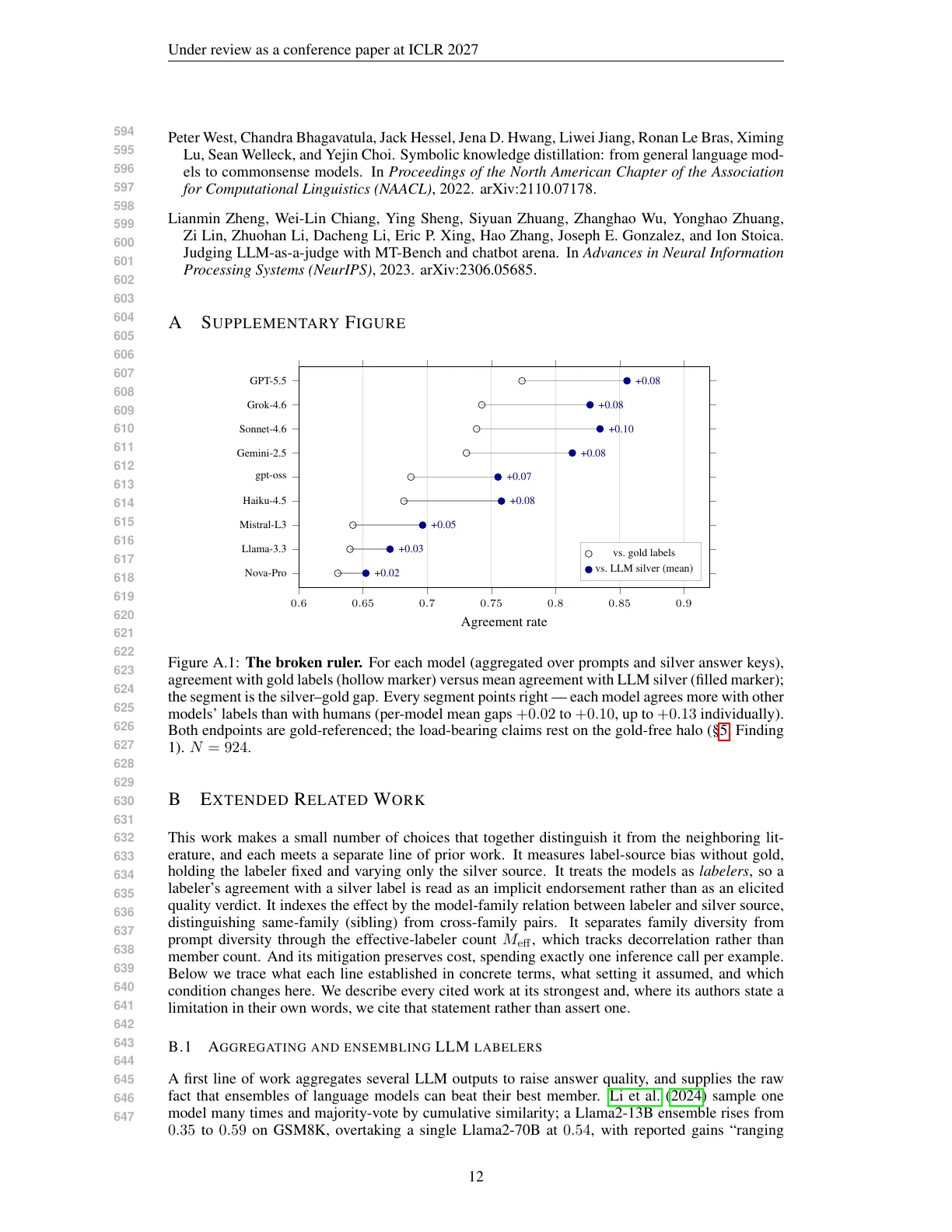
Finding 4 — General silver–gold divergence (motivation only). Every labeler scores higher
against LLM silver than against gold labels (Figure A.1; per-model mean gaps +0.02 to +0.10,
individual labelers up to +0.13). A manual review of disagreement cases suggests part of this
is genuine gold error — human labels that are flatly wrong where the model is right — so the
divergence is consistent with both shared bias and superior model competence and is reported as
motivation, not as evidence of bias.

Finding 5 — Structured, taxonomy-local disagreement. Where labelers disagree, the disagreement collapses to a few clusters of semantically adjacent categories, suggesting a portion of the
“error” is overlapping category definitions — or too little signal in the call itself to separate them —
rather than model failure.

6

M ITIGATING M ODEL –P ROMPT B IAS BY C OMBINATORIAL S ILVER -L ABEL
C ONSTRUCTION

What this section contributes. Randomizing the silver source per call equalizes each configuration’s exposure by design, at exactly one inference call — the same as any fixed source (shown
below). Its value as a design rule rests on the halo of §5 and on these accounting properties, not

7
Text of page 8
Under review as a conference paper at ICLR 2027

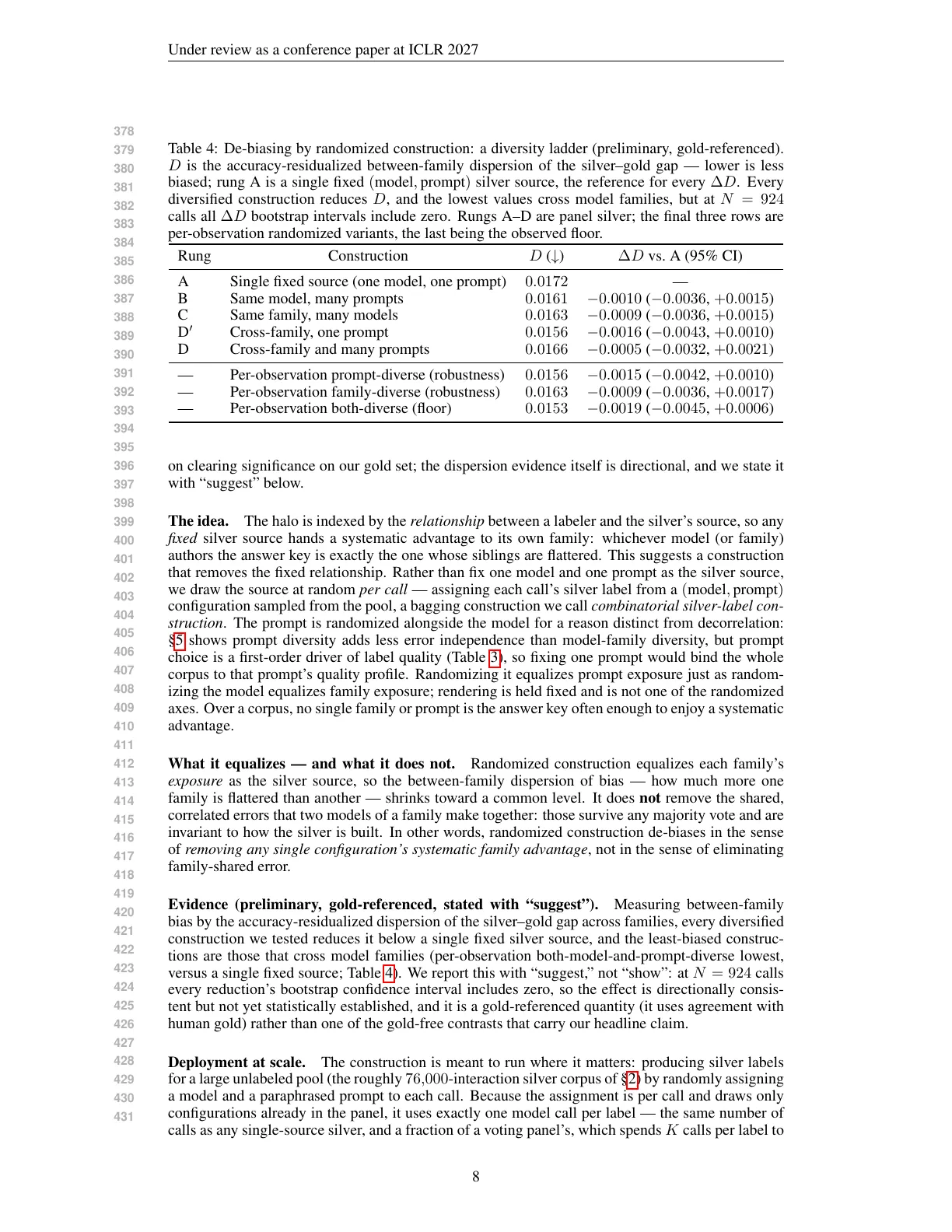
Table 4: De-biasing by randomized construction: a diversity ladder (preliminary, gold-referenced).
D is the accuracy-residualized between-family dispersion of the silver–gold gap — lower is less
biased; rung A is a single fixed (model, prompt) silver source, the reference for every ∆D. Every
diversified construction reduces D, and the lowest values cross model families, but at N = 924
calls all ∆D bootstrap intervals include zero. Rungs A–D are panel silver; the final three rows are
per-observation randomized variants, the last being the observed floor.
Rung
Construction
D (↓)
∆D vs. A (95% CI)

A
B
C
D ′
D

Single fixed source (one model, one prompt)
Same model, many prompts
Same family, many models
Cross-family, one prompt
Cross-family and many prompts

0.0172
0.0161
0.0163
0.0156
0.0166

—
−0.0010 (−0.0036, +0.0015)
−0.0009 (−0.0036, +0.0015)
−0.0016 (−0.0043, +0.0010)
−0.0005 (−0.0032, +0.0021)

—
—
—

Per-observation prompt-diverse (robustness)
Per-observation family-diverse (robustness)
Per-observation both-diverse (floor)

0.0156
0.0163
0.0153

−0.0015 (−0.0042, +0.0010)
−0.0009 (−0.0036, +0.0017)
−0.0019 (−0.0045, +0.0006)

on clearing significance on our gold set; the dispersion evidence itself is directional, and we state it
with “suggest” below.

The idea. The halo is indexed by the relationship between a labeler and the silver’s source, so any
fixed silver source hands a systematic advantage to its own family: whichever model (or family)
authors the answer key is exactly the one whose siblings are flattered. This suggests a construction
that removes the fixed relationship. Rather than fix one model and one prompt as the silver source,
we draw the source at random per call — assigning each call’s silver label from a (model, prompt)
configuration sampled from the pool, a bagging construction we call combinatorial silver-label construction. The prompt is randomized alongside the model for a reason distinct from decorrelation:
§5 shows prompt diversity adds less error independence than model-family diversity, but prompt
choice is a first-order driver of label quality (Table 3), so fixing one prompt would bind the whole
corpus to that prompt’s quality profile. Randomizing it equalizes prompt exposure just as randomizing the model equalizes family exposure; rendering is held fixed and is not one of the randomized
axes. Over a corpus, no single family or prompt is the answer key often enough to enjoy a systematic
advantage.

What it equalizes — and what it does not. Randomized construction equalizes each family’s
exposure as the silver source, so the between-family dispersion of bias — how much more one
family is flattered than another — shrinks toward a common level. It does not remove the shared,
correlated errors that two models of a family make together: those survive any majority vote and are
invariant to how the silver is built. In other words, randomized construction de-biases in the sense
of removing any single configuration’s systematic family advantage, not in the sense of eliminating
family-shared error.

Evidence (preliminary, gold-referenced, stated with “suggest”). Measuring between-family
bias by the accuracy-residualized dispersion of the silver–gold gap across families, every diversified
construction we tested reduces it below a single fixed silver source, and the least-biased constructions are those that cross model families (per-observation both-model-and-prompt-diverse lowest,
versus a single fixed source; Table 4). We report this with “suggest,” not “show”: at N = 924 calls
every reduction’s bootstrap confidence interval includes zero, so the effect is directionally consistent but not yet statistically established, and it is a gold-referenced quantity (it uses agreement with
human gold) rather than one of the gold-free contrasts that carry our headline claim.

Deployment at scale. The construction is meant to run where it matters: producing silver labels
for a large unlabeled pool (the roughly 76,000-interaction silver corpus of §2) by randomly assigning
a model and a paraphrased prompt to each call. Because the assignment is per call and draws only
configurations already in the panel, it uses exactly one model call per label — the same number of
calls as any single-source silver, and a fraction of a voting panel’s, which spends K calls per label to

8
Text of page 9
Under review as a conference paper at ICLR 2027

aggregate K configurations. The same mixing reduces between-family dispersion in our evaluation
— directional only, on the gold-referenced measure detailed above. (Per-token prices differ across
models, so the expected dollar cost of a random draw equals the pool’s average per-call price rather
than any one model’s; the call count, which dominates at scale, is unchanged.)

7

C ONCLUSION & B ROADER I MPACT

Model agreement is the default currency for trusting LLM-generated labels, but this paper shows
that its evidentiary value is source-dependent: a labeler can exhibit excess agreement with labels
from a distinct same-family source relative to cross-family sources, a pattern that a gold-referenced
measurement cannot cleanly identify but a within-labeler, gold-free contrast can. The evidence
points to one operational rule, one construction, and one caution. The rule: prioritize diversifying
model families over prompts when building a panel to vet silver labels, because family diversity
supplies more error decorrelation; prompt choice, meanwhile, remains a first-order driver of label
quality, so the two are levers for different ends rather than substitutes. The construction: randomize
the silver source per call so no single configuration is systematically flattered. The caution:
do not treat same-family consensus as stronger independent confirmation than cross-family
agreement.

We conjecture, rather than demonstrate, that similar source dependence may arise wherever
LLM consensus certifies labels over a large, fine-grained label space — in medical coding
(ICD/SNOMED), content-moderation policy taxonomies, and the growing practice of using LLM
juries to score other models: each relies on the same agreement premise, and in each the same-family
halo raises the possibility that a panel drawn from one vendor’s model line will certify its own errors.
Testing this prediction on an independent, publicly labeled taxonomy (e.g., a consumer-complaint
or intent-classification corpus) is the most direct next step, and one that requires no new human annotation: because the halo is gold-free, it can be recomputed wherever several model families label
the same items.

We close by marking the frontier this work does not cross. Because our evidence is drawn from
a single task and corpus, the halo’s magnitude on other label spaces is untested. The ingredients
it rests on — a labeler’s self-preference for its own family’s generations, and the correlated errors
that same-family models share (Panickssery et al., 2024; Wataoka et al., 2024; Kim et al., 2025) —
are documented beyond our setting, but whether the same-family halo itself generalizes across tasks
and label spaces remains to be tested. Within our corpus the halo is estimated across the full combinatorial grid of labeler pairs (§5), not a single comparison. Two features of the panel nonetheless
bound how far the family claim currently reaches. First, only two vendor lines contribute sibling
models (Anthropic and OpenAI), so the within-panel same-family contrasts are concentrated rather
than spread across many families; the effect is most directly evidenced for the Anthropic pair, and a
roster with more multi-model families would test whether it is equally pronounced elsewhere. Second, same- and cross-family silver sources are not matched on capability, so a residual concern is
that proximity in capability — not lineage per se — drives part of the halo. Disentangling the two,
ideally by contrasting sources matched on strength, is a limitation we flag rather than resolve. We
measure bias in the agreement signal; we do not demonstrate that a family-diverse panel yields a
more accurate downstream model, and we do not resolve, against the imperfect gold available to
us, how much of the general LLM–human divergence is bias versus competence. The randomized
construction of §6 rests on the same footing: it is a design rule that is exposure-equalizing and
inference-count-neutral by construction, while its empirical dispersion-reduction stays directional
at our sample size — suggested, not shown. These two gaps have clear next steps: a downstream
training study would test whether de-biased silver labels yield a more accurate model, and an adjudication study that replaces the broken ruler with case-level ground truth would separate bias from
competence. The gold-free halo, however, stands without any of them.

E THICS S TATEMENT

The data are human-subject customer-service call transcripts containing personally identifiable information. All records are de-identified and access-controlled; we report only genericized category
names and aggregate metrics, and no raw transcripts or operator identifiers. Our finding carries a
fairness dimension: the same-family halo means a single-vendor labeling panel can silently certify

9
Text of page 10
Under review as a conference paper at ICLR 2027

its own errors, most harmfully on rare or sensitive call reasons (e.g., vulnerable-customer intents)
where labels are scarce and least checkable; the family-diversity recommendation is in part a mitigation for that risk. No individual-level decisions are made from model outputs in this study.

R EPRODUCIBILITY S TATEMENT

The evaluation protocol (the N = 924 human-gold set, the 48-labeler combinatorial grid, and the
within-labeler halo contrast H) is specified in §3 and §4; the bias-grid construction with its two
leave-out rules, the paired McNemar / Bonferroni / Benjamini–Hochberg testing, and the decorrelation statistics (ρ̄, M eff ) are given in §4; the randomized silver construction and its dispersion metric
in §6. The data are real customer-service call transcripts and cannot be released; we describe all
processing steps and provide the category-level statistics needed to interpret the results.

AI U SE S TATEMENT

Large language models are the object of study (the labelers) and the source of the silver labels we audit, as described in §3 and §4. LLM assistance was also used in drafting and editing this manuscript;
all technical claims, experiments, and numbers were produced and verified by the authors.

R EFERENCES

Hritik Bansal, Arian Hosseini, Rishabh Agarwal, Vinh Q. Tran, and Mehran Kazemi. Smaller,
weaker, yet better: Training LLM reasoners via compute-optimal sampling. In International
Conference on Learning Representations (ICLR), 2025. arXiv:2408.16737.

Yijun Bian and Huanhuan Chen. When does diversity help generalization in classification ensembles? arXiv preprint arXiv:1910.13631, 2019.

Rishi Bommasani, Kathleen A. Creel, Ananya Kumar, Dan Jurafsky, and Percy Liang. Picking on
the same person: Does algorithmic monoculture lead to outcome homogenization? In Advances
in Neural Information Processing Systems (NeurIPS), 2022. arXiv:2211.13972.

Leo Breiman. Random forests. Machine Learning, 45(1):5–32, 2001.

Collin Burns, Pavel Izmailov, Jan Hendrik Kirchner, Bowen Baker, Leo Gao, Leopold Aschenbrenner, Yining Chen, Adrien Ecoffet, Manas Joglekar, Jan Leike, Ilya Sutskever, and Jeff Wu. Weakto-strong generalization: Eliciting strong capabilities with weak supervision. In Proceedings of
the International Conference on Machine Learning (ICML), 2024. arXiv:2312.09390.

Lingjiao Chen, Matei Zaharia, and James Zou. FrugalGPT: How to use large language models while
reducing cost and improving performance. arXiv preprint arXiv:2305.05176, 2023.

A. P. Dawid and A. M. Skene. Maximum likelihood estimation of observer error-rates using the EM
algorithm. Journal of the Royal Statistical Society: Series C (Applied Statistics), 28(1):20–28,
1979.

Thomas G. Dietterich. Ensemble methods in machine learning. In Multiple Classifier Systems
(MCS), pp. 1–15, 2000.

Fabrizio Gilardi, Meysam Alizadeh, and Maël Kubli. ChatGPT outperforms crowd workers
for text-annotation tasks. Proceedings of the National Academy of Sciences (PNAS), 2023.
arXiv:2303.15056.

Brian Hedden and Manish Raghavan. Algorithmic monoculture and its critics. arXiv preprint
arXiv:2604.06047, 2026.

Geoffrey E. Hinton, Oriol Vinyals, and Jeff Dean. Distilling the knowledge in a neural network.
arXiv preprint arXiv:1503.02531, 2015. NeurIPS Deep Learning Workshop.

Dongfu Jiang, Xiang Ren, and Bill Yuchen Lin. LLM-Blender: Ensembling large language models with pairwise ranking and generative fusion. In Proceedings of the Annual Meeting of the
Association for Computational Linguistics (ACL), 2023. arXiv:2306.02561.

10
Text of page 11
Under review as a conference paper at ICLR 2027

Elliot Myunghoon Kim, Avi Garg, Kenny Peng, and Nikhil Garg. Correlated errors in large language
models. In Proceedings of the International Conference on Machine Learning (ICML), 2025.
arXiv:2506.07962.

Jon M. Kleinberg and Manish Raghavan. Algorithmic monoculture and social welfare. Proceedings
of the National Academy of Sciences (PNAS), 2021. arXiv:2101.05853.

Ryan Koo, Minhwa Lee, Vipul Raheja, Jong Inn Park, Zae Myung Kim, and Dongyeop
Kang. Benchmarking cognitive biases in large language models as evaluators. arXiv preprint
arXiv:2309.17012, 2023.

Anders Krogh and Jesper Vedelsby. Neural network ensembles, cross validation, and active learning.
In Advances in Neural Information Processing Systems (NeurIPS), 1994.

Ludmila I. Kuncheva and Christopher J. Whitaker. Measures of diversity in classifier ensembles and
their relationship with the ensemble accuracy. Machine Learning, 51(2):181–207, 2003.

Gregory Kang Ruey Lau, Wenyang Hu, Diwen Liu, Jizhuo Chen, See-Kiong Ng, and Bryan
Kian Hsiang Low. DIPPER: Diversity in prompts for producing large language model ensembles in reasoning tasks. arXiv preprint arXiv:2412.15238, 2024.

Junyou Li, Qin Zhang, Yangbin Yu, Qiang Fu, and Deheng Ye. More agents is all you need. Transactions on Machine Learning Research (TMLR), 2024. arXiv:2402.05120.

Yang Liu, Dan Iter, Yichong Xu, Shuohang Wang, Ruochen Xu, and Chenguang Zhu. G-Eval:
NLG evaluation using GPT-4 with better human alignment. In Proceedings of the Conference on
Empirical Methods in Natural Language Processing (EMNLP), 2023. arXiv:2303.16634.

Arjun Panickssery, Samuel R. Bowman, and Shi Feng. LLM evaluators recognize and favor their
own generations. In Advances in Neural Information Processing Systems (NeurIPS), 2024.
arXiv:2404.13076.

Alexander Ratner, Stephen H. Bach, Henry Ehrenberg, Jason Fries, Sen Wu, and Christopher Ré.
Snorkel: Rapid training data creation with weak supervision. Proceedings of the VLDB Endowment (PVLDB), 11(3), 2017. arXiv:1711.10160.

Alexander J. Ratner, Christopher De Sa, Sen Wu, Daniel Selsam, and Christopher Ré. Data programming: Creating large training sets, quickly. In Advances in Neural Information Processing
Systems (NeurIPS), 2016. arXiv:1605.07723.

Chenglei Si, Weijia Shi, Chen Zhao, Luke Zettlemoyer, and Jordan L. Boyd-Graber. Getting MoRE
out of mixture of language model reasoning experts. In Findings of the Association for Computational Linguistics: EMNLP, 2023. arXiv:2305.14628.

Alberto Andres Valdes Gonzalez. Cost-aware model selection for text classification: Multi-objective
trade-offs between fine-tuned encoders and LLM prompting in production. arXiv preprint
arXiv:2602.06370, 2026.

Junlin Wang, Jue Wang, Ben Athiwaratkun, Ce Zhang, and James Zou. Mixture-of-agents enhances
large language model capabilities. arXiv preprint arXiv:2406.04692, 2024a.

Xuezhi Wang, Jason Wei, Dale Schuurmans, Quoc V. Le, Ed H. Chi, Sharan Narang, Aakanksha
Chowdhery, and Denny Zhou. Self-consistency improves chain of thought reasoning in
language models. In International Conference on Learning Representations (ICLR), 2023.
arXiv:2203.11171.

Peiyi Wang, Lei Li, Liang Chen, Zefan Cai, Dawei Zhu, Binghuai Lin, Yunbo Cao, Qi Liu, Tianyu
Liu, and Zhifang Sui. Large language models are not fair evaluators. In Proceedings of the Annual
Meeting of the Association for Computational Linguistics (ACL), 2024b. arXiv:2305.17926.

Koki Wataoka, Tsubasa Takahashi, and Ryokan Ri. Self-preference bias in LLM-as-a-judge. arXiv
preprint arXiv:2410.21819, 2024.

11
Text of page 12
Under review as a conference paper at ICLR 2027

Peter West, Chandra Bhagavatula, Jack Hessel, Jena D. Hwang, Liwei Jiang, Ronan Le Bras, Ximing
Lu, Sean Welleck, and Yejin Choi. Symbolic knowledge distillation: from general language models to commonsense models. In Proceedings of the North American Chapter of the Association
for Computational Linguistics (NAACL), 2022. arXiv:2110.07178.

Lianmin Zheng, Wei-Lin Chiang, Ying Sheng, Siyuan Zhuang, Zhanghao Wu, Yonghao Zhuang,
Zi Lin, Zhuohan Li, Dacheng Li, Eric P. Xing, Hao Zhang, Joseph E. Gonzalez, and Ion Stoica.
Judging LLM-as-a-judge with MT-Bench and chatbot arena. In Advances in Neural Information
Processing Systems (NeurIPS), 2023. arXiv:2306.05685.

A

GPT-5.5

+0.08

Grok-4.6

+0.08

Sonnet-4.6

+0.10

Gemini-2.5

+0.08

gpt-oss

S UPPLEMENTARY F IGURE

+0.07

Haiku-4.5

+0.08

Mistral-L3

+0.05

Llama-3.3

+0.03

Nova-Pro

vs. gold labels
vs. LLM silver (mean)

+0.02

0.6

0.65

0.7

0.75

0.8

0.85

0.9

Agreement rate

Figure A.1: The broken ruler. For each model (aggregated over prompts and silver answer keys),
agreement with gold labels (hollow marker) versus mean agreement with LLM silver (filled marker);
the segment is the silver–gold gap. Every segment points right — each model agrees more with other
models’ labels than with humans (per-model mean gaps +0.02 to +0.10, up to +0.13 individually).
Both endpoints are gold-referenced; the load-bearing claims rest on the gold-free halo (§5, Finding
1). N = 924.

B

E XTENDED R ELATED W ORK

This work makes a small number of choices that together distinguish it from the neighboring literature, and each meets a separate line of prior work. It measures label-source bias without gold,
holding the labeler fixed and varying only the silver source. It treats the models as labelers, so a
labeler’s agreement with a silver label is read as an implicit endorsement rather than as an elicited
quality verdict. It indexes the effect by the model-family relation between labeler and silver source,
distinguishing same-family (sibling) from cross-family pairs. It separates family diversity from
prompt diversity through the effective-labeler count M eff , which tracks decorrelation rather than
member count. And its mitigation preserves cost, spending exactly one inference call per example.
Below we trace what each line established in concrete terms, what setting it assumed, and which
condition changes here. We describe every cited work at its strongest and, where its authors state a
limitation in their own words, we cite that statement rather than assert one.

B.1

A GGREGATING AND ENSEMBLING LLM LABELERS

A first line of work aggregates several LLM outputs to raise answer quality, and supplies the raw
fact that ensembles of language models can beat their best member. Li et al. (2024) sample one
model many times and majority-vote by cumulative similarity; a Llama2-13B ensemble rises from
0.35 to 0.59 on GSM8K, overtaking a single Llama2-70B at 0.54, with reported gains “ranging

12
Text of page 13
Under review as a conference paper at ICLR 2027

from 12% to 24%.” Their default is homogeneous self-ensembling, and they note in conclusion
that multiple calls bring “escalating costs” and that “the sampling phase can be optimized to reduce
the cost . . . We leave it as future work.” Wang et al. (2023) similarly sample diverse reasoning
paths from a single model and marginalize over final answers, reporting absolute gains of “GSM8K
(+17.9%), SVAMP (+11.0%), AQuA (+12.2%), StrategyQA (+6.4%) and ARC-challenge (+3.9%),”
while conceding that self-consistency “incurs more computation cost” and applies only where the
answer comes from a fixed set. Both establish that agreement among samples tracks accuracy, but
the diversity they exploit is decoding or prompt diversity within one model family, priced at many
calls per example.

Other systems ensemble across heterogeneous models or roles. Jiang et al. (2023) rank eleven opensource models’ candidates with a trained pairwise ranker (DeBERTa-400M) and fuse the top three
with a Flan-T5-XL generator, reaching a GPT-Rank of 3.01 against the best single model’s 3.90 on
their MixInstruct benchmark; they note the ranker “may need to call the model O(n 2 ) times” and that
they “cannot afford large-scale human evaluation,” so ChatGPT supplies the oracle rankings. Wang
et al. (2024a) layer proposer and aggregator LLMs, reaching 65.1% on AlpacaEval 2.0 against GPT-
4 Omni’s 57.5%, and show a multiple-proposer mix beats a single-proposer setup at matched budget
(their Table 3); they flag “high Time to First Token” from iterative aggregation. Si et al. (2023)
specialise one Codex backbone into four prompted “reasoning experts” and route among them with
a random forest that uses an inter-expert agreement feature, reaching 57.6 macro-average accuracy
against the best single expert’s 49.6; their stated limits are that they “only focused on the Codex
model” and on QA. Chen et al. (2023) cascade twelve commercial APIs behind a learned DistilBERT
scorer, reporting up to “98%” inference-cost reduction while matching GPT-4 on HEADLINES; they
state the cascade “need[s] some labeled examples” drawn “from the same or similar distribution as
the test examples.”

These systems demonstrate that combining models improves output quality, and several already use
agreement as a signal. The hinge is that each elicits or optimises toward a correct answer measured
against gold, and each spends a variable and often large number of inference calls to do so. This
work instead reads agreement as a gold-free bias indicator, indexes it by the labeler–source family
relation, and fixes exactly one call per example. Where Si et al. (2023) and Wang et al. (2023) draw
their diversity from prompts on a fixed model, this paper argues that the family axis, not the prompt
axis, is what drives decorrelation.

B.2

D IVERSITY AS DECORRELATION , NOT MEMBER COUNT

The claim that ensemble accuracy comes from decorrelated errors rather than from adding members
has a long theoretical lineage, and this line supplies the formal basis for the effective-labeler count.
Krogh & Vedelsby (1994) derive the error–ambiguity decomposition E = Ē − Ā, showing the
ensemble error equals mean individual error minus an “ambiguity” (disagreement) term that “can
be estimated entirely from unlabeled data.” Breiman (2001) bounds forest generalisation error as
P E ∗ ≤ ρ̄(1 − s 2 )/s 2 in the mean inter-tree correlation ρ̄ and strength s, and states plainly that the
mechanism behind the accuracy gain “is not obvious.” Dietterich (2000) gives the accuracy-plus-diversity condition and the binomial-voting intuition (for 21 hypotheses at error 0.3 with independent
errors, the chance of eleven or more being simultaneously wrong is 0.026), leaving open the interaction between boosting and the base learner. Kuncheva & Whitaker (2003) catalogue ten diversity
measures and report that their link to accuracy is weak on real data, concluding that “the problem
of measuring this diversity and so using it effectively . . . is still to be solved.” Bian & Chen (2019)
extend the decomposition to classification ( Ḡ = Ā − D̄) and show diversity helps “only . . . in a few
specific ranges,” leaving the multi-class case to future work.

This body of theory concerns trained classifiers on tabular or vision data under 0/1 or squared loss;
“diversity” there means differing errors among independently trained models, not a relation between
an LLM labeler and a silver source. This work carries the decorrelation principle, not member count,
into LLM silver labeling: the effective-labeler count M eff is the direct descendant of ambiguity and
inter-model correlation.

Two recent works bring diversity to LLM ensembles specifically and frame the prompt-versus-model
contrast this paper sharpens. Lau et al. (2024) build a training-free inference-time ensemble from
a single base model fed a diversity-maximising subset of reasoning prompts, reporting for DIPPER

13
Text of page 14
Under review as a conference paper at ICLR 2027

that “n = 9 has close to a 10%-pt increase (~20% accuracy gain) compared to the single LLM
baseline”; the authors state that DIPPER “currently does not take into account . . . model diversity.”
That is precisely the axis this paper foregrounds: it spends its diversity budget on model families
rather than on prompts, and treats the DIPPER position as the directly contrasted prompt-diversity
emphasis.

B.3

C ORRELATED ERRORS AND ALGORITHMIC MONOCULTURE

The closest prior work asks whether different models err together. Kim et al. (2025) measure pairwise error correlation as the agreement rate when both models are wrong across large panels—349
LLMs on 12,032 MMLU items, 71 on HELM, and 20 on a resume-screening task—and report that
“pairs of models agree on average about 60% of the time when both models are incorrect,” with a
mean error-agreement rate of 0.423 on the HuggingFace panel and 0.6 on HELM. They regress correlation on model attributes and find that “even after conditioning on these factors, pairs of models
that are more accurate individually also have more correlated errors,” and they trace downstream
harms in LLM-as-judge inflation and matching-market simulations. Crucially, their correlation is
measured against reference answers: they ask “are different LLMs more correlated with each other
than they are with ground truth?” and, for the judge setting, recommend to “calibrate error metrics for each model-judge pair using ground-truth data”; on resumes they “treat the human rating as
‘ground truth’.” They also state their current metrics “treat incorrect answers identically . . . Future
work should consider developing a metric,” and they do not claim to fully separate lineage from
individual capability.

This is the paper’s central point of contact and its clearest hinge. The setting here is gold-free: agreement is measured among LLM labelers with no reference answer, in a fixed-label silver-labeling
workflow rather than on MMLU multiple-choice or LLM-as-judge, and the effect is organised by
the labeler–source family relation. The two works agree that capability proximity is a plausible
driver of shared error, and this paper is explicit that it does not resolve lineage-per-se versus capability proximity—an open question it shares with Kim et al. (2025).

The systemic-cost framing comes from the monoculture literature. Kleinberg & Raghavan (2021)
prove in a hiring model that adopting a shared, more accurate ranking can be a strictly dominant strategy yet lower social welfare (roughly “4% less” in a Gaussian three-candidate instance),
and leave the multi-firm and larger-candidate-set extensions as open questions. Bommasani et al.
(2022) formalise “outcome homogenization”—systemic-failure rate over its expected rate—and find
a fixed-data setting “reliably shows more homogeneity than the disjoint setting,” while conceding the
sharing–homogenization link is “not fully explained by our hypothesis” and that the notion’s “statistical estimation, mitigation, and connections to monoculture remain poorly understood.” Hedden
& Raghavan (2026) weigh three objections to monoculture and note in passing that “algorithms are
also likely to make correlated errors . . . trained on overlapping datasets,” while describing the polyculture independence assumption as “implausible” and their analysis as idealised. These are welfare
and allocation arguments about shared versus diverse decision-makers; they motivate the concern
that correlated behaviour has systemic costs, but they are not gold-free measurements of labeler
agreement, and none is indexed by model family.

B.4

J UDGES THAT ISSUE VERDICTS VERSUS LABELERS WHOSE AGREEMENT ENDORSES

A large literature studies LLMs as judges and documents their biases, and this paper draws its
labelers-not-judges stance by contrast with it. In these works an evaluator is prompted to rate or
choose the higher-quality response, and the resulting verdict is benchmarked against human gold.
Zheng et al. (2023) establish that strong judges reach “over 80% agreement, the same level of agreement between humans” (GPT-4 vs. humans 85% against 81% human–human), yet state that their
“study cannot determine whether the models exhibit a self-enhancement bias.” Liu et al. (2023) score
outputs by chain-of-thought form-filling and reach a Spearman correlation of 0.514 with humans on
summarisation, while flagging that G-EVAL “always gives higher scores to GPT-3.5 summaries than
human-written summaries” and calling their analysis “a preliminary study on this issue.” Wang et al.
(2024b) reveal positional bias—“Vicuna-13B could beat ChatGPT on 66 over 80 tested queries” by
reordering—and propose calibration that raises alignment by 9.8%/14.3%. Koo et al. (2023) bench-

14
Text of page 15
Under review as a conference paper at ICLR 2027

mark six cognitive biases across sixteen evaluators and report a human–machine agreement of 44%
and egocentric self-preference above 50% for the largest models.

Self-preference in judging is the sub-thread nearest the same-family halo, and its findings sharpen
rather than pre-empt the present claim. Panickssery et al. (2024) show that “GPT-4 is 73.5% accurate
distinguishing itself from two other LLMs and humans” and report a linear correlation between selfrecognition and self-preference after fine-tuning, but the self-preference is read from an explicit
rating or pairwise choice, concerns a single model’s own outputs rather than family gradations,
and is not tied to any label’s correctness; the authors add that their “experiments can only provide
evidence towards the causal hypothesis without fully validating it.” Wataoka et al. (2024) quantify
self-preference against human pairwise preferences and, tellingly for this paper, disconnect it from
authorship: “the factor influencing the LLM evaluators’ judgments is not whether the response is
their own but rather the perplexity of the responses.”

Across this line the unit is a judge that issues an elicited verdict on a candidate answer, scored against
human gold. The hinge is that this paper’s models are labelers, not judges: they assign a fixed label
to a call, no verdict on quality is elicited, and a labeler’s agreement with a silver label is itself the
endorsement signal, measured without gold. The self-preference results are complementary—they
concern a model preferring its own generations under an elicited rating, whereas the halo here is a
family-organised agreement among independent labelers, and one of these works locates the cause
in perplexity rather than authorship, leaving the family-indexed, gold-free question open.

B.5

L EARNING FROM LLM LABELS , AND CONSENSUS OVER NOISY LABELERS

The workflow this paper audits—train or decide on labels produced by models rather than humans—
has its own established line, and this supplies both the practical motivation and the one-call mitigation framing. Gilardi et al. (2023) show a single LLM annotator exceeds crowd-workers “by about
25 percentage points on average” at “thirty times cheaper” cost, validating LLM labeling but against
human gold throughout. Hinton et al. (2015) transfer a teacher’s temperature-softened outputs to a
smaller student, carrying “more than 80% of the improvement,” and West et al. (2022) prompt GPT-3
into a machine-authored knowledge graph, filter it with a learned critic, and lift accuracy from “78.5
to 88.4”; both treat a single source’s outputs as a target to imitate rather than examining agreement
across sources. Burns et al. (2024) fine-tune a strong student on a weak supervisor’s labels, recovering “more than 20%” of the performance gap naively and “nearly 80%” with an auxiliary loss, and
warn that the student can “imitate” the weak model’s systematic errors and that “none of our methods
work consistently in all settings.” Bansal et al. (2025) show compute-matched data from a weaker,
cheaper model can beat a stronger one’s, with “relative gains of up to 31.6%,” while treating diversity
as within-source solution variety (coverage, diversity, and false-positive rate). These works establish
that downstream models can learn from LLM labels and that such labels carry source-specific error,
but they do not measure whether the agreement among label sources is organised by model family,
and their diversity notion is within-source rather than cross-family.

The consensus-modeling thread addresses aggregation of noisy labelers directly, and it is where
the paper’s caution bites hardest. Ratner et al. (2016) recover labeling-function accuracies without
ground truth, reporting an “average 2.34 point F1” gain, under a model in which functions “label
independently, given the true label class”; dependencies must be user-declared. Ratner et al. (2017)
model labeling functions as an “independent noisy voter” generative model, achieve “132% average
improvements . . . over prior heuristic approaches,” and can learn pairwise correlations from cooccurrence statistics—yet Example 3.1 shows correlated functions causing an estimated accuracy of
100%, a catastrophic failure, and the correlations are never indexed by the sources’ model family.
The ancestor of this thread, Dawid & Skene (1979), estimates per-observer error rates by EM under
an explicit conditional-independence assumption: responses “to successive clinicians . . . are independent, given the true response,” with “no patient-by-clinician interaction.” The authors themselves
warn that “the restrictive nature of these assumptions should be carefully noted in any application”
and point to intervening variables “common to all clinicians” that would break independence.

This is the formal crux. Consensus and weak-supervision aggregation presume that noisy labelers
err independently given the truth, or that any dependence is declared or learnable from co-occurrence
alone. The concern raised here is that LLM labelers drawn from shared model families violate that
premise in a structured, family-indexed way—the same-family halo—so that a consensus built on

15
Text of page 16
Under review as a conference paper at ICLR 2027

the Dawid–Skene assumption can be miscalibrated exactly when the raters are sibling models. The
paper does not claim its family-indexed dependence structure is the only such violation, nor that
removing it raises downstream accuracy, which our evidence does not test.

B.6

C OST - AWARE LABEL PRODUCTION

Finally, one recent work optimises the economics of producing labels and is complementary to
the credibility question asked here. Valdes Gonzalez (2026) frame model selection for fixed-label
text classification as a multi-objective trade-off among macro-F1, latency, and cost, and find that
“fine-tuned encoder-based models from the BERT family achieve competitive, and often superior,
classification performance while operating at one to two orders of magnitude lower cost and latency”
(for example, IMDB DistilBERT at $12.44 versus Claude 4.5 zero-shot at $1174.95 per one million
requests). The paper positions LLMs as upstream “knowledge generators” that supply “weak supervision signals, candidate labels,” but it examines only cost, accuracy, and latency (with governance
concerns), and states that objectives such as “probability calibration and abstention logic . . . warrant
further investigation.” It never audits the trustworthiness, independence, or family bias of the labels
produced. The hinge is one of complementary axes: that work optimises the price of label production, whereas this paper sits upstream of cost and asks whether the labels such pipelines rely on or
agree upon can be trusted at all.

B.7

W HAT IS AND IS NOT NEW

The ingredients this paper uses have precedent, and we name them. That ensembles beat their best
member, and that the benefit comes from decorrelated errors rather than member count, is classical
(Krogh & Vedelsby, 1994; Breiman, 2001; Dietterich, 2000; Kuncheva & Whitaker, 2003; Bian &
Chen, 2019) and has been carried to LLMs (Li et al., 2024; Wang et al., 2023; 2024a; Lau et al.,
2024). That different models make correlated errors, and that shared components carry systemic
cost, is established (Kim et al., 2025; Kleinberg & Raghavan, 2021; Bommasani et al., 2022; Hedden
& Raghavan, 2026). That LLM evaluators exhibit self-preference and other biases is documented
(Panickssery et al., 2024; Wataoka et al., 2024; Zheng et al., 2023; Liu et al., 2023; Koo et al., 2023;
Wang et al., 2024b). That models can label data, that downstream models learn from those labels,
and that consensus over noisy labelers presumes conditional independence is long known (Gilardi
et al., 2023; Hinton et al., 2015; West et al., 2022; Burns et al., 2024; Bansal et al., 2025; Ratner
et al., 2016; 2017; Dawid & Skene, 1979).

What is new is the combination and the measurement. No prior work measures source-dependent
agreement without gold, holding the labeler fixed and varying only the silver source; reads a labeler’s
agreement as an implicit endorsement rather than eliciting a judge’s verdict; indexes the effect by the
labeler–source model-family relation, separating same-family from cross-family pairs; distinguishes
family diversity from prompt diversity through an effective-labeler count M eff that tracks decorrelation rather than member count; and does so under a cost-preserving budget of one inference call
per example. The nearest prior measurement, Kim et al. (2025), quantifies error correlation against
reference answers on multiple-choice and judging tasks; this paper detects a family-organised agreement halo in a gold-free silver-labeling workflow. Consistent with the paper’s limitations, we do not
claim to separate lineage per se from capability proximity, we do not treat silver–gold divergence
as itself evidence of bias, and we do not claim that a de-biased panel raises downstream accuracy—
these remain open.

C

A DDITIONAL E XPERIMENTAL D ETAIL

The two roles of a silver label. The same kind of object plays two roles in the audit. The silver
labels under audit are a labeler’s own predictions L(x), while a silver source’s labels {S(x)} serve
only as the answer key those predictions are scored against. For example, Haiku’s label for a call
can be the prediction under audit, while Sonnet’s independently produced label for the same call is
the silver answer key used only to score Haiku’s agreement.

What a rendering is. Of the three labeler axes, the rendering is the one least familiar from the
labeling literature, so we make it concrete. Every prompt contains a placeholder for the enumerated

16
Text of page 17
Under review as a conference paper at ICLR 2027

list of candidate categories, and the rendering decides how that list is filled in. Under the full
rendering each entry pairs the category name with its business description — for example, “Name:
Payment Arrangement / Extension; Description: customer requests more time to pay or to defer
a due date” — so the model is handed the definitions that separate near-twin categories. Under
the none rendering each entry is the bare name — “Name: Payment Arrangement / Extension”
— and the model must rely on the label string alone. Nothing else changes between the two: the
instructions and the required output format are held fixed, so rendering isolates the effect of showing
versus withholding the definitions. A rendering therefore only bites when a prompt actually consults
those definitions, which is why the two name-only prompts (which never refer to a description) take
the single none setting while the three definition-based prompts take both — the source of the “8
configurations from 5 prompts” count.

Paired comparability. Fixing all labelers to the same 924 calls makes any two labelers directly
comparable and paired, which the paired statistics of §4 exploit.

What the analysis deliberately avoids. Every reported bias quantity is either gold-free (the halo,
decorrelation) or explicitly flagged as gold-referenced and hence motivational (the divergence). No
claim rests on the raw silver–gold gap.

D

S UPPLEMENTARY R ESULTS

Structured, taxonomy-local disagreement. Where labelers disagree, the disagreement collapses
to a few clusters of semantically adjacent categories (the largest: Customer Prospecting ↔ Inquiries
about Services, 293 co-confusions), suggesting a portion of the “error” is overlapping category
definitions rather than model failure — a lever orthogonal to panel composition.

A definition-sharpening lever. Independently of model choice, because disagreement concentrates in a few semantically adjacent category pairs, sharpening these definitions is a plausible
system-level lever that could lift multiple labelers at once — one the practitioners can act on without
changing the panel.

17