The Architecture of Errors: From Universal Impossibility to Patch-Local LLM Reliability
Back to the paper page. COLM 2026 workshop poster, August 2026.
All 24 pages are shown below.
Text of page 1
Published as a conference paper at COLM 2026

The Architecture of Errors:
From Universal Impossibility to Patch-Local LLM Reliability

Mikhail L. Arbuzov
Independent Researcher
mike.arbuzov54@gmail.com

Sisong Bei
Independent Researcher
qurining@gmail.com

Ziwei Dong
Independent Researcher
ziwei.dong@alumni.emory.edu

Dmitri Kalaev
Independent Researcher
kalaevdr@gmail.com

Alexey Shvets
Palo Alto Networks
ashvets@paloaltonetworks.com

Abstract

Reliability is the implicit goal of context management — what a model
retrieves, remembers, and is scaffolded with is chosen so it fails less — yet
it is usually analysed asymptotically, as if each token compounded the
risk. We argue the object to track is not raw sequence length but a small,
local catalogue of recurring failure modes. Universal LLM reliability is not
a finite-library problem: across all possible tasks, tools, schemas, knowledge sources, and evaluator expectations, new intervention-distinguishable
failure modes can appear without bound, so no finite intervention dictionary can guarantee bounded residual error for every such mode. But
deployed systems do not operate over the whole universe. They operate
inside operationally bounded patches (legal review, medical RAG, code
repair, customer-support agents, contract extraction) with recurring tasks,
schemas, tools, and evaluator expectations—the operational envelope that
the context scaffold of retrieval, memory, tools, and orchestration defines
and maintains. Within such patches, empirical evidence suggests failures
are sparse, repetitive, and concentrated in a small recurring catalogue, so
reliability becomes a local catalogue-discovery and intervention-coverage
problem rather than an exponential token-length problem. We formalize
this transition with two propositions and one corollary. Proposition 1 is
the worst-case-mode-wise negative result: no finite intervention dictionary
covers every distinguishable failure mode of an unbounded domain. Corollary 1 is the inverse-discovery implication: the logarithmic upper bound
on mode discovery cannot accommodate linearly more distinct tail modes
without exponentially more observed hard-failure events. Proposition 2 is
the positive patch-local result: under log active-mode exposure and headheavy coverage, a sufficient per-hard-decision intervention budget grows
polylogarithmically in sequence length and becomes domain-constant once
the patch catalogue saturates. The framework relocates rather than dissolves long-context difficulty: where the number of hard decisions itself
grows with task length, reliability remains hard; the contribution is to
identify the on-axis intervention rather than to make those regimes easy.

Introduction

The standard worry about long-context generation is exponential: if every token has independent error probability e, the chance of a fully correct n-token output is ( 1 − e ) n , collapsing

1
Text of page 2
Published as a conference paper at COLM 2026

to zero for any nontrivial e (LeCun, 2023; Dziri et al., 2023). Prior work (Arbuzov et al.,
2025) argued this is misplaced because errors are not uniform across tokens: only 5–10% are
“key” (dependent on long-range context (Fang et al., 2025)), the rest near-deterministic once
context accumulates. The two-rate model P ( correct ) = ( 1 − e key ) k ( 1 − e non ) n − k with k ≪ n
sublinear in n recovers long-context coherence and converts the question from “how does n
grow?” to “how does k grow?”.

From sparse tokens to recurring patterns. This paper takes the next step. Sparsity tells us
where errors live; the follow-up is what they are. Recent failure-mode atlases answer: errors
are not only sparse but repetitive — ErrorAtlas (Ashury-Tahan et al., 2026) sorts failures
into 17 head-concentrated categories, two error types cover 86.35% of HumanEval (Wen
et al., 2024), MWPES-300K categorises 304,865 math errors (Sun et al., 2025), and multi-hop
QA (Zhang et al., 2026), agentic tool use (Cemri et al., 2025), and RAG (Wood & Forbes,
2024) show the same. This suggests a third architectural layer beyond key-token sparsity
(Layer 1) and within-key manifold structure (Layer 2; Arbuzov et al. 2025): within the key
tokens only a fraction β produce hard failures, and inside bounded patches those failures
cluster into a finite or effectively capped catalogue whose size grows much more slowly
than the number of observed events.

Contributions. The central contribution is a shift in the reliability object. Universal LLM
reliability is not a finite-library problem, but patch-local reliability can be treated as catalogue
discovery and intervention coverage. We formalise this transition with two propositions
and one corollary.

Proposition 1 (negative) says no finite dictionary covers every intervention-distinguishable
mode of an unbounded domain. Corollary 1 (inverse-discovery) says the logarithmic bound
cannot accommodate linearly more tail modes without exponentially more observed failures,
so open-domain tail discovery has diminishing returns. Proposition 2 (positive) says that
inside a fixed patch, under log active-mode exposure and head-heavy coverage, a sufficient
per-hard-decision budget satisfies m ≥ ⌈| C eff | 1 − ε/e hard ⌉ — doubly-logarithmic in sequence
length pre-cap, domain-constant once the catalogue saturates. The sequence-level analogue
is strictly tighter.

Around this transition the paper does four supporting things. It frames reliability in three
layers — sparsity (α), hard-token stratification (β), and patch-local mode catalogue ( | C D | )
— separating where errors occur, what forms they take, and which interventions address
them (§3). It states logarithmic mode discovery as an empirical postulate, not a theorem,
calibrated against ErrorAtlas, HumanEval, and MWPES at σ ∈ [ 0.87, 1.85 ] (σ ≈ 1.85
as a conservative planning value). It synthesises ∼ 60 published results for clustering,
cluster-selective interventions, and sublinear length scaling, including a six-axis harvest of
28 quantitatively-anchored citations (Appendix B). And it re-audits the most-cited steepdecay counter-evidence (Appendix C), showing it decays over task-structure variables —
compositional graph size, fact count, log-time horizon, capacity threshold, evidence scope —
rather than raw token length.

Relevance to context management. The reframing for this workshop is direct: a deployment patch is an operational context envelope, and the levers a context-management system
pulls — what to retrieve, what to keep in memory, which tools and validators to attach, how
to orchestrate multi-turn and multi-session state — determine which failure modes in C D
are reachable and which are covered. The budget below bounds how much reliability a
well-managed context buys inside a fixed patch; Corollary 1 bounds the cost of discovering
the catalogue the scaffold must cover.

2

Related Work

Failure-mode taxonomies. ErrorAtlas (Ashury-Tahan et al., 2026), MWPES-300K (Sun
et al., 2025), the HumanEval categorisation (Wen et al., 2024), and RFMDataset (Guo et al.,
2025) together suggest that at any corpus size the number of named failure modes is small

2
Text of page 3
Published as a conference paper at COLM 2026

(typically 8–20) with high top-mode coverage; domain taxonomies for multi-hop QA (Zhang
et al., 2026), multi-agent systems (Cemri et al., 2025), and tool agents (Yao et al., 2024) report
the same.

Targeted interventions. Each named cluster has a focused countermeasure — Python
execution, constrained decoding, execution feedback, process reward models, RAG, preference optimisation, and structured tool-call uncertainty (Gao et al., 2023a; Chen et al., 2023;
Gou et al., 2024b; Suresh et al., 2025; Wang et al., 2025b; Dong et al., 2025; Shinn et al., 2023;
Huang et al., 2023; Wang et al., 2024b; Lightman et al., 2024; Wood & Forbes, 2024; Karaman
et al., 2024; Suri et al., 2025) — quantified in §4. Two structural facts recur: each intervention
is cluster-selective (residuals land in a different cluster) and additivity is approximate (Patel
et al., 2026; Le, 2026).

Length-decay benchmarks. A parallel literature measures the decay curve’s shape. Milddecay results (Loong (Wang et al., 2024a), GSM-∞ (Zhou et al., 2025), RULER (Hsieh et al.,
2024), anchor LLMs (Pang et al., 2024)) report log-linear, sigmoidal, or threshold decay
inconsistent with smooth ( 1 − ε ) n ; steep-decay results (Dziri et al., 2023; Kuratov et al., 2024;
Kwa et al., 2025; Wan et al., 2026) cited as exponential-compounding evidence each, on
re-audit, decay over a variable distinct from raw token length (Appendix C).

Gap. What is missing is a quantitative bridge between the small, repeating taxonomy
catalogue and a polylog intervention budget. We provide that bridge in §3.

3

Theoretical Framework

Four levels of | C | . LLM error analysis routinely conflates four objects we keep apart: L1
failure events (raw observed errors); L2 empirical taxonomy categories (researcher labels
grouping L1, e.g. ErrorAtlas’s 17 categories or HumanEval’s AssertionError/NameError);
L3 latent failure modes (the unobserved clusters L2 approximates); and L4 capability axes
/ interventions (the engineering unit — a Python interpreter, a constrained decoder, a
retrieval-augmented generator). Throughout this section | C | is the L2 count, which is what
published taxonomies report. Postulate 1 is engineering-relevant because L4 is coarser than
L2 (one capability axis sweeps several L2 categories at once; §4, Claim B), and epistemically
conditional because L2 is only a noisy proxy for the L3 catalogue, whose faithfulness is
unmeasured.

Roadmap. The framework separates three questions often conflated: where errors occur
(a sparse subset of key decisions), what recurs (a local catalogue of failure modes), and
what fixes them (a smaller library of capability interventions). The two propositions of §3.4
formalise the transition from universal impossibility to patch-local tractability.

3.1

β-stratification of key tokens

The two-rate model of Arbuzov et al. (2025) distinguishes k key tokens (error rate e key )
from n − k non-key tokens (e non ≪ e key ). Empirical atlases suggest that even within the
key-token class errors are not uniformly distributed: most key tokens are “decisions” for
which the model has stable representations; only a fraction concentrate the actual failures.

Definition 1 (Hard fraction). Partition the k key tokens of a sequence into easy and hard
subsets,
k hard = βk,
k easy = ( 1 − β ) k,
β ∈ ( 0, 1 ) ,

where hard key tokens have an elevated error rate e hard corresponding to manifold-transition
decisions in the sense of Arbuzov et al. (2025, §3.2), and easy key tokens have e easy ≈ e non .

Under Definition 1, the composed sequence-level reliability becomes

P ( correct ) = ( 1 − e hard ) βk ( 1 − e easy ) ( 1 − β ) k ( 1 − e non ) n − k .

3

(1)
Text of page 4
Published as a conference paper at COLM 2026

We do not assume iid token errors: the three rates are conditional per-decision hazards, and
grouping by stratum gives the multiplicative survival expression. Since e easy ≈ e non once
context accumulates, the rate is dominated by the βk hard tokens, so e hard is load-bearing;
β is latent (atlases report Pr ( category | error ) , not Pr ( hard | key decision ) ), so we carry it
symbolically.

3.2

Empirical postulate: logarithmic mode discovery

Stratification names the target — the βk hard-token decisions — but not how many distinct
ways they fail. Failures repeat (§1): the question is how the catalogue grows with observed
failures, since that is what an intervention library must keep up with.

Two type–token candidates exist: Heaps’ law (power-law, | C | ≈ K k b hard , b ∈ [ 0.4, 0.6 ] (Manning et al., 2008)) and logarithmic discovery. Zipfian rank-frequency does not imply
logarithmic growth — Heaps’ law is the correct type–token consequence of Zipf, and it
is power-law. We therefore state logarithmic mode discovery as an empirical postulate,
defensible by direct measurement, not a theorem.

Two sample-size variables matter and are easily conflated. Let h ( n ) = βk ( n ) be the number
of hard-token decisions in a sequence of length n, and T the number of observed hard-failure
events in a discovery corpus: h ( n ) controls per-sequence exposure, T controls empirical
discovery. We write C D for the full reachable catalogue in patch D, C seen,D ( T ) for the subset
discovered after T failures, and C active,D ( n ) for the subset one sequence of length n can
activate. (Small-sample ln ( 1 + ·) forms and floor/expectation readings of discrete counts
do not affect any rate claim below.)

Postulate 1 (Patch-indexed catalogue discovery). Within a fixed application domain D, the
number of named recurring failure modes discovered after T sampled hard-failure events is
bounded by
| C seen,D ( T )| ≤ min A D + σ D ln T, | C D | ,
σ D > 0, A D ≥ 0.

The cap | C D | is the domain-imposed ceiling. The postulate concerns catalogue discovery, not
the number of hard decisions inside a single sequence.

Assumption 2 (Per-sequence active-mode exposure). For a single sequence of length n in
domain D,
′
| C active,D ( n )| ≤ min A ′ D + σ D
ln h ( n ) , | C D | .

Primed constants are distinct from those of Postulate 1: corpus discovery and per-sequence
activation need not share the same rate.

The two bounds answer different questions: C active,D ( n ) governs Proposition 2’s sequencelength rate, while full library budgeting uses C D ; once sampling or activation saturates the
cap | C D | , the budget becomes domain-constant.

Empirical calibration. ErrorAtlas, HumanEval-style code taxonomies (Wen et al., 2024),
and MWPES (Sun et al., 2025) place | C | in the 8–20 range across 10 4 to 3 × 10 5 failures,
yielding σ ∈ [ 0.87, 1.85 ] under the simple A = 0 calibration; we carry σ ≈ 1.85 as a
conservative planning value. These are endpoint counts, not discovery curves — the missing
test is a subsample-vs-discovered-modes measurement within a patch (Appendix E).

L2 → L4 as weighted set cover. Coverage is formally a weighted set cover (each L4
intervention removes a fraction of several modes’ mass; one maximises ∑ i p i max j:I j ∈I r ij
over |I| ≤ m). Proposition 2 uses the tractable one-mode-per-intervention special case;
since one capability covers several categories, this ranked-category budget is a conservative
proxy, and Appendix B (the full harvest) treats overlap and additivity empirically.

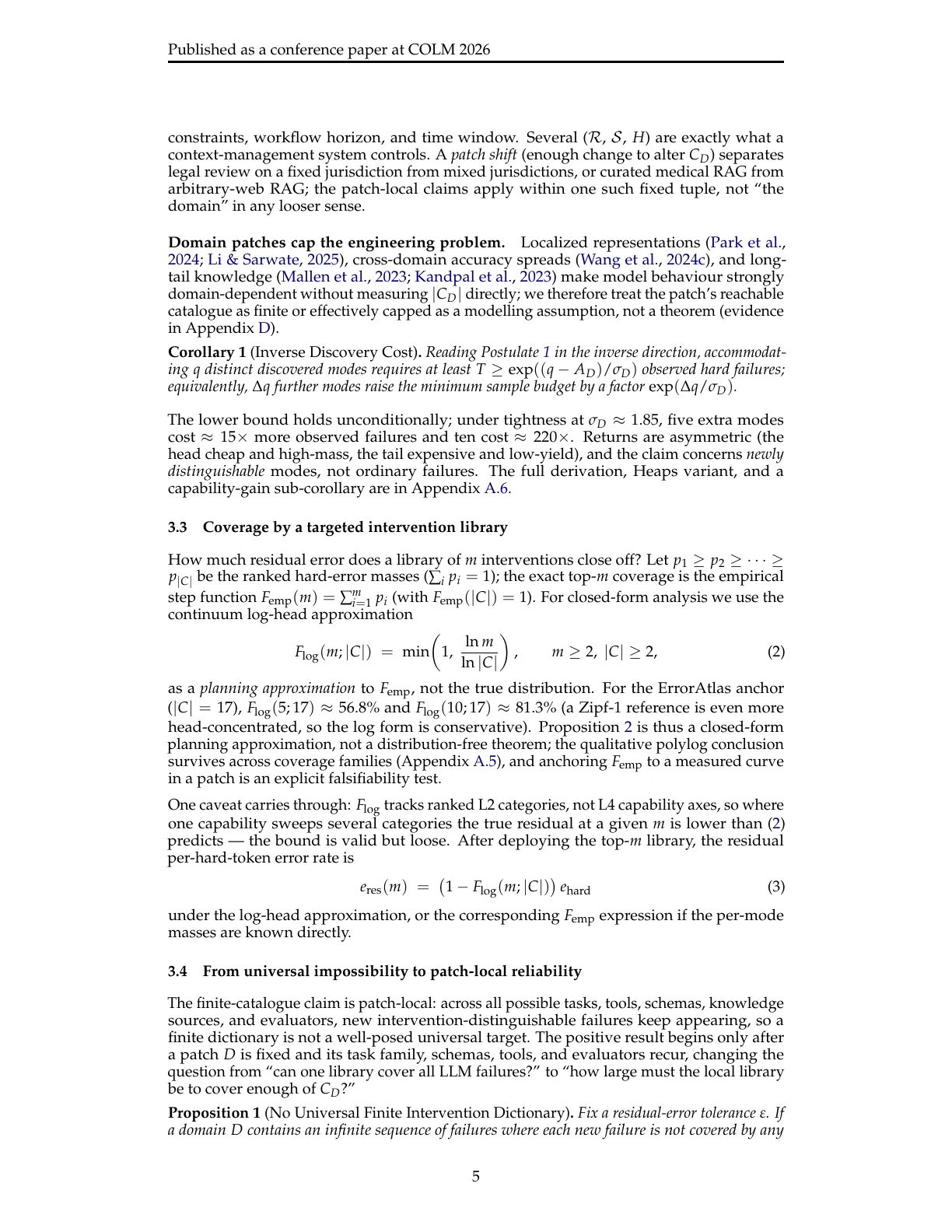
Operational patch. A deployment patch D is not a topic label but an operational tuple
fixing, over a time window, which failure modes are reachable: D = (X , S , U , R , E , P , H, τ )
— task input distribution, schema family, user/client class, retrieval corpus, evaluator, policy

4
Text of page 5
Published as a conference paper at COLM 2026

constraints, workflow horizon, and time window. Several ( R , S , H) are exactly what a
context-management system controls. A patch shift (enough change to alter C D ) separates
legal review on a fixed jurisdiction from mixed jurisdictions, or curated medical RAG from
arbitrary-web RAG; the patch-local claims apply within one such fixed tuple, not “the
domain” in any looser sense.

Domain patches cap the engineering problem. Localized representations (Park et al.,
2024; Li & Sarwate, 2025), cross-domain accuracy spreads (Wang et al., 2024c), and longtail knowledge (Mallen et al., 2023; Kandpal et al., 2023) make model behaviour strongly
domain-dependent without measuring | C D | directly; we therefore treat the patch’s reachable
catalogue as finite or effectively capped as a modelling assumption, not a theorem (evidence
in Appendix D).

Corollary 1 (Inverse Discovery Cost). Reading Postulate 1 in the inverse direction, accommodating q distinct discovered modes requires at least T ≥ exp (( q − A D ) /σ D ) observed hard failures;
equivalently, ∆q further modes raise the minimum sample budget by a factor exp ( ∆q/σ D ) .

The lower bound holds unconditionally; under tightness at σ D ≈ 1.85, five extra modes
cost ≈ 15 × more observed failures and ten cost ≈ 220 × . Returns are asymmetric (the
head cheap and high-mass, the tail expensive and low-yield), and the claim concerns newly
distinguishable modes, not ordinary failures. The full derivation, Heaps variant, and a
capability-gain sub-corollary are in Appendix A.6.

3.3

Coverage by a targeted intervention library

How much residual error does a library of m interventions close off? Let p 1 ≥ p 2 ≥ · · · ≥
p | C | be the ranked hard-error masses ( ∑ i p i = 1); the exact top-m coverage is the empirical
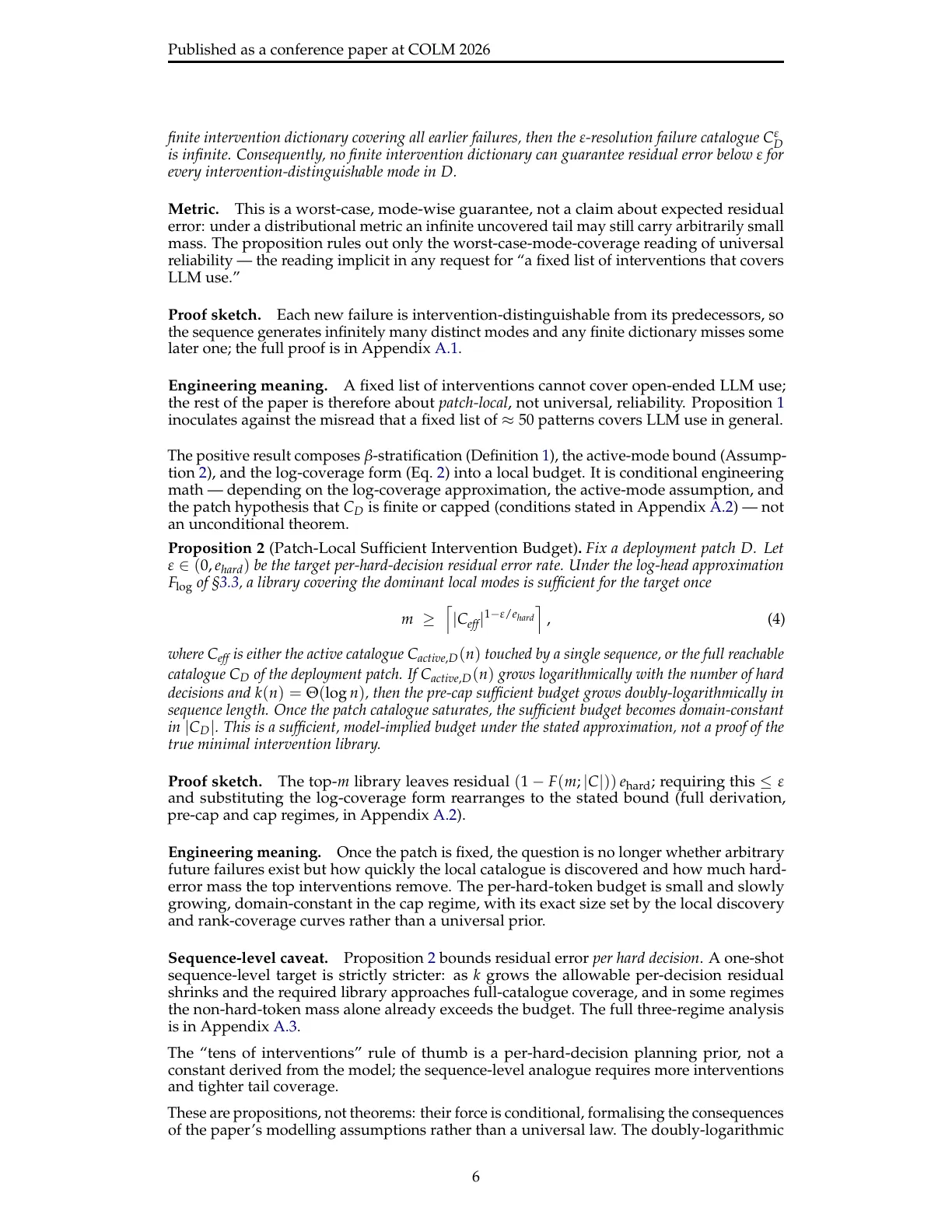
step function F emp ( m ) = ∑ i m = 1 p i (with F emp (| C |) = 1). For closed-form analysis we use the
continuum log-head approximation
ln m
F log ( m; | C |) = min 1,
,
m ≥ 2, | C | ≥ 2,
(2)
ln | C |

as a planning approximation to F emp , not the true distribution. For the ErrorAtlas anchor
( | C | = 17), F log ( 5; 17 ) ≈ 56.8% and F log ( 10; 17 ) ≈ 81.3% (a Zipf-1 reference is even more
head-concentrated, so the log form is conservative). Proposition 2 is thus a closed-form
planning approximation, not a distribution-free theorem; the qualitative polylog conclusion
survives across coverage families (Appendix A.5), and anchoring F emp to a measured curve
in a patch is an explicit falsifiability test.

One caveat carries through: F log tracks ranked L2 categories, not L4 capability axes, so where
one capability sweeps several categories the true residual at a given m is lower than (2)
predicts — the bound is valid but loose. After deploying the top-m library, the residual
per-hard-token error rate is
e res ( m ) = 1 − F log ( m; | C |) e hard
(3)

under the log-head approximation, or the corresponding F emp expression if the per-mode
masses are known directly.

3.4

From universal impossibility to patch-local reliability

The finite-catalogue claim is patch-local: across all possible tasks, tools, schemas, knowledge
sources, and evaluators, new intervention-distinguishable failures keep appearing, so a
finite dictionary is not a well-posed universal target. The positive result begins only after
a patch D is fixed and its task family, schemas, tools, and evaluators recur, changing the
question from “can one library cover all LLM failures?” to “how large must the local library
be to cover enough of C D ?”

Proposition 1 (No Universal Finite Intervention Dictionary). Fix a residual-error tolerance ε. If
a domain D contains an infinite sequence of failures where each new failure is not covered by any

5
Text of page 6
Published as a conference paper at COLM 2026

ε
finite intervention dictionary covering all earlier failures, then the ε-resolution failure catalogue C D
is infinite. Consequently, no finite intervention dictionary can guarantee residual error below ε for
every intervention-distinguishable mode in D.

Metric. This is a worst-case, mode-wise guarantee, not a claim about expected residual
error: under a distributional metric an infinite uncovered tail may still carry arbitrarily small
mass. The proposition rules out only the worst-case-mode-coverage reading of universal
reliability — the reading implicit in any request for “a fixed list of interventions that covers
LLM use.”

Proof sketch. Each new failure is intervention-distinguishable from its predecessors, so
the sequence generates infinitely many distinct modes and any finite dictionary misses some
later one; the full proof is in Appendix A.1.

Engineering meaning. A fixed list of interventions cannot cover open-ended LLM use;
the rest of the paper is therefore about patch-local, not universal, reliability. Proposition 1
inoculates against the misread that a fixed list of ≈ 50 patterns covers LLM use in general.

The positive result composes β-stratification (Definition 1), the active-mode bound (Assumption 2), and the log-coverage form (Eq. 2) into a local budget. It is conditional engineering
math — depending on the log-coverage approximation, the active-mode assumption, and
the patch hypothesis that C D is finite or capped (conditions stated in Appendix A.2) — not
an unconditional theorem.

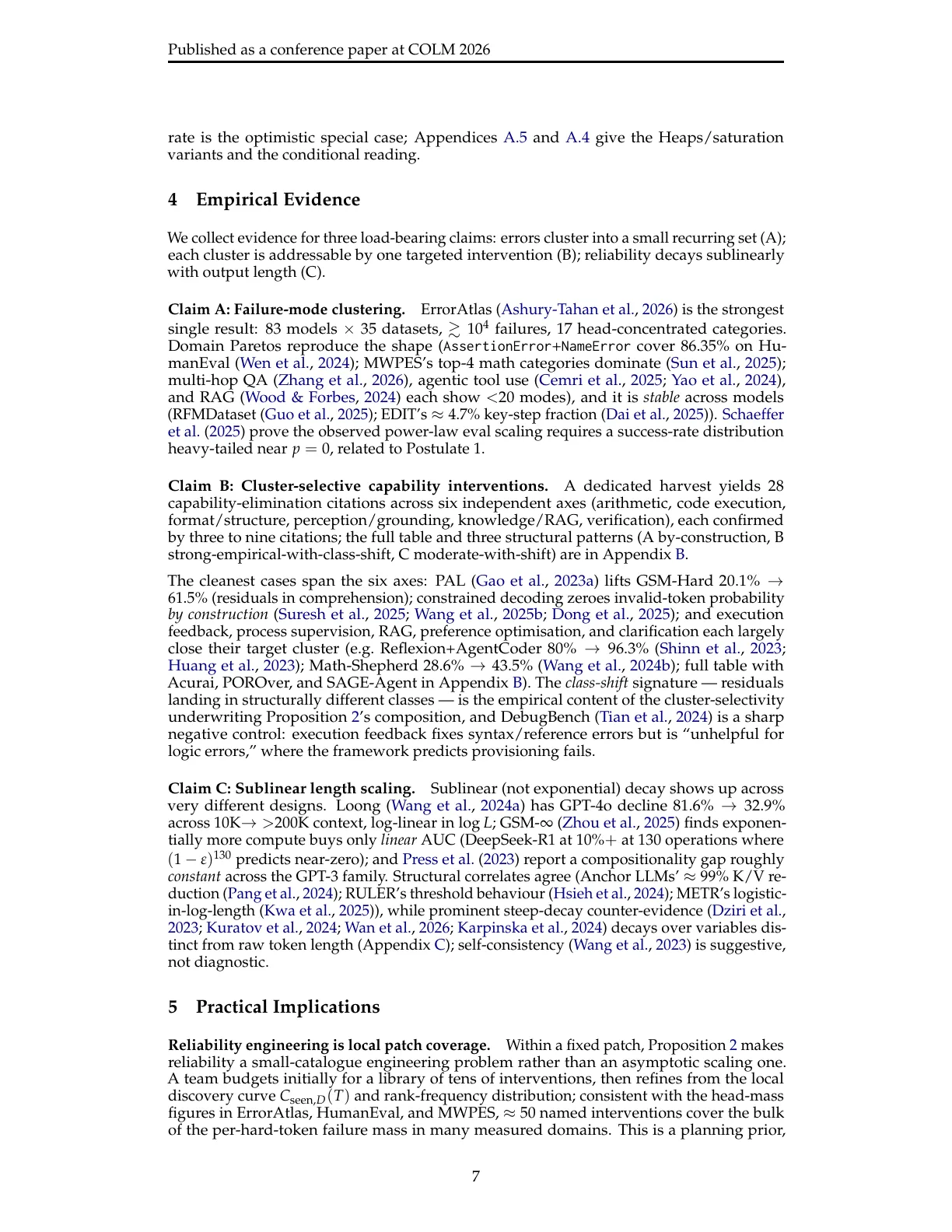
Proposition 2 (Patch-Local Sufficient Intervention Budget). Fix a deployment patch D. Let
ε ∈ ( 0, e hard ) be the target per-hard-decision residual error rate. Under the log-head approximation
F log of §3.3, a library covering the dominant local modes is sufficient for the target once
l
m
m ≥ | C eff | 1 − ε/e hard ,
(4)

where C eff is either the active catalogue C active,D ( n ) touched by a single sequence, or the full reachable
catalogue C D of the deployment patch. If C active,D ( n ) grows logarithmically with the number of hard
decisions and k ( n ) = Θ ( log n ) , then the pre-cap sufficient budget grows doubly-logarithmically in
sequence length. Once the patch catalogue saturates, the sufficient budget becomes domain-constant
in | C D | . This is a sufficient, model-implied budget under the stated approximation, not a proof of the
true minimal intervention library.

Proof sketch. The top-m library leaves residual ( 1 − F ( m; | C |)) e hard ; requiring this ≤ ε
and substituting the log-coverage form rearranges to the stated bound (full derivation,
pre-cap and cap regimes, in Appendix A.2).

Engineering meaning. Once the patch is fixed, the question is no longer whether arbitrary
future failures exist but how quickly the local catalogue is discovered and how much harderror mass the top interventions remove. The per-hard-token budget is small and slowly
growing, domain-constant in the cap regime, with its exact size set by the local discovery
and rank-coverage curves rather than a universal prior.

Sequence-level caveat. Proposition 2 bounds residual error per hard decision. A one-shot
sequence-level target is strictly stricter: as k grows the allowable per-decision residual
shrinks and the required library approaches full-catalogue coverage, and in some regimes
the non-hard-token mass alone already exceeds the budget. The full three-regime analysis
is in Appendix A.3.

The “tens of interventions” rule of thumb is a per-hard-decision planning prior, not a
constant derived from the model; the sequence-level analogue requires more interventions
and tighter tail coverage.

These are propositions, not theorems: their force is conditional, formalising the consequences
of the paper’s modelling assumptions rather than a universal law. The doubly-logarithmic

6
Text of page 7
Published as a conference paper at COLM 2026

rate is the optimistic special case; Appendices A.5 and A.4 give the Heaps/saturation
variants and the conditional reading.

4

Empirical Evidence

We collect evidence for three load-bearing claims: errors cluster into a small recurring set (A);
each cluster is addressable by one targeted intervention (B); reliability decays sublinearly
with output length (C).

Claim A: Failure-mode clustering. ErrorAtlas (Ashury-Tahan et al., 2026) is the strongest
single result: 83 models × 35 datasets, ≳ 10 4 failures, 17 head-concentrated categories.
Domain Paretos reproduce the shape (AssertionError+NameError cover 86.35% on HumanEval (Wen et al., 2024); MWPES’s top-4 math categories dominate (Sun et al., 2025);
multi-hop QA (Zhang et al., 2026), agentic tool use (Cemri et al., 2025; Yao et al., 2024),
and RAG (Wood & Forbes, 2024) each show < 20 modes), and it is stable across models
(RFMDataset (Guo et al., 2025); EDIT’s ≈ 4.7% key-step fraction (Dai et al., 2025)). Schaeffer
et al. (2025) prove the observed power-law eval scaling requires a success-rate distribution
heavy-tailed near p = 0, related to Postulate 1.

Claim B: Cluster-selective capability interventions. A dedicated harvest yields 28
capability-elimination citations across six independent axes (arithmetic, code execution,
format/structure, perception/grounding, knowledge/RAG, verification), each confirmed
by three to nine citations; the full table and three structural patterns (A by-construction, B
strong-empirical-with-class-shift, C moderate-with-shift) are in Appendix B.

The cleanest cases span the six axes: PAL (Gao et al., 2023a) lifts GSM-Hard 20.1% →
61.5% (residuals in comprehension); constrained decoding zeroes invalid-token probability
by construction (Suresh et al., 2025; Wang et al., 2025b; Dong et al., 2025); and execution
feedback, process supervision, RAG, preference optimisation, and clarification each largely
close their target cluster (e.g. Reflexion+AgentCoder 80% → 96.3% (Shinn et al., 2023;
Huang et al., 2023); Math-Shepherd 28.6% → 43.5% (Wang et al., 2024b); full table with
Acurai, POROver, and SAGE-Agent in Appendix B). The class-shift signature — residuals
landing in structurally different classes — is the empirical content of the cluster-selectivity
underwriting Proposition 2’s composition, and DebugBench (Tian et al., 2024) is a sharp
negative control: execution feedback fixes syntax/reference errors but is “unhelpful for
logic errors,” where the framework predicts provisioning fails.

Claim C: Sublinear length scaling. Sublinear (not exponential) decay shows up across
very different designs. Loong (Wang et al., 2024a) has GPT-4o decline 81.6% → 32.9%
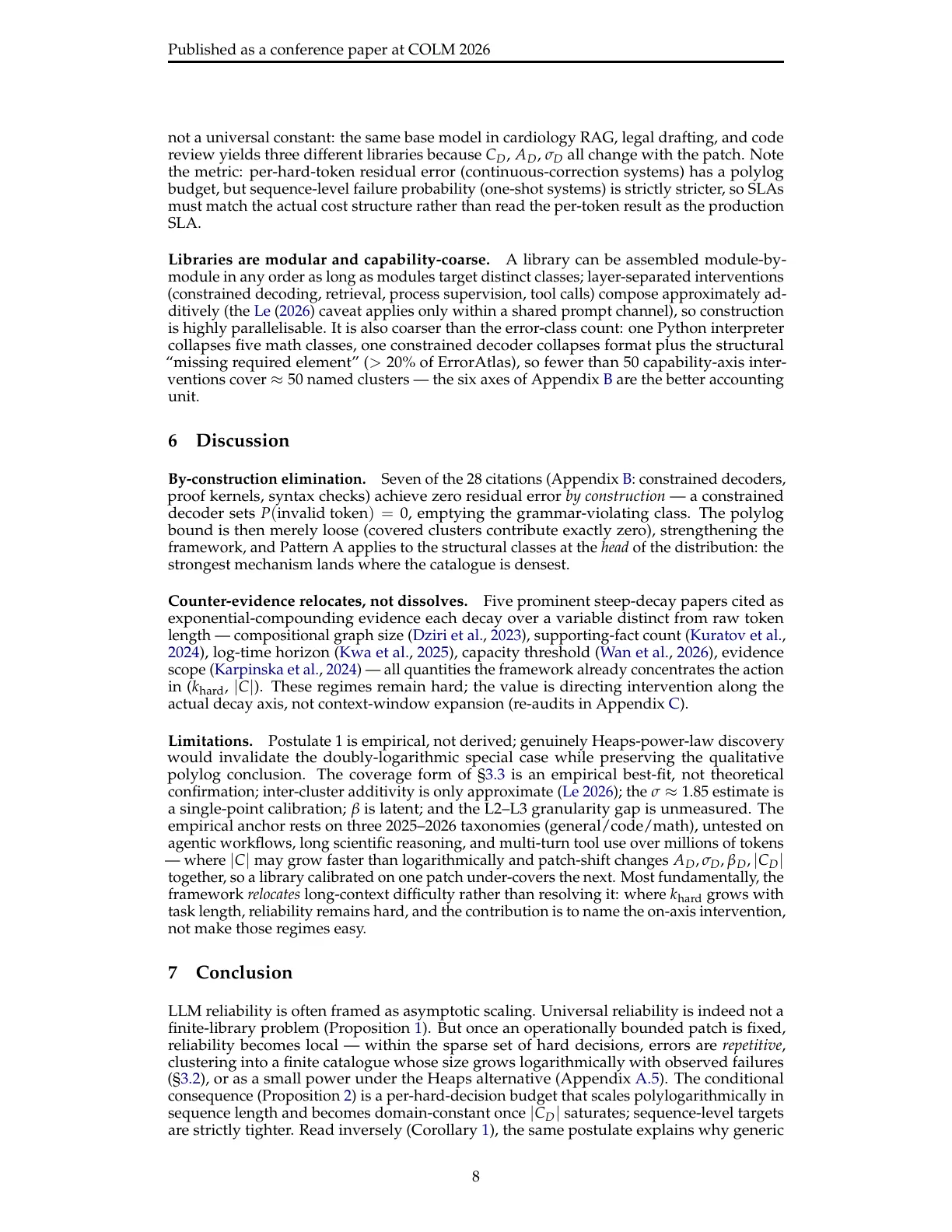
across 10K → > 200K context, log-linear in log L; GSM-∞ (Zhou et al., 2025) finds exponentially more compute buys only linear AUC (DeepSeek-R1 at 10% + at 130 operations where
( 1 − ε ) 130 predicts near-zero); and Press et al. (2023) report a compositionality gap roughly
constant across the GPT-3 family. Structural correlates agree (Anchor LLMs’ ≈ 99% K/V reduction (Pang et al., 2024); RULER’s threshold behaviour (Hsieh et al., 2024); METR’s logisticin-log-length (Kwa et al., 2025)), while prominent steep-decay counter-evidence (Dziri et al.,
2023; Kuratov et al., 2024; Wan et al., 2026; Karpinska et al., 2024) decays over variables distinct from raw token length (Appendix C); self-consistency (Wang et al., 2023) is suggestive,
not diagnostic.

5

Practical Implications

Reliability engineering is local patch coverage. Within a fixed patch, Proposition 2 makes
reliability a small-catalogue engineering problem rather than an asymptotic scaling one.
A team budgets initially for a library of tens of interventions, then refines from the local
discovery curve C seen,D ( T ) and rank-frequency distribution; consistent with the head-mass
figures in ErrorAtlas, HumanEval, and MWPES, ≈ 50 named interventions cover the bulk
of the per-hard-token failure mass in many measured domains. This is a planning prior,

7
Text of page 8
Published as a conference paper at COLM 2026

not a universal constant: the same base model in cardiology RAG, legal drafting, and code
review yields three different libraries because C D , A D , σ D all change with the patch. Note
the metric: per-hard-token residual error (continuous-correction systems) has a polylog
budget, but sequence-level failure probability (one-shot systems) is strictly stricter, so SLAs
must match the actual cost structure rather than read the per-token result as the production
SLA.

Libraries are modular and capability-coarse. A library can be assembled module-by-module in any order as long as modules target distinct classes; layer-separated interventions
(constrained decoding, retrieval, process supervision, tool calls) compose approximately additively (the Le (2026) caveat applies only within a shared prompt channel), so construction
is highly parallelisable. It is also coarser than the error-class count: one Python interpreter
collapses five math classes, one constrained decoder collapses format plus the structural
“missing required element” ( > 20% of ErrorAtlas), so fewer than 50 capability-axis interventions cover ≈ 50 named clusters — the six axes of Appendix B are the better accounting
unit.

6

Discussion

By-construction elimination. Seven of the 28 citations (Appendix B: constrained decoders,
proof kernels, syntax checks) achieve zero residual error by construction — a constrained
decoder sets P ( invalid token ) = 0, emptying the grammar-violating class. The polylog
bound is then merely loose (covered clusters contribute exactly zero), strengthening the
framework, and Pattern A applies to the structural classes at the head of the distribution: the
strongest mechanism lands where the catalogue is densest.

Counter-evidence relocates, not dissolves. Five prominent steep-decay papers cited as
exponential-compounding evidence each decay over a variable distinct from raw token
length — compositional graph size (Dziri et al., 2023), supporting-fact count (Kuratov et al.,
2024), log-time horizon (Kwa et al., 2025), capacity threshold (Wan et al., 2026), evidence
scope (Karpinska et al., 2024) — all quantities the framework already concentrates the action
in (k hard , | C | ). These regimes remain hard; the value is directing intervention along the
actual decay axis, not context-window expansion (re-audits in Appendix C).

Limitations. Postulate 1 is empirical, not derived; genuinely Heaps-power-law discovery
would invalidate the doubly-logarithmic special case while preserving the qualitative
polylog conclusion. The coverage form of §3.3 is an empirical best-fit, not theoretical
confirmation; inter-cluster additivity is only approximate (Le 2026); the σ ≈ 1.85 estimate is
a single-point calibration; β is latent; and the L2–L3 granularity gap is unmeasured. The
empirical anchor rests on three 2025–2026 taxonomies (general/code/math), untested on
agentic workflows, long scientific reasoning, and multi-turn tool use over millions of tokens
— where | C | may grow faster than logarithmically and patch-shift changes A D , σ D , β D , | C D |
together, so a library calibrated on one patch under-covers the next. Most fundamentally, the
framework relocates long-context difficulty rather than resolving it: where k hard grows with
task length, reliability remains hard, and the contribution is to name the on-axis intervention,
not make those regimes easy.

7

Conclusion

LLM reliability is often framed as asymptotic scaling. Universal reliability is indeed not a
finite-library problem (Proposition 1). But once an operationally bounded patch is fixed,
reliability becomes local — within the sparse set of hard decisions, errors are repetitive,
clustering into a finite catalogue whose size grows logarithmically with observed failures
(§3.2), or as a small power under the Heaps alternative (Appendix A.5). The conditional
consequence (Proposition 2) is a per-hard-decision budget that scales polylogarithmically in
sequence length and becomes domain-constant once | C D | saturates; sequence-level targets
are strictly tighter. Read inversely (Corollary 1), the same postulate explains why generic

8
Text of page 9
Published as a conference paper at COLM 2026

frontier post-training faces diminishing reliability returns once a patch’s head modes are
covered.

This shifts the question from “can we bound n-token error?” to “have we catalogued
enough failure modes inside the patch?” — finite and addressable, with direct measurement
of the mode-rate σ on new domains the natural empirical follow-up. The paper names the
engineering object (a patch-local failure catalogue and the budget covering its head) but not
how the deployment-time scaffold of instructions, tools, retrieval, memory, and orchestration
governs that library over time; in that frame, reliability engineering is governance of the scaffold
rather than scaling of the weights.

References

Mikhail L. Arbuzov, Sisong Bei, Ziwei Dong, Dmitri Kalaev, and Alexey Shvets. Beyond
exponential decay: Rethinking error accumulation in large language models. arXiv
preprint arXiv:2505.24187v2, 2025. Posted 06 May 2026; CC BY 4.0 license.

Akari Asai, Zeqiu Wu, Yizhong Wang, Avirup Sil, and Hannaneh Hajishirzi. Self-RAG:
Learning to retrieve, generate, and critique through self-reflection. In International Conference on Learning Representations (ICLR), 2024.

Shir Ashury-Tahan, Yifan Mai, Elron Bandel, Michal Shmueli-Scheuer, and Leshem Choshen.
ErrorMap and ErrorAtlas: Charting the failure landscape of large language models. arXiv
preprint, 2026.

Mert Cemri, Melissa Z. Pan, Shuyi Yang, Lakshya A. Agrawal, Bhavya Chopra, Rishabh
Tiwari, Kurt Keutzer, Aditya Parameswaran, Dan Klein, Kannan Ramchandran, Matei
Zaharia, Joseph E. Gonzalez, and Ion Stoica. Why do multi-agent LLM systems fail? arXiv
preprint, 2025. Introduces the MAST taxonomy (Multi-Agent System Failure Taxonomy).

Wenhu Chen, Xueguang Ma, Xinyi Wang, and William W. Cohen. Program of thoughts
prompting: Disentangling computation from reasoning for numerical reasoning tasks.
Transactions on Machine Learning Research (TMLR), 2023.

Kanzhi Cheng, Qiushi Sun, Yougang Chu, Fangzhi Xu, Yantao Li, Jianbing Zhang, and
Zhiyong Wu. SeeClick: Harnessing GUI grounding for advanced visual GUI agents. In
Proceedings of ACL, 2024.

Chengwei Dai, Kun Li, Wei Zhou, and Songlin Hu. Capture the key in reasoning to
enhance CoT distillation generalization. In Proceedings of ACL, 2025. Earlier arXiv version
titled “Beyond Imitation: Learning Key Reasoning Steps from Dual Chain-of-Thoughts in
Reasoning Distillation”.

Alex Dantart. Reliability by design: Quantifying and eliminating fabrication risk in LLMs.
from generative to consultative AI: A comparative analysis in the legal domain and
lessons for high-stakes knowledge bases. arXiv preprint, 2026.

Yixin Dong, Charlie F. Ruan, Yaxing Cai, Ruihang Lai, Ziyi Xu, Yilong Zhao, and Tianqi
Chen. XGrammar: Flexible and efficient structured generation engine for large language
models. In Proceedings of MLSys, 2025.

Nouha Dziri, Ximing Lu, Melanie Sclar, Xiang Lorraine Li, Liwei Jiang, Bill Yuchen Lin,
Peter West, Chandra Bhagavatula, Ronan Le Bras, Jena D. Hwang, Soumya Sanyal, Sean
Welleck, Xiang Ren, Allyson Ettinger, Zaid Harchaoui, and Yejin Choi. Faith and fate:
Limits of transformers on compositionality. In Advances in Neural Information Processing
Systems, volume 36, 2023.

Lizhe Fang, Yifei Wang, Zhaoyang Liu, Chenyang Zhang, Stefanie Jegelka, Jianfeng Gao,
Bolin Ding, and Yisen Wang. What is wrong with perplexity for long-context language
modeling? In International Conference on Learning Representations (ICLR), 2025.

9
Text of page 10
Published as a conference paper at COLM 2026

Luyu Gao, Aman Madaan, Shuyan Zhou, Uri Alon, Pengfei Liu, Yiming Yang, Jamie Callan,
and Graham Neubig. PAL: Program-aided language models. In Proceedings of ICML,
2023a.

Tianyu Gao, Howard Yen, Jiatong Yu, and Danqi Chen. Enabling large language models
to generate text with citations. In Proceedings of EMNLP, 2023b. Introduces the ALCE
benchmark.

Alex J. Goodell, Simon N. Chu, Dara Rouholiman, and Larry F. Chu. Large language model
agents can use tools to perform clinical calculations. npj Digital Medicine, 8(1):163, 2025.
doi: 10.1038/s41746-025-01475-8.

Boyu Gou, Ruohan Wang, Boyuan Zheng, Yanan Xie, Cheng Chang, Yiheng Shu, Huan Sun,
and Yu Su. Navigating the digital world as humans do: Universal visual grounding for
GUI agents. In International Conference on Learning Representations (ICLR), 2025. ICLR 2025
Oral. Introduces the UGround model.

Zhibin Gou, Zhihong Shao, Yeyun Gong, Yelong Shen, Yujiu Yang, Nan Duan, and Weizhu
Chen. CRITIC: Large language models can self-correct with tool-interactive critiquing. In
International Conference on Learning Representations (ICLR), 2024a.

Zhibin Gou, Zhihong Shao, Yeyun Gong, Yelong Shen, Yujiu Yang, Minlie Huang, Nan
Duan, and Weizhu Chen. ToRA: A tool-integrated reasoning agent for mathematical
problem solving. In International Conference on Learning Representations (ICLR), 2024b.

Dadi Guo, Jiayu Liu, Zhiyuan Fan, Zhitao He, Haoran Li, Yuxin Li, Yumeng Wang, and
Yi R. Fung. Mathematical proof as a litmus test: Revealing failure modes of advanced
large reasoning models. arXiv preprint, 2025. Introduces the RFMDataset (Reveal Failure
Modes).

Cheng-Ping Hsieh, Simeng Sun, Samuel Kriman, Shantanu Acharya, Dima Rekesh, Fei Jia,
Yang Zhang, and Boris Ginsburg. RULER: What’s the real context size of your long-context
language models? In Conference on Language Modeling (COLM), 2024.

Dong Huang, Qingwen Bu, Jie M. Zhang, Michael Luck, and Heming Cui. AgentCoder:
Multi-agent-based code generation with iterative testing and optimisation. arXiv preprint,
2023.

Nikhil Kandpal, Haikang Deng, Adam Roberts, Eric Wallace, and Colin Raffel. Large
language models struggle to learn long-tail knowledge. In Proceedings of ICML, 2023.

Batuhan K. Karaman, Ishmam Zabir, Alon Benhaim, Vishrav Chaudhary, Mert R. Sabuncu,
and Xia Song. POROver: Improving safety and reducing overrefusal in large language
models with overgeneration and preference optimization. arXiv preprint, 2024.

Marzena Karpinska, Katherine Thai, Kyle Lo, Tanya Goyal, and Mohit Iyyer. One thousand
and one pairs: A “novel” challenge for long-context language models. In Proceedings of
EMNLP, 2024.

Yuri Kuratov, Aydar Bulatov, Pavel Anokhin, Ivan Rodkin, Dmitry Sorokin, Artyom Sorokin,
and Mikhail Burtsev. BABILong: Testing the limits of LLMs with long context reasoningin-a-haystack. In NeurIPS Datasets and Benchmarks Track, 2024.

Thomas Kwa, Ben West, Joel Becker, Amy Deng, Katharyn Garcia, Max Hasin, Sami Jawhar,
Megan Kinniment, Nate Rush, Sydney Von Arx, Ryan Bloom, Thomas Broadley, Haoxing
Du, Brian Goodrich, Nikola Jurkovic, Luke Harold Miles, Seraphina Nix, Tao Lin, Neev
Parikh, David Rein, Lucas Jun Koba Sato, Hjalmar Wijk, Daniel M. Ziegler, Elizabeth
Barnes, and Lawrence Chan. Measuring AI ability to complete long software tasks. In
Advances in Neural Information Processing Systems (NeurIPS), 2025. METR technical report.

Yifan Le. Schema key wording as an instruction channel in structured generation under
constrained decoding. arXiv preprint, 2026.

10
Text of page 11
Published as a conference paper at COLM 2026

Yann LeCun. Auto-regressive LLMs are doomed. Tweet, March 26, 2023. https://x.com/
ylecun/status/1640122342570336267, 2023.

Linzhang Li, Yixin Dong, Guanjie Wang, Ziyi Xu, Alexander Jiang, and Tianqi Chen.
XGrammar-2: Efficient dynamic structured generation engine for agentic LLMs. arXiv
preprint, 2026.

Xin Li and Anand D. Sarwate. Unraveling the localized latents: Learning stratified manifold
structures in LLM embedding space with sparse mixture-of-experts. arXiv preprint, 2025.

Yujia Li, David H. Choi, Junyoung Chung, Nate Kushman, Julian Schrittwieser, Rémi
Leblond, Tom Eccles, James Keeling, Felix Gimeno, Agustin Dal Lago, Thomas Hubert,
Peter Choy, Cyprien de Masson d’Autume, Igor Babuschkin, Xinyun Chen, Po-Sen Huang,
Johannes Welbl, Sven Gowal, Alexey Cherepanov, James Molloy, Daniel J. Mankowitz,
Esme Sutherland Robson, Pushmeet Kohli, Nando de Freitas, Koray Kavukcuoglu, and
Oriol Vinyals. Competition-level code generation with AlphaCode. Science, 378(6624):
1092–1097, 2022. doi: 10.1126/science.abq1158.

Hunter Lightman, Vineet Kosaraju, Yura Burda, Harri Edwards, Bowen Baker, Teddy Lee,
Jan Leike, John Schulman, Ilya Sutskever, and Karl Cobbe. Let’s verify step by step. In
International Conference on Learning Representations (ICLR), 2024.

Fangyu Liu, Julian Martin Eisenschlos, Francesco Piccinno, Syrine Krichene, Chenxi Pang,
Kenton Lee, Mandar Joshi, Wenhu Chen, Nigel Collier, and Yasemin Altun. DePlot:
One-shot visual language reasoning by plot-to-table translation. In Findings of ACL, 2023.

Yadong Lu, Jianwei Yang, Yelong Shen, and Ahmed Awadallah. OmniParser for pure vision
based GUI agent. arXiv preprint, 2024.

Alex Mallen, Akari Asai, Victor Zhong, Rajarshi Das, Daniel Khashabi, and Hannaneh
Hajishirzi. When not to trust language models: Investigating effectiveness of parametric
and non-parametric memories. In Proceedings of ACL, 2023. Introduces the PopQA
benchmark.

Christopher D. Manning, Prabhakar Raghavan, and Hinrich Schütze.
Introduction to Information Retrieval.
Cambridge University Press, 2008.
Section on Heaps’ law:
https://nlp.stanford.edu/IR-book/html/htmledition/
heaps-law-estimating-the-number-of-terms-1.html.

Ayana Niwa and Hayate Iso. AmbigNLG: Addressing task ambiguity in instruction for
NLG. In Proceedings of EMNLP, 2024.

OpenAI. Introducing structured outputs in the API. OpenAI Engineering Blog. https:
//openai.com/index/introducing-structured-outputs-in-the-api/, 2024. Published
August 6, 2024.

OpenAI. GPT-5 system card. https://cdn.openai.com/gpt-5-system-card.pdf, 2025. Published August 7, 2025.

Jianhui Pang, Fanghua Ye, Derek F. Wong, Xun He, Wenxiang Chen, and Longyue Wang.
Anchor-based large language models. In Findings of ACL, 2024.

Kiho Park, Yo Joong Choe, and Victor Veitch. The linear representation hypothesis and the
geometry of large language models. In Proceedings of ICML, 2024.

Khush Patel, Siva Surendira, Jithin George, and Shreyas Kapale. The six sigma agent: Achieving enterprise-grade reliability in LLM systems through consensus-driven decomposed
execution. arXiv preprint, 2026.

Ofir Press, Muru Zhang, Sewon Min, Ludwig Schmidt, Noah A. Smith, and Mike Lewis.
Measuring and narrowing the compositionality gap in language models. In Findings of
EMNLP, 2023.

11
Text of page 12
Published as a conference paper at COLM 2026

Z. Z. Ren, Zhihong Shao, Junxiao Song, Huajian Xin, Haocheng Wang, Wanjia Zhao, Liyue
Zhang, Zhe Fu, Qihao Zhu, Dejian Yang, Z. F. Wu, Zhibin Gou, Shirong Ma, Hongxuan
Tang, Yuxuan Liu, Wenjun Gao, Daya Guo, and Chong Ruan. DeepSeek-Prover-V2:
Advancing formal mathematical reasoning via reinforcement learning for subgoal decomposition. arXiv preprint, 2025.

Rylan Schaeffer, Joshua Kazdan, John Hughes, Jordan Juravsky, Sara Price, Aengus Lynch,
Erik Jones, Robert Kirk, Azalia Mirhoseini, and Sanmi Koyejo. How do large language
monkeys get their power (laws)? In International Conference on Machine Learning (ICML),
2025.

Yu Shang, Yu Li, Keyu Zhao, Likai Ma, Jiahe Liu, Fengli Xu, and Yong Li. AgentSquare:
Automatic LLM agent search in modular design space. arXiv preprint, 2024.

Yuling Shi, Songsong Wang, Chengcheng Wan, Min Wang, and Xiaodong Gu. From code to
correctness: Closing the last mile of code generation with hierarchical debugging. arXiv
preprint, 2024. Introduces the MGDebugger method.

Noah Shinn, Federico Cassano, Edward Berman, Ashwin Gopinath, Karthik Narasimhan,
and Shunyu Yao. Reflexion: Language agents with verbal reinforcement learning. In
Advances in Neural Information Processing Systems, volume 36, 2023.

Yuhong Sun, Zhangyue Yin, Xuanjing Huang, Xipeng Qiu, and Hui Zhao. Error classification
of large language models on math word problems: A dynamically adaptive framework.
In arXiv preprint, 2025. Introduces the MWPES-300K dataset (304,865 error samples from
15 LLMs across four MWP datasets).

Tarun Suresh, Debangshu Banerjee, Shubham Ugare, Sasa Misailovic, and Gagandeep Singh.
DINGO: Constrained inference for diffusion LLMs. arXiv preprint, 2025.

Manan Suri, Puneet Mathur, Nedim Lipka, Franck Dernoncourt, Ryan A. Rossi, and Dinesh
Manocha. Structured uncertainty guided clarification for LLM agents. arXiv preprint, 2025.
Introduces the SAGE-Agent method.

Runchu Tian, Yining Ye, Yujia Qin, Xin Cong, Yankai Lin, Yinxu Pan, Yesai Wu, Haotian
Hui, Weichuan Liu, Zhiyuan Liu, and Maosong Sun. DebugBench: Evaluating debugging
capability of large language models. In Findings of ACL, 2024.

Akihiko Wada, Yuya Tanaka, Mitsuo Nishizawa, Akira Yamamoto, Toshiaki Akashi, Akifumi
Hagiwara, Yayoi Hayakawa, Junko Kikuta, Keigo Shimoji, Katsuhiro Sano, Koji Kamagata,
Atsushi Nakanishi, and Shigeki Aoki. Retrieval-augmented generation elevates local
LLM quality in radiology contrast media consultation. npj Digital Medicine, 8(1):395, 2025.
doi: 10.1038/s41746-025-01802-z.

Kaiyang Wan, Lang Gao, Honglin Mu, Preslav Nakov, Yuxia Wang, and Xiuying Chen. A
Fano-style accuracy upper bound for LLM single-pass reasoning in multi-hop QA. In
International Conference on Learning Representations (ICLR), 2026.

Benlu Wang, Iris Xia, Yifan Zhang, Junda Wang, Feiyun Ouyang, Shuo Han, Arman Cohan,
Hong Yu, and Zonghai Yao. From scores to steps: Diagnosing and improving LLM
performance in evidence-based medical calculations. In Proceedings of EMNLP, 2025a.
Introduces the MedRaC benchmark.

Darren Yow-Bang Wang, Zhengyuan Shen, Soumya Smruti Mishra, Zhichao Xu, Yifei Teng,
and Haibo Ding. SLOT: Structuring the output of large language models. arXiv preprint,
2025b. SLOT = Structured LLM Output Transformer.

Minzheng Wang, Longze Chen, Cheng Fu, Shengyi Liao, Xinghua Zhang, Bingli Wu,
Haiyang Yu, Nan Xu, Lei Zhang, Run Luo, Yunshui Li, Min Yang, Fei Huang, and
Yongbin Li. Leave no document behind: Benchmarking long-context LLMs with extended
multi-doc QA. In Proceedings of EMNLP, 2024a.

12
Text of page 13
Published as a conference paper at COLM 2026

Peiyi Wang, Lei Li, Zhihong Shao, R. X. Xu, Damai Dai, Yifei Li, Deli Chen, Y. Wu, and
Zhifang Sui. Math-Shepherd: Verify and reinforce LLMs step-by-step without human
annotations. In Proceedings of ACL, 2024b.

Xuezhi Wang, Jason Wei, Dale Schuurmans, Quoc Le, Ed Chi, Sharan Narang, Aakanksha
Chowdhery, and Denny Zhou. Self-consistency improves chain of thought reasoning in
language models. In International Conference on Learning Representations (ICLR), 2023.

Yubo Wang, Xueguang Ma, Ge Zhang, Yuansheng Ni, Abhranil Chandra, Shiguang Guo,
Weiming Ren, Aaran Arulraj, Xuan He, Ziyan Jiang, Tianle Li, Max Ku, Kai Wang, Alex
Zhuang, Rongqi Fan, Xiang Yue, and Wenhu Chen. MMLU-Pro: A more robust and
challenging multi-task language understanding benchmark. In NeurIPS Datasets and
Benchmarks Track (Spotlight), 2024c.

Hao Wen, Yueheng Zhu, Chao Liu, Xiaoxue Ren, Weiwei Du, and Meng Yan. Fixing functionlevel code generation errors for foundation large language models. arXiv preprint, 2024.
Introduces the LlmFix method. Reports AssertionError 63.64% + NameError 22.71% =
86.35% of HumanEval failures across 14 LLMs.

Michael C. Wood and Adam A. Forbes. 100% elimination of hallucinations on RAGTruth
for GPT-4 and GPT-3.5 Turbo. arXiv preprint, 2024. Introduces the Acurai method.

Tianbao Xie, Jiaqi Deng, Xiaochuan Li, Junlin Yang, Haoyuan Wu, Jixuan Chen, Wenjing Hu,
Xinyuan Wang, Yuhui Xu, Zekun Wang, Yiheng Xu, Junli Wang, Doyen Sahoo, Tao Yu, and
Caiming Xiong. Scaling computer-use grounding via user interface decomposition and
synthesis. In Advances in Neural Information Processing Systems (NeurIPS), 2025. NeurIPS
2025 Spotlight. Introduces the Jedi grounding dataset and OSWorld-G benchmark.

Shunyu Yao, Noah Shinn, Pedram Razavi, and Karthik Narasimhan. τ-bench: A benchmark
for tool-agent-user interaction in real-world domains. arXiv preprint, 2024.

Cyril Zakka, Rohan Shad, Akash Chaurasia, Alex R. Dalal, Jennifer L. Kim, Michael Moor,
Robyn Fong, Curran Phillips, Kevin Alexander, Euan Ashley, Jack Boyd, Kathleen Boyd,
Karen Hirsch, Curtis Langlotz, Rita Lee, Joanna Melia, Joanna Nelson, Karim Sallam,
Stacey Tullis, Melissa Ann Vogelsong, John Patrick Cunningham, and William Hiesinger.
Almanac — retrieval-augmented language models for clinical medicine. NEJM AI, 1(2):
AIoa2300068, 2024. doi: 10.1056/AIoa2300068.

Kexun Zhang, Hongqiao Chen, Lei Li, and William Wang. Don’t fine-tune, decode: Syntax
error-free tool use via constrained decoding. arXiv preprint, 2023. Introduces the ToolDec
method.

Meiru Zhang, Zaiqiao Meng, and Nigel Collier. Failure modes in multi-hop QA: The weakest
link effect and the recognition bottleneck. arXiv preprint, 2026.

Yang Zhou, Hongyi Liu, Zhuoyan Chen, Yuandong Tian, and Beidi Chen. GSM-Infinite:
How do your LLMs behave over infinitely increasing context length and reasoning
complexity? arXiv preprint, 2025.

A

Formal Proofs, Derivations, and Sensitivity Analysis

A.1

Proof of Proposition 1: No Universal Finite Intervention Dictionary

Fix a residual-error tolerance ε. Say that an intervention covers a failure mode if it reduces
the residual error of that mode below ε. Coverage is mode-level: an intervention that covers
a mode covers every failure event in that mode. The two conditions “D is intervention-
ε | = ∞” are equivalent under mode-level coverage; an unbounded
unbounded” and “ | C D
witnessing sequence is constructed by taking one representative per mode, and an infinite
catalogue forces the existence of such a sequence.

Let D be a domain. Call D intervention-unbounded if it contains an infinite sequence of failures
f 1 , f 2 , f 3 , . . . such that each new f j is not covered by any finite intervention dictionary that
covers all earlier failures { f 1 , . . . , f j − 1 } .

13
Text of page 14
Published as a conference paper at COLM 2026

ε is finite. Then there
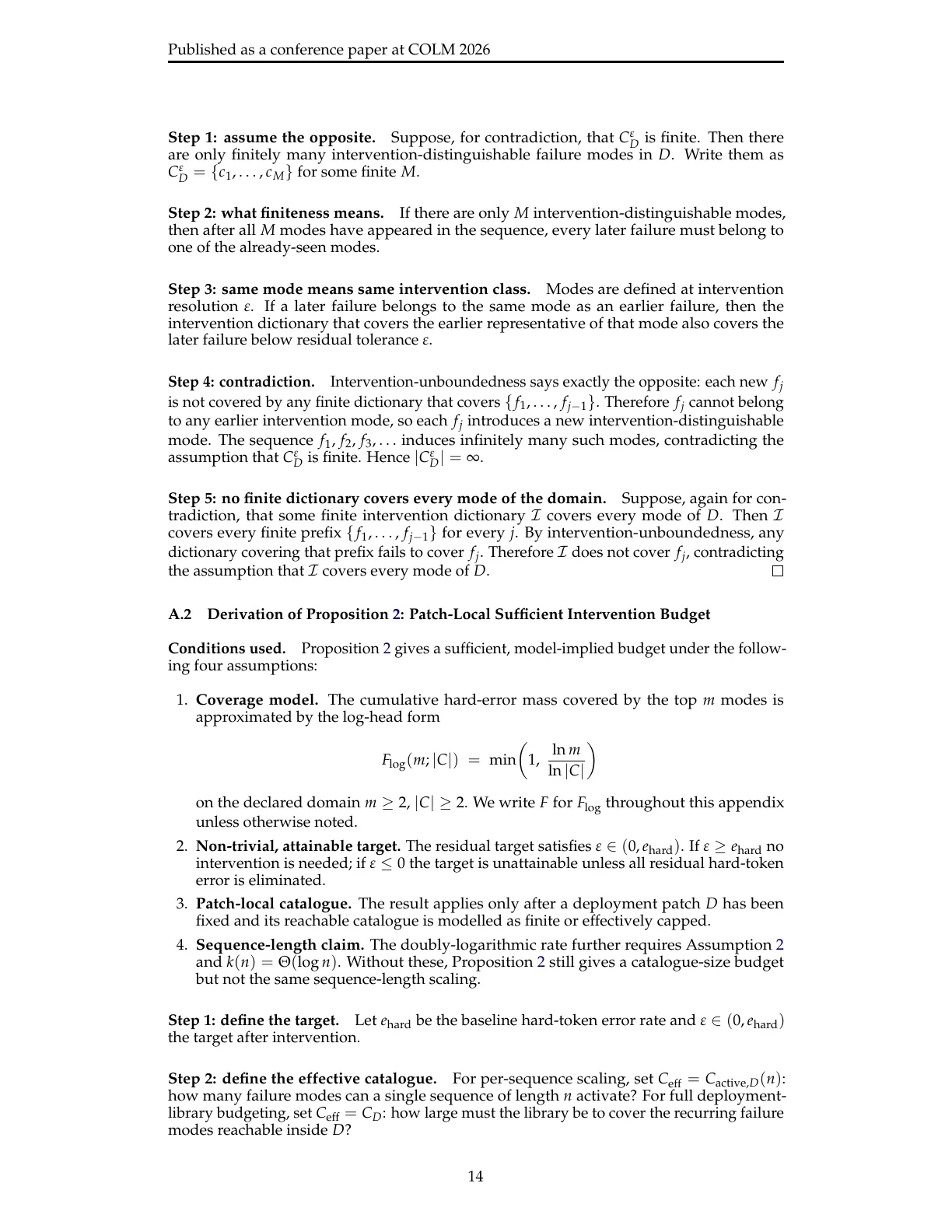
Step 1: assume the opposite. Suppose, for contradiction, that C D
are only finitely many intervention-distinguishable failure modes in D. Write them as
ε = { c , . . . , c } for some finite M.
C D
M
1

Step 2: what finiteness means. If there are only M intervention-distinguishable modes,
then after all M modes have appeared in the sequence, every later failure must belong to
one of the already-seen modes.

Step 3: same mode means same intervention class. Modes are defined at intervention
resolution ε. If a later failure belongs to the same mode as an earlier failure, then the
intervention dictionary that covers the earlier representative of that mode also covers the
later failure below residual tolerance ε.

Step 4: contradiction. Intervention-unboundedness says exactly the opposite: each new f j
is not covered by any finite dictionary that covers { f 1 , . . . , f j − 1 } . Therefore f j cannot belong
to any earlier intervention mode, so each f j introduces a new intervention-distinguishable
mode. The sequence f 1 , f 2 , f 3 , . . . induces infinitely many such modes, contradicting the
ε is finite. Hence | C ε | = ∞.
assumption that C D
D

Step 5: no finite dictionary covers every mode of the domain. Suppose, again for contradiction, that some finite intervention dictionary I covers every mode of D. Then I
covers every finite prefix { f 1 , . . . , f j − 1 } for every j. By intervention-unboundedness, any
dictionary covering that prefix fails to cover f j . Therefore I does not cover f j , contradicting
the assumption that I covers every mode of D.

A.2

Derivation of Proposition 2: Patch-Local Sufficient Intervention Budget

Conditions used. Proposition 2 gives a sufficient, model-implied budget under the following four assumptions:

1. Coverage model. The cumulative hard-error mass covered by the top m modes is
approximated by the log-head form
ln m
F log ( m; | C |) = min 1,
ln | C |

on the declared domain m ≥ 2, | C | ≥ 2. We write F for F log throughout this appendix
unless otherwise noted.

2. Non-trivial, attainable target. The residual target satisfies ε ∈ ( 0, e hard ) . If ε ≥ e hard no
intervention is needed; if ε ≤ 0 the target is unattainable unless all residual hard-token
error is eliminated.

3. Patch-local catalogue. The result applies only after a deployment patch D has been
fixed and its reachable catalogue is modelled as finite or effectively capped.

4. Sequence-length claim. The doubly-logarithmic rate further requires Assumption 2
and k ( n ) = Θ ( log n ) . Without these, Proposition 2 still gives a catalogue-size budget
but not the same sequence-length scaling.

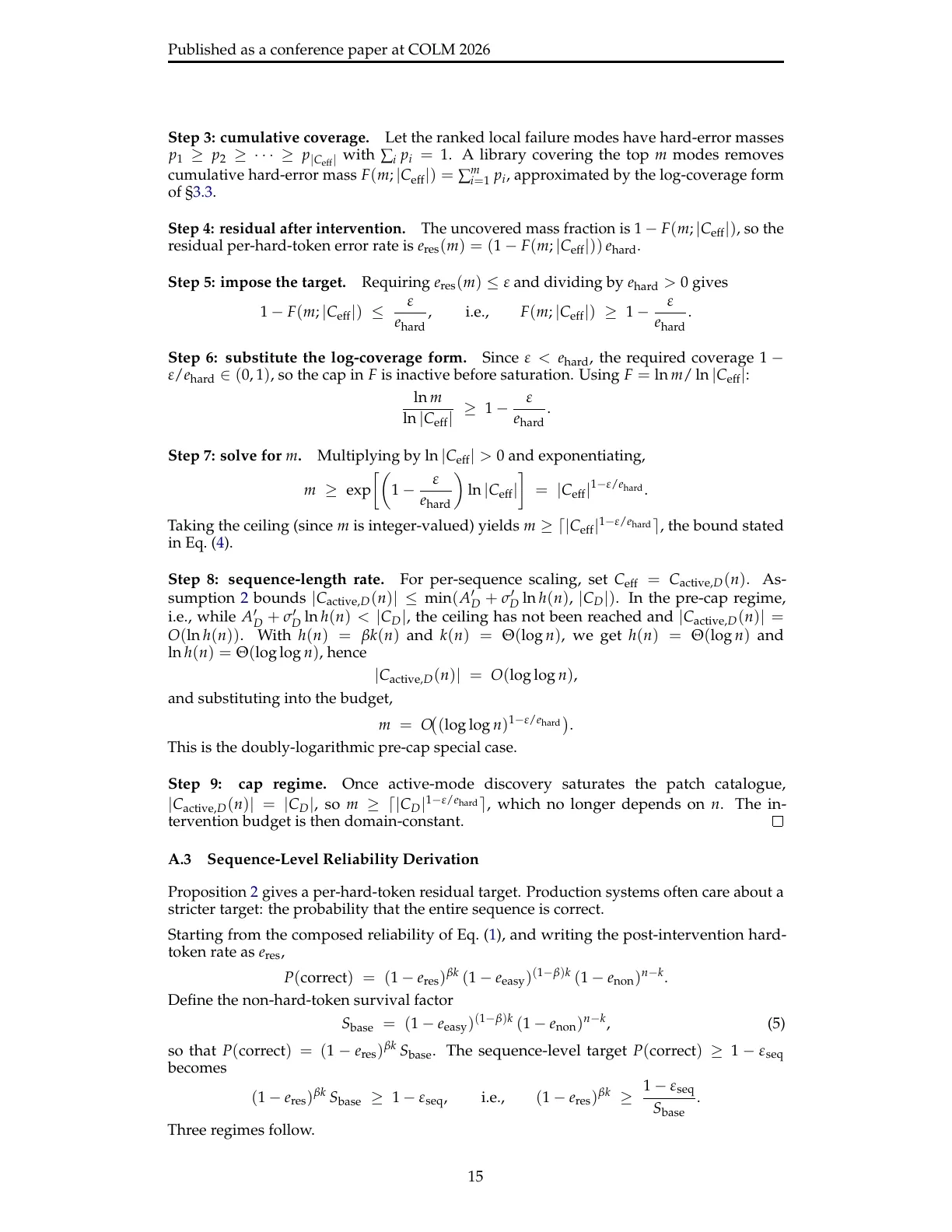
Step 1: define the target. Let e hard be the baseline hard-token error rate and ε ∈ ( 0, e hard )
the target after intervention.

Step 2: define the effective catalogue. For per-sequence scaling, set C eff = C active,D ( n ) :
how many failure modes can a single sequence of length n activate? For full deploymentlibrary budgeting, set C eff = C D : how large must the library be to cover the recurring failure
modes reachable inside D?

14
Text of page 15
Published as a conference paper at COLM 2026

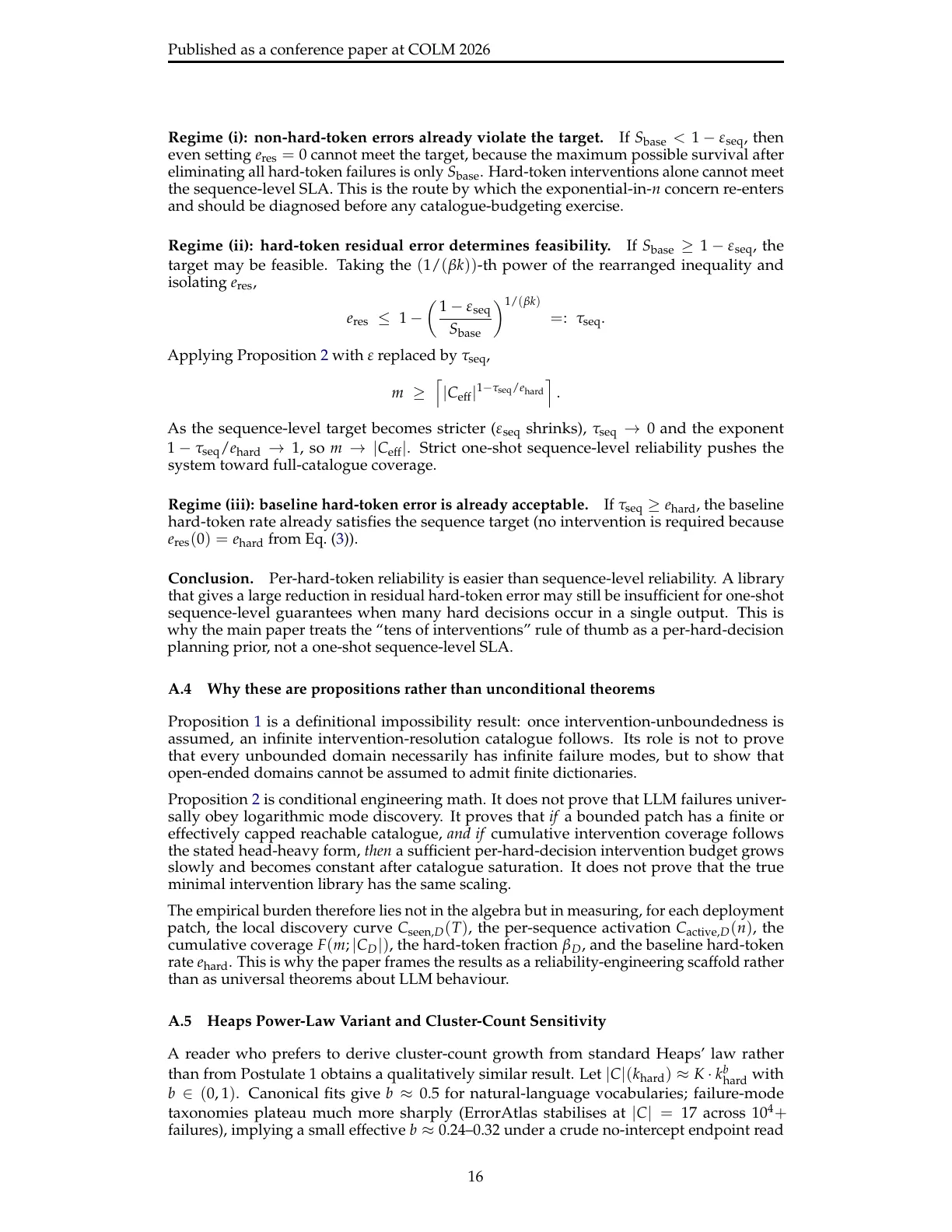
Step 3: cumulative coverage. Let the ranked local failure modes have hard-error masses
p 1 ≥ p 2 ≥ · · · ≥ p | C eff | with ∑ i p i = 1. A library covering the top m modes removes
cumulative hard-error mass F ( m; | C eff |) = ∑ i m = 1 p i , approximated by the log-coverage form
of §3.3.

Step 4: residual after intervention. The uncovered mass fraction is 1 − F ( m; | C eff |) , so the
residual per-hard-token error rate is e res ( m ) = ( 1 − F ( m; | C eff |)) e hard .

Requiring e res ( m ) ≤ ε and dividing by e hard > 0 gives
ε
ε
1 − F ( m; | C eff |) ≤
,
i.e.,
F ( m; | C eff |) ≥ 1 −
.
e hard
e hard

Step 5: impose the target.

Step 6: substitute the log-coverage form. Since ε < e hard , the required coverage 1 −
ε/e hard ∈ ( 0, 1 ) , so the cap in F is inactive before saturation. Using F = ln m/ ln | C eff | :
ln m
ε
≥ 1 −
.
ln | C eff |
e hard

Step 7: solve for m.

Multiplying by ln | C eff | > 0 and exponentiating,
ε
ln | C eff | = | C eff | 1 − ε/e hard .
m ≥ exp 1 −
e hard

Taking the ceiling (since m is integer-valued) yields m ≥ ⌈| C eff | 1 − ε/e hard ⌉ , the bound stated
in Eq. (4).

Step 8: sequence-length rate. For per-sequence scaling, set C eff = C active,D ( n ) . As-
′ ln h ( n ) , | C |) . In the pre-cap regime,
sumption 2 bounds | C active,D ( n )| ≤ min ( A ′ D + σ D
D
′ ln h ( n ) < | C | , the ceiling has not been reached and | C
i.e., while A ′ D + σ D
D
active,D ( n )| =
O ( ln h ( n )) . With h ( n ) = βk ( n ) and k ( n ) = Θ ( log n ) , we get h ( n ) = Θ ( log n ) and
ln h ( n ) = Θ ( log log n ) , hence
| C active,D ( n )| = O ( log log n ) ,
and substituting into the budget,
m = O ( log log n ) 1 − ε/e hard .
This is the doubly-logarithmic pre-cap special case.

Step 9: cap regime. Once active-mode discovery saturates the patch catalogue,
| C active,D ( n )| = | C D | , so m ≥ ⌈| C D | 1 − ε/e hard ⌉ , which no longer depends on n. The intervention budget is then domain-constant.

A.3

Sequence-Level Reliability Derivation

Proposition 2 gives a per-hard-token residual target. Production systems often care about a
stricter target: the probability that the entire sequence is correct.

Starting from the composed reliability of Eq. (1), and writing the post-intervention hardtoken rate as e res ,

P ( correct ) = ( 1 − e res ) βk ( 1 − e easy ) ( 1 − β ) k ( 1 − e non ) n − k .
Define the non-hard-token survival factor
S base = ( 1 − e easy ) ( 1 − β ) k ( 1 − e non ) n − k ,

so that P ( correct ) = ( 1 − e res
becomes

) βk S

base .

(5)

The sequence-level target P ( correct ) ≥ 1 − ε seq

( 1 − e res ) βk S base ≥ 1 − ε seq ,

i.e.,

Three regimes follow.

15

( 1 − e res ) βk ≥

1 − ε seq
.
S base
Text of page 16
Published as a conference paper at COLM 2026

Regime (i): non-hard-token errors already violate the target. If S base < 1 − ε seq , then
even setting e res = 0 cannot meet the target, because the maximum possible survival after
eliminating all hard-token failures is only S base . Hard-token interventions alone cannot meet
the sequence-level SLA. This is the route by which the exponential-in-n concern re-enters
and should be diagnosed before any catalogue-budgeting exercise.

Regime (ii): hard-token residual error determines feasibility. If S base ≥ 1 − ε seq , the
target may be feasible. Taking the ( 1/ ( βk )) -th power of the rearranged inequality and
isolating e res ,
1 − ε seq 1/ ( βk )
e res ≤ 1 −
= : τ seq .
S base

Applying Proposition 2 with ε replaced by τ seq ,
l
m
m ≥ | C eff | 1 − τ seq /e hard .

As the sequence-level target becomes stricter (ε seq shrinks), τ seq → 0 and the exponent
1 − τ seq /e hard → 1, so m → | C eff | . Strict one-shot sequence-level reliability pushes the
system toward full-catalogue coverage.

Regime (iii): baseline hard-token error is already acceptable. If τ seq ≥ e hard , the baseline
hard-token rate already satisfies the sequence target (no intervention is required because
e res ( 0 ) = e hard from Eq. (3)).

Conclusion. Per-hard-token reliability is easier than sequence-level reliability. A library
that gives a large reduction in residual hard-token error may still be insufficient for one-shot
sequence-level guarantees when many hard decisions occur in a single output. This is
why the main paper treats the “tens of interventions” rule of thumb as a per-hard-decision
planning prior, not a one-shot sequence-level SLA.

A.4

Why these are propositions rather than unconditional theorems

Proposition 1 is a definitional impossibility result: once intervention-unboundedness is
assumed, an infinite intervention-resolution catalogue follows. Its role is not to prove
that every unbounded domain necessarily has infinite failure modes, but to show that
open-ended domains cannot be assumed to admit finite dictionaries.

Proposition 2 is conditional engineering math. It does not prove that LLM failures universally obey logarithmic mode discovery. It proves that if a bounded patch has a finite or
effectively capped reachable catalogue, and if cumulative intervention coverage follows
the stated head-heavy form, then a sufficient per-hard-decision intervention budget grows
slowly and becomes constant after catalogue saturation. It does not prove that the true
minimal intervention library has the same scaling.

The empirical burden therefore lies not in the algebra but in measuring, for each deployment
patch, the local discovery curve C seen,D ( T ) , the per-sequence activation C active,D ( n ) , the
cumulative coverage F ( m; | C D |) , the hard-token fraction β D , and the baseline hard-token
rate e hard . This is why the paper frames the results as a reliability-engineering scaffold rather
than as universal theorems about LLM behaviour.

A.5

Heaps Power-Law Variant and Cluster-Count Sensitivity

A reader who prefers to derive cluster-count growth from standard Heaps’ law rather
than from Postulate 1 obtains a qualitatively similar result. Let | C |( k hard ) ≈ K · k b hard with
b ∈ ( 0, 1 ) . Canonical fits give b ≈ 0.5 for natural-language vocabularies; failure-mode
taxonomies plateau much more sharply (ErrorAtlas stabilises at | C | = 17 across 10 4 +
failures), implying a small effective b ≈ 0.24–0.32 under a crude no-intercept endpoint read

16
Text of page 17
Published as a conference paper at COLM 2026

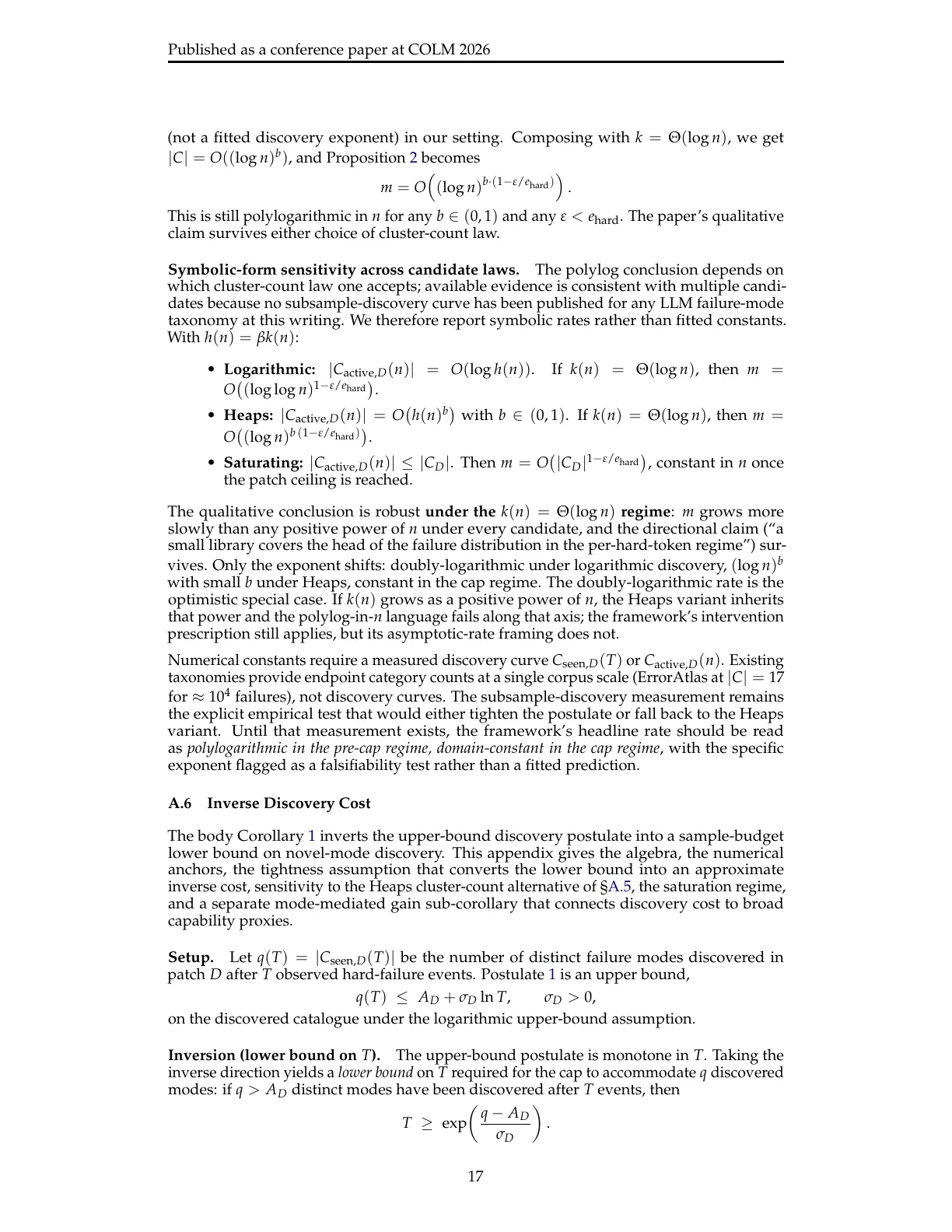
(not a fitted discovery exponent) in our setting. Composing with k = Θ ( log n ) , we get
| C | = O (( log n ) b ) , and Proposition 2 becomes
m = O ( log n ) b ·( 1 − ε/e hard ) .

This is still polylogarithmic in n for any b ∈ ( 0, 1 ) and any ε < e hard . The paper’s qualitative
claim survives either choice of cluster-count law.

Symbolic-form sensitivity across candidate laws. The polylog conclusion depends on
which cluster-count law one accepts; available evidence is consistent with multiple candidates because no subsample-discovery curve has been published for any LLM failure-mode
taxonomy at this writing. We therefore report symbolic rates rather than fitted constants.
With h ( n ) = βk ( n ) :

• Logarithmic: | C active,D ( n )| = O ( log h ( n )) . If k ( n ) = Θ ( log n ) , then m =
O ( log log n ) 1 − ε/e hard .
• Heaps: | C active,D ( n )| = O h ( n ) b with b ∈ ( 0, 1 ) . If k ( n ) = Θ ( log n ) , then m =
O ( log n ) b ( 1 − ε/e hard ) .
• Saturating: | C active,D ( n )| ≤ | C D | . Then m = O | C D | 1 − ε/e hard , constant in n once
the patch ceiling is reached.

The qualitative conclusion is robust under the k ( n ) = Θ ( log n ) regime: m grows more
slowly than any positive power of n under every candidate, and the directional claim (“a
small library covers the head of the failure distribution in the per-hard-token regime”) survives. Only the exponent shifts: doubly-logarithmic under logarithmic discovery, ( log n ) b
with small b under Heaps, constant in the cap regime. The doubly-logarithmic rate is the
optimistic special case. If k ( n ) grows as a positive power of n, the Heaps variant inherits
that power and the polylog-in-n language fails along that axis; the framework’s intervention
prescription still applies, but its asymptotic-rate framing does not.

Numerical constants require a measured discovery curve C seen,D ( T ) or C active,D ( n ) . Existing
taxonomies provide endpoint category counts at a single corpus scale (ErrorAtlas at | C | = 17
for ≈ 10 4 failures), not discovery curves. The subsample-discovery measurement remains
the explicit empirical test that would either tighten the postulate or fall back to the Heaps
variant. Until that measurement exists, the framework’s headline rate should be read
as polylogarithmic in the pre-cap regime, domain-constant in the cap regime, with the specific
exponent flagged as a falsifiability test rather than a fitted prediction.

A.6

Inverse Discovery Cost

The body Corollary 1 inverts the upper-bound discovery postulate into a sample-budget
lower bound on novel-mode discovery. This appendix gives the algebra, the numerical
anchors, the tightness assumption that converts the lower bound into an approximate
inverse cost, sensitivity to the Heaps cluster-count alternative of §A.5, the saturation regime,
and a separate mode-mediated gain sub-corollary that connects discovery cost to broad
capability proxies.

Setup. Let q ( T ) = | C seen,D ( T )| be the number of distinct failure modes discovered in
patch D after T observed hard-failure events. Postulate 1 is an upper bound,
q ( T ) ≤ A D + σ D ln T,
σ D > 0,
on the discovered catalogue under the logarithmic upper-bound assumption.

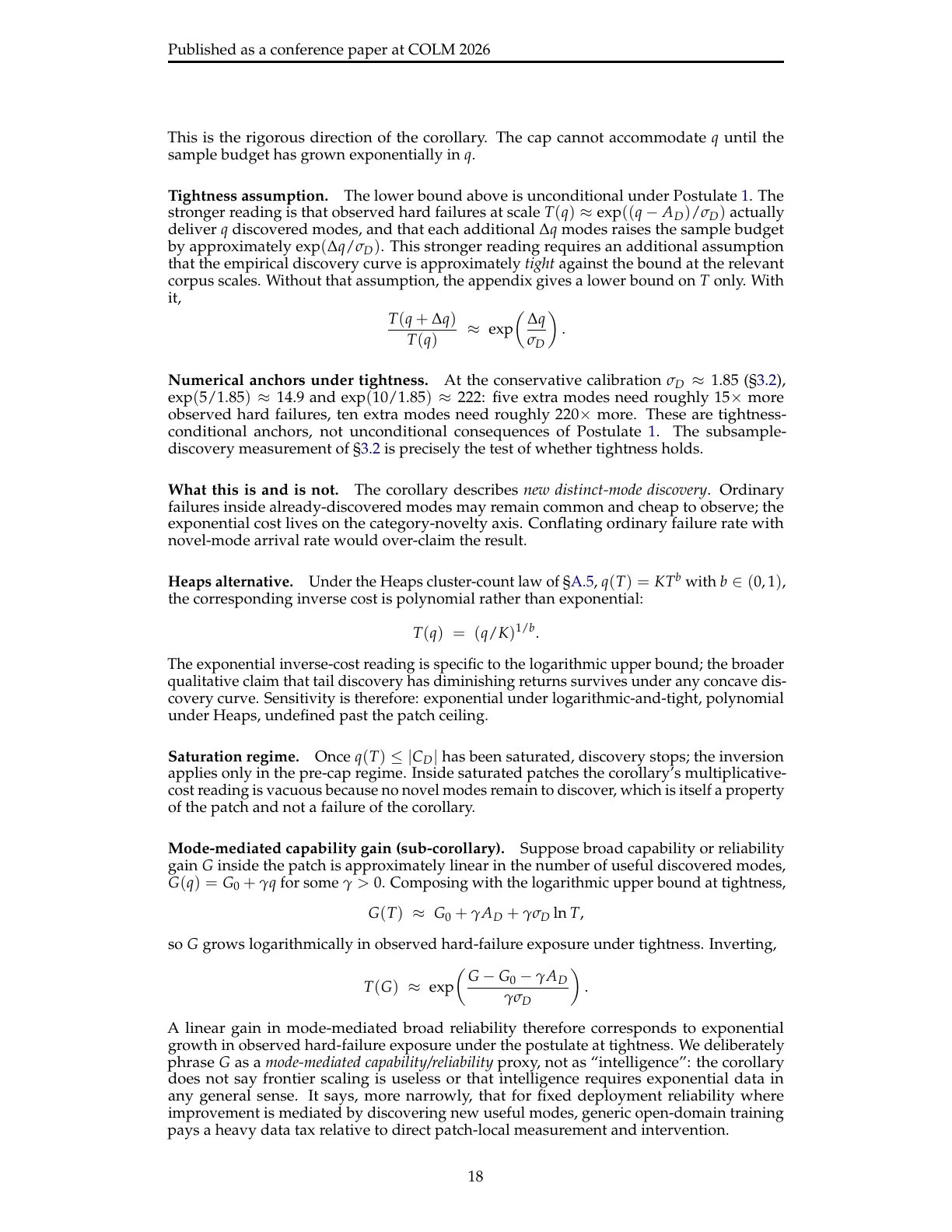
Inversion (lower bound on T). The upper-bound postulate is monotone in T. Taking the
inverse direction yields a lower bound on T required for the cap to accommodate q discovered
modes: if q > A D distinct modes have been discovered after T events, then
q − A D
T ≥ exp
.
σ D

17
Text of page 18
Published as a conference paper at COLM 2026

This is the rigorous direction of the corollary. The cap cannot accommodate q until the
sample budget has grown exponentially in q.

Tightness assumption. The lower bound above is unconditional under Postulate 1. The
stronger reading is that observed hard failures at scale T ( q ) ≈ exp (( q − A D ) /σ D ) actually
deliver q discovered modes, and that each additional ∆q modes raises the sample budget
by approximately exp ( ∆q/σ D ) . This stronger reading requires an additional assumption
that the empirical discovery curve is approximately tight against the bound at the relevant
corpus scales. Without that assumption, the appendix gives a lower bound on T only. With
it,
∆q
T ( q + ∆q )
≈ exp
.
T ( q )
σ D

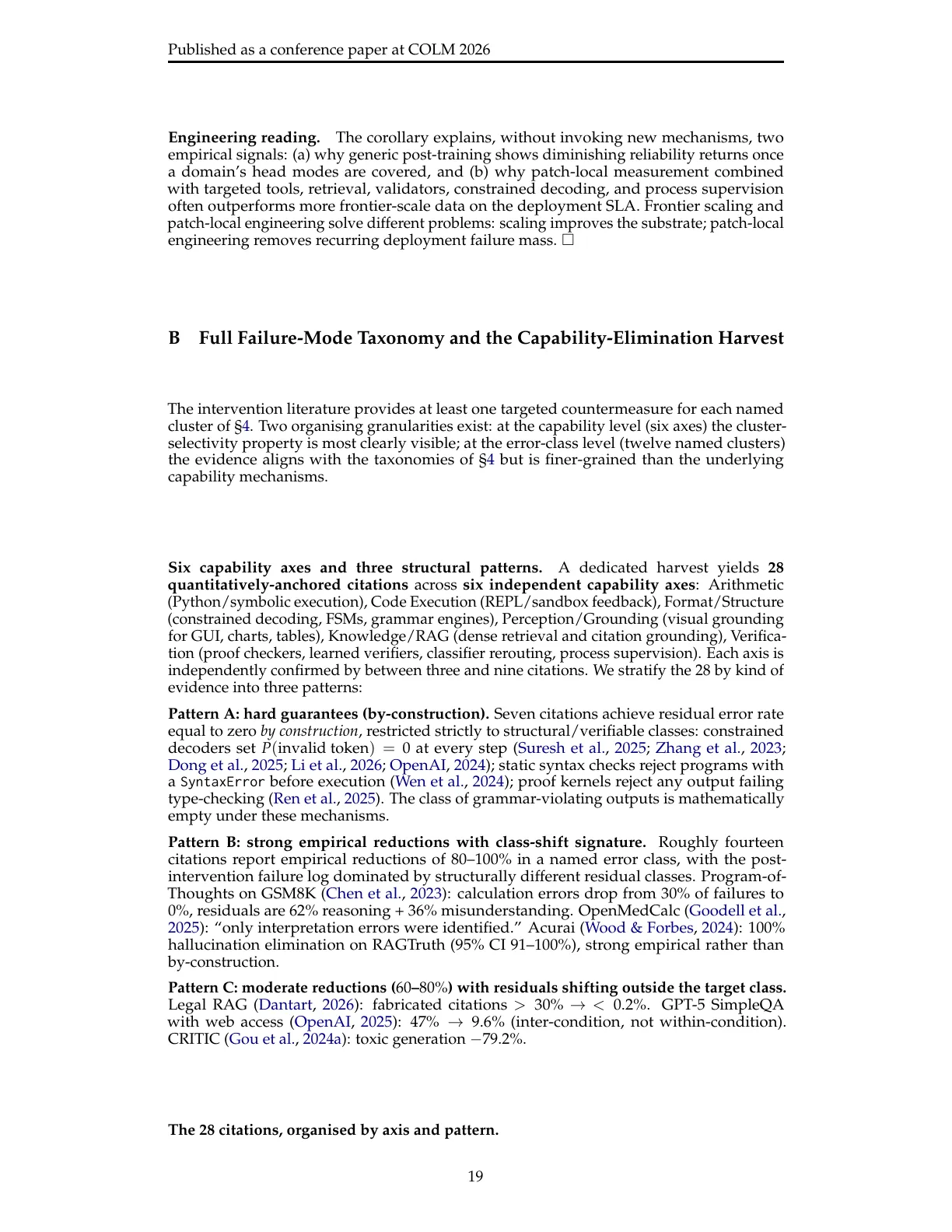
Numerical anchors under tightness. At the conservative calibration σ D ≈ 1.85 (§3.2),
exp ( 5/1.85 ) ≈ 14.9 and exp ( 10/1.85 ) ≈ 222: five extra modes need roughly 15 × more
observed hard failures, ten extra modes need roughly 220 × more. These are tightnessconditional anchors, not unconditional consequences of Postulate 1. The subsamplediscovery measurement of §3.2 is precisely the test of whether tightness holds.

What this is and is not. The corollary describes new distinct-mode discovery. Ordinary
failures inside already-discovered modes may remain common and cheap to observe; the
exponential cost lives on the category-novelty axis. Conflating ordinary failure rate with
novel-mode arrival rate would over-claim the result.

Heaps alternative. Under the Heaps cluster-count law of §A.5, q ( T ) = KT b with b ∈ ( 0, 1 ) ,
the corresponding inverse cost is polynomial rather than exponential:

T ( q ) = ( q/K ) 1/b .

The exponential inverse-cost reading is specific to the logarithmic upper bound; the broader
qualitative claim that tail discovery has diminishing returns survives under any concave discovery curve. Sensitivity is therefore: exponential under logarithmic-and-tight, polynomial
under Heaps, undefined past the patch ceiling.

Saturation regime. Once q ( T ) ≤ | C D | has been saturated, discovery stops; the inversion
applies only in the pre-cap regime. Inside saturated patches the corollary’s multiplicativecost reading is vacuous because no novel modes remain to discover, which is itself a property
of the patch and not a failure of the corollary.

Mode-mediated capability gain (sub-corollary). Suppose broad capability or reliability
gain G inside the patch is approximately linear in the number of useful discovered modes,
G ( q ) = G 0 + γq for some γ > 0. Composing with the logarithmic upper bound at tightness,

G ( T ) ≈ G 0 + γA D + γσ D ln T,

so G grows logarithmically in observed hard-failure exposure under tightness. Inverting,
G − G 0 − γA D
T ( G ) ≈ exp
.
γσ D

A linear gain in mode-mediated broad reliability therefore corresponds to exponential
growth in observed hard-failure exposure under the postulate at tightness. We deliberately
phrase G as a mode-mediated capability/reliability proxy, not as “intelligence”: the corollary
does not say frontier scaling is useless or that intelligence requires exponential data in
any general sense. It says, more narrowly, that for fixed deployment reliability where
improvement is mediated by discovering new useful modes, generic open-domain training
pays a heavy data tax relative to direct patch-local measurement and intervention.

18
Text of page 19
Published as a conference paper at COLM 2026

Engineering reading. The corollary explains, without invoking new mechanisms, two
empirical signals: (a) why generic post-training shows diminishing reliability returns once
a domain’s head modes are covered, and (b) why patch-local measurement combined
with targeted tools, retrieval, validators, constrained decoding, and process supervision
often outperforms more frontier-scale data on the deployment SLA. Frontier scaling and
patch-local engineering solve different problems: scaling improves the substrate; patch-local
engineering removes recurring deployment failure mass. □

B Full Failure-Mode Taxonomy and the Capability-Elimination Harvest

The intervention literature provides at least one targeted countermeasure for each named
cluster of §4. Two organising granularities exist: at the capability level (six axes) the clusterselectivity property is most clearly visible; at the error-class level (twelve named clusters)
the evidence aligns with the taxonomies of §4 but is finer-grained than the underlying
capability mechanisms.

Six capability axes and three structural patterns. A dedicated harvest yields 28
quantitatively-anchored citations across six independent capability axes: Arithmetic
(Python/symbolic execution), Code Execution (REPL/sandbox feedback), Format/Structure
(constrained decoding, FSMs, grammar engines), Perception/Grounding (visual grounding
for GUI, charts, tables), Knowledge/RAG (dense retrieval and citation grounding), Verification (proof checkers, learned verifiers, classifier rerouting, process supervision). Each axis is
independently confirmed by between three and nine citations. We stratify the 28 by kind of
evidence into three patterns:

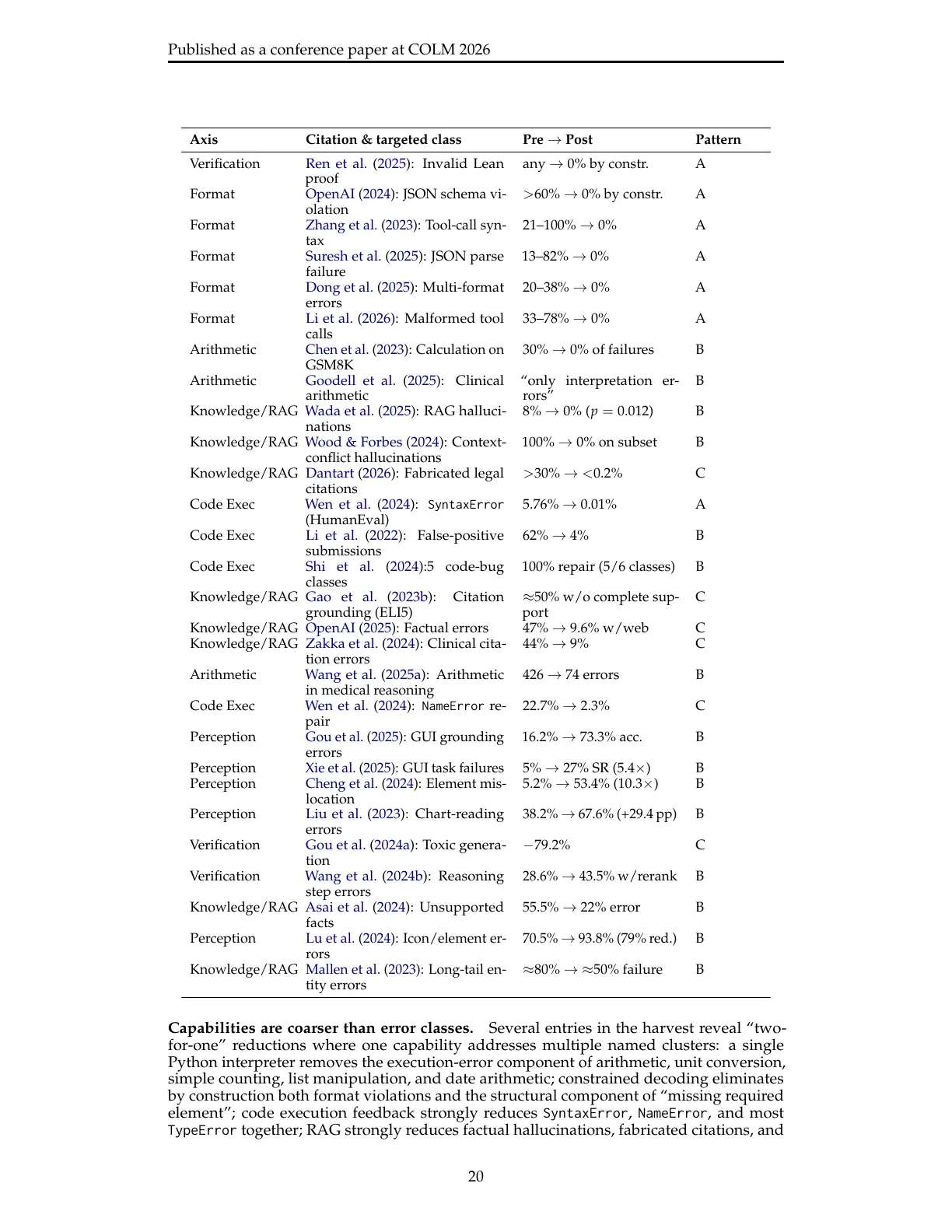
Pattern A: hard guarantees (by-construction). Seven citations achieve residual error rate
equal to zero by construction, restricted strictly to structural/verifiable classes: constrained
decoders set P ( invalid token ) = 0 at every step (Suresh et al., 2025; Zhang et al., 2023;
Dong et al., 2025; Li et al., 2026; OpenAI, 2024); static syntax checks reject programs with
a SyntaxError before execution (Wen et al., 2024); proof kernels reject any output failing
type-checking (Ren et al., 2025). The class of grammar-violating outputs is mathematically
empty under these mechanisms.

Pattern B: strong empirical reductions with class-shift signature. Roughly fourteen
citations report empirical reductions of 80–100% in a named error class, with the postintervention failure log dominated by structurally different residual classes. Program-of-
Thoughts on GSM8K (Chen et al., 2023): calculation errors drop from 30% of failures to
0%, residuals are 62% reasoning + 36% misunderstanding. OpenMedCalc (Goodell et al.,
2025): “only interpretation errors were identified.” Acurai (Wood & Forbes, 2024): 100%
hallucination elimination on RAGTruth (95% CI 91–100%), strong empirical rather than
by-construction.

Pattern C: moderate reductions (60–80%) with residuals shifting outside the target class.
Legal RAG (Dantart, 2026): fabricated citations > 30% → < 0.2%. GPT-5 SimpleQA
with web access (OpenAI, 2025): 47% → 9.6% (inter-condition, not within-condition).
CRITIC (Gou et al., 2024a): toxic generation − 79.2%.

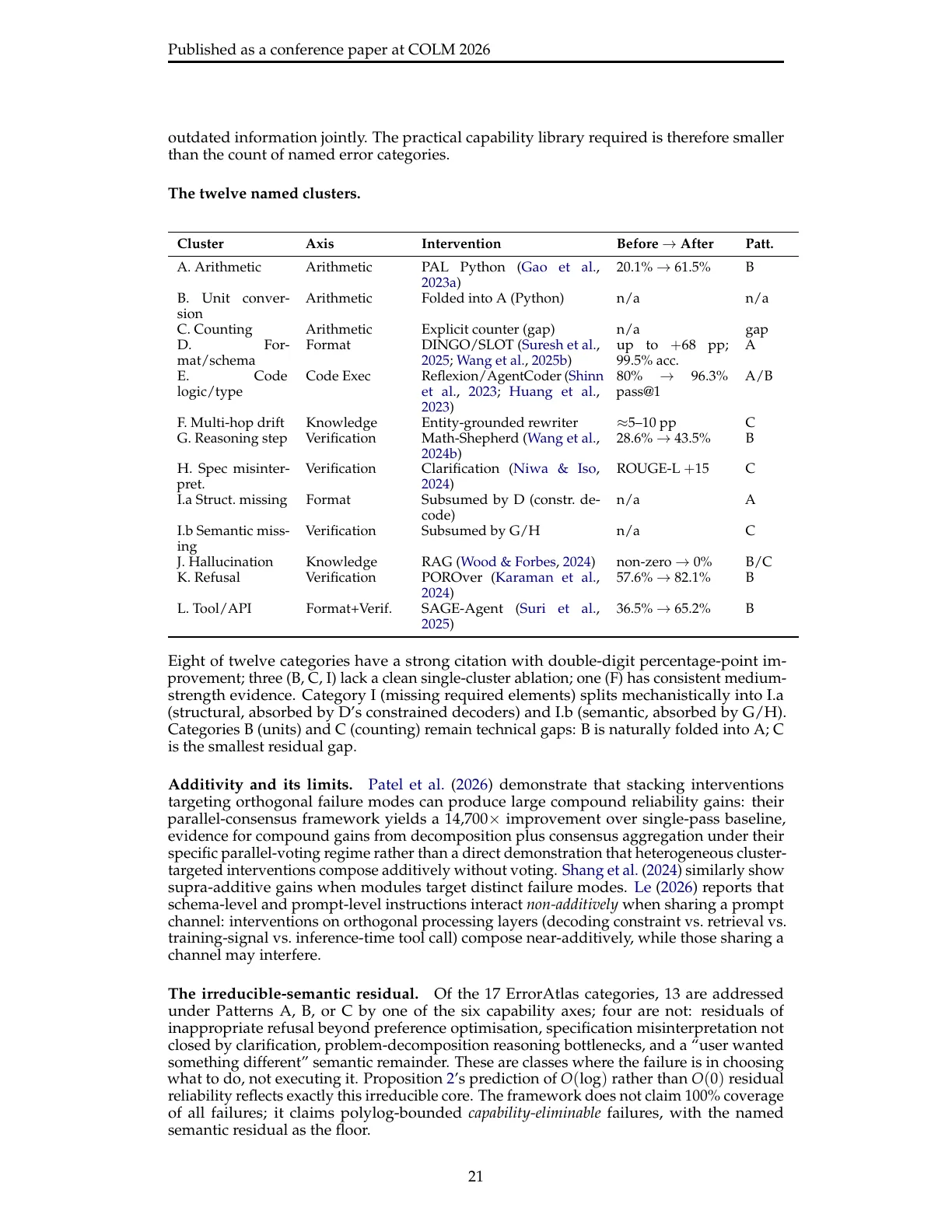
The 28 citations, organised by axis and pattern.

19
Text of page 20
Published as a conference paper at COLM 2026

Axis

Citation & targeted class

Verification

Ren et al. (2025): Invalid Lean
proof
Format
OpenAI (2024): JSON schema violation
Format
Zhang et al. (2023): Tool-call syntax
Suresh et al. (2025): JSON parse
Format
failure
Format
Dong et al. (2025): Multi-format
errors
Format
Li et al. (2026): Malformed tool
calls
Arithmetic
Chen et al. (2023): Calculation on
GSM8K
Arithmetic
Goodell et al. (2025): Clinical
arithmetic
Knowledge/RAG Wada et al. (2025): RAG hallucinations
Knowledge/RAG Wood & Forbes (2024): Contextconflict hallucinations
Knowledge/RAG Dantart (2026): Fabricated legal
citations
Code Exec
Wen et al. (2024): SyntaxError
(HumanEval)
Li et al. (2022): False-positive
Code Exec
submissions
Code Exec
Shi et al. (2024):5 code-bug
classes
Knowledge/RAG Gao et al. (2023b): Citation
grounding (ELI5)
Knowledge/RAG OpenAI (2025): Factual errors
Knowledge/RAG Zakka et al. (2024): Clinical citation errors
Arithmetic
Wang et al. (2025a): Arithmetic
in medical reasoning
Code Exec
Wen et al. (2024): NameError repair
Perception
Gou et al. (2025): GUI grounding
errors
Perception
Xie et al. (2025): GUI task failures
Cheng et al. (2024): Element mis-
Perception
location
Perception
Liu et al. (2023): Chart-reading
errors
Verification
Gou et al. (2024a): Toxic generation
Verification
Wang et al. (2024b): Reasoning
step errors
Knowledge/RAG Asai et al. (2024): Unsupported
facts
Perception
Lu et al. (2024): Icon/element errors
Knowledge/RAG Mallen et al. (2023): Long-tail entity errors

Pre → Post

Pattern

any → 0% by constr.

A

> 60% → 0% by constr.

A

21–100% → 0%

A

13–82% → 0%

A

20–38% → 0%

A

33–78% → 0%

A

30% → 0% of failures

B

“only interpretation errors”
8% → 0% (p = 0.012)

B

B

100% → 0% on subset

B

> 30% → < 0.2%

C

5.76% → 0.01%

A

62% → 4%

B

100% repair (5/6 classes)

B

≈ 50% w/o complete support
47% → 9.6% w/web
44% → 9%

C

C
C

426 → 74 errors

B

22.7% → 2.3%

C

16.2% → 73.3% acc.

B

5% → 27% SR (5.4 × )
5.2% → 53.4% (10.3 × )

B
B

38.2% → 67.6% (+29.4 pp)

B

− 79.2%

C

28.6% → 43.5% w/rerank

B

55.5% → 22% error

B

70.5% → 93.8% (79% red.)

B

≈ 80% → ≈ 50% failure

B

Capabilities are coarser than error classes. Several entries in the harvest reveal “twofor-one” reductions where one capability addresses multiple named clusters: a single
Python interpreter removes the execution-error component of arithmetic, unit conversion,
simple counting, list manipulation, and date arithmetic; constrained decoding eliminates
by construction both format violations and the structural component of “missing required
element”; code execution feedback strongly reduces SyntaxError, NameError, and most
TypeError together; RAG strongly reduces factual hallucinations, fabricated citations, and

20
Text of page 21
Published as a conference paper at COLM 2026

outdated information jointly. The practical capability library required is therefore smaller
than the count of named error categories.

The twelve named clusters.

Cluster

Axis

Intervention

Before → After

Patt.

A. Arithmetic

Arithmetic

20.1% → 61.5%

B

B. Unit conversion
C. Counting
D.
Format/schema
E.
Code
logic/type

Arithmetic

PAL Python (Gao et al.,
2023a)
Folded into A (Python)

n/a

n/a

n/a
up to + 68 pp;
99.5% acc.
80% → 96.3%
pass@1

gap
A

F. Multi-hop drift
G. Reasoning step

Knowledge
Verification

≈ 5–10 pp
28.6% → 43.5%

C
B

H. Spec misinterpret.
I.a Struct. missing

Verification

ROUGE-L + 15

C

n/a

A

I.b Semantic missing
J. Hallucination
K. Refusal

Verification

Explicit counter (gap)
DINGO/SLOT (Suresh et al.,
2025; Wang et al., 2025b)
Reflexion/AgentCoder (Shinn
et al., 2023; Huang et al.,
2023)
Entity-grounded rewriter
Math-Shepherd (Wang et al.,
2024b)
Clarification (Niwa & Iso,
2024)
Subsumed by D (constr. decode)
Subsumed by G/H

n/a

C

non-zero → 0%
57.6% → 82.1%

B/C
B

L. Tool/API

Format+Verif.

RAG (Wood & Forbes, 2024)
POROver (Karaman et al.,
2024)
SAGE-Agent (Suri et al.,
2025)

36.5% → 65.2%

B

Arithmetic
Format

Code Exec

Format

Knowledge
Verification

A/B

Eight of twelve categories have a strong citation with double-digit percentage-point improvement; three (B, C, I) lack a clean single-cluster ablation; one (F) has consistent mediumstrength evidence. Category I (missing required elements) splits mechanistically into I.a
(structural, absorbed by D’s constrained decoders) and I.b (semantic, absorbed by G/H).
Categories B (units) and C (counting) remain technical gaps: B is naturally folded into A; C
is the smallest residual gap.

Additivity and its limits. Patel et al. (2026) demonstrate that stacking interventions
targeting orthogonal failure modes can produce large compound reliability gains: their
parallel-consensus framework yields a 14,700 × improvement over single-pass baseline,
evidence for compound gains from decomposition plus consensus aggregation under their
specific parallel-voting regime rather than a direct demonstration that heterogeneous clustertargeted interventions compose additively without voting. Shang et al. (2024) similarly show
supra-additive gains when modules target distinct failure modes. Le (2026) reports that
schema-level and prompt-level instructions interact non-additively when sharing a prompt
channel: interventions on orthogonal processing layers (decoding constraint vs. retrieval vs.
training-signal vs. inference-time tool call) compose near-additively, while those sharing a
channel may interfere.

The irreducible-semantic residual. Of the 17 ErrorAtlas categories, 13 are addressed
under Patterns A, B, or C by one of the six capability axes; four are not: residuals of
inappropriate refusal beyond preference optimisation, specification misinterpretation not
closed by clarification, problem-decomposition reasoning bottlenecks, and a “user wanted
something different” semantic remainder. These are classes where the failure is in choosing
what to do, not executing it. Proposition 2’s prediction of O ( log ) rather than O ( 0 ) residual
reliability reflects exactly this irreducible core. The framework does not claim 100% coverage
of all failures; it claims polylog-bounded capability-eliminable failures, with the named
semantic residual as the floor.

21
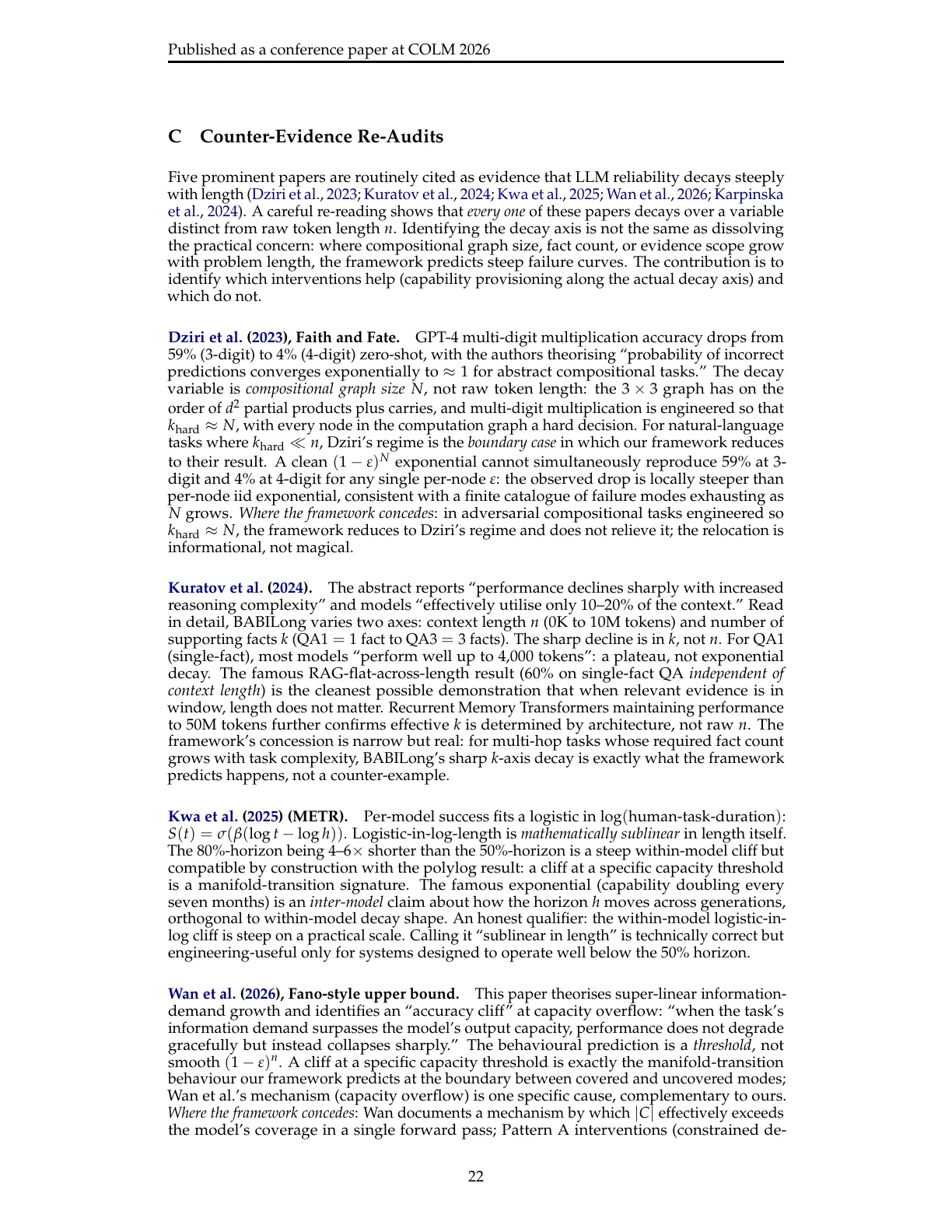
Text of page 22
Published as a conference paper at COLM 2026

C

Counter-Evidence Re-Audits

Five prominent papers are routinely cited as evidence that LLM reliability decays steeply
with length (Dziri et al., 2023; Kuratov et al., 2024; Kwa et al., 2025; Wan et al., 2026; Karpinska
et al., 2024). A careful re-reading shows that every one of these papers decays over a variable
distinct from raw token length n. Identifying the decay axis is not the same as dissolving
the practical concern: where compositional graph size, fact count, or evidence scope grow
with problem length, the framework predicts steep failure curves. The contribution is to
identify which interventions help (capability provisioning along the actual decay axis) and
which do not.

Dziri et al. (2023), Faith and Fate. GPT-4 multi-digit multiplication accuracy drops from
59% (3-digit) to 4% (4-digit) zero-shot, with the authors theorising “probability of incorrect
predictions converges exponentially to ≈ 1 for abstract compositional tasks.” The decay
variable is compositional graph size N, not raw token length: the 3 × 3 graph has on the
order of d 2 partial products plus carries, and multi-digit multiplication is engineered so that
k hard ≈ N, with every node in the computation graph a hard decision. For natural-language
tasks where k hard ≪ n, Dziri’s regime is the boundary case in which our framework reduces
to their result. A clean ( 1 − ε ) N exponential cannot simultaneously reproduce 59% at 3digit and 4% at 4-digit for any single per-node ε: the observed drop is locally steeper than
per-node iid exponential, consistent with a finite catalogue of failure modes exhausting as
N grows. Where the framework concedes: in adversarial compositional tasks engineered so
k hard ≈ N, the framework reduces to Dziri’s regime and does not relieve it; the relocation is
informational, not magical.

Kuratov et al. (2024). The abstract reports “performance declines sharply with increased
reasoning complexity” and models “effectively utilise only 10–20% of the context.” Read
in detail, BABILong varies two axes: context length n (0K to 10M tokens) and number of
supporting facts k (QA1 = 1 fact to QA3 = 3 facts). The sharp decline is in k, not n. For QA1
(single-fact), most models “perform well up to 4,000 tokens”: a plateau, not exponential
decay. The famous RAG-flat-across-length result (60% on single-fact QA independent of
context length) is the cleanest possible demonstration that when relevant evidence is in
window, length does not matter. Recurrent Memory Transformers maintaining performance
to 50M tokens further confirms effective k is determined by architecture, not raw n. The
framework’s concession is narrow but real: for multi-hop tasks whose required fact count
grows with task complexity, BABILong’s sharp k-axis decay is exactly what the framework
predicts happens, not a counter-example.

Kwa et al. (2025) (METR). Per-model success fits a logistic in log ( human-task-duration ) :
S ( t ) = σ ( β ( log t − log h )) . Logistic-in-log-length is mathematically sublinear in length itself.
The 80%-horizon being 4–6 × shorter than the 50%-horizon is a steep within-model cliff but
compatible by construction with the polylog result: a cliff at a specific capacity threshold
is a manifold-transition signature. The famous exponential (capability doubling every
seven months) is an inter-model claim about how the horizon h moves across generations,
orthogonal to within-model decay shape. An honest qualifier: the within-model logistic-in-log cliff is steep on a practical scale. Calling it “sublinear in length” is technically correct but
engineering-useful only for systems designed to operate well below the 50% horizon.

Wan et al. (2026), Fano-style upper bound. This paper theorises super-linear informationdemand growth and identifies an “accuracy cliff” at capacity overflow: “when the task’s
information demand surpasses the model’s output capacity, performance does not degrade
gracefully but instead collapses sharply.” The behavioural prediction is a threshold, not
smooth ( 1 − ε ) n . A cliff at a specific capacity threshold is exactly the manifold-transition
behaviour our framework predicts at the boundary between covered and uncovered modes;
Wan et al.’s mechanism (capacity overflow) is one specific cause, complementary to ours.
Where the framework concedes: Wan documents a mechanism by which | C | effectively exceeds
the model’s coverage in a single forward pass; Pattern A interventions (constrained de-

22
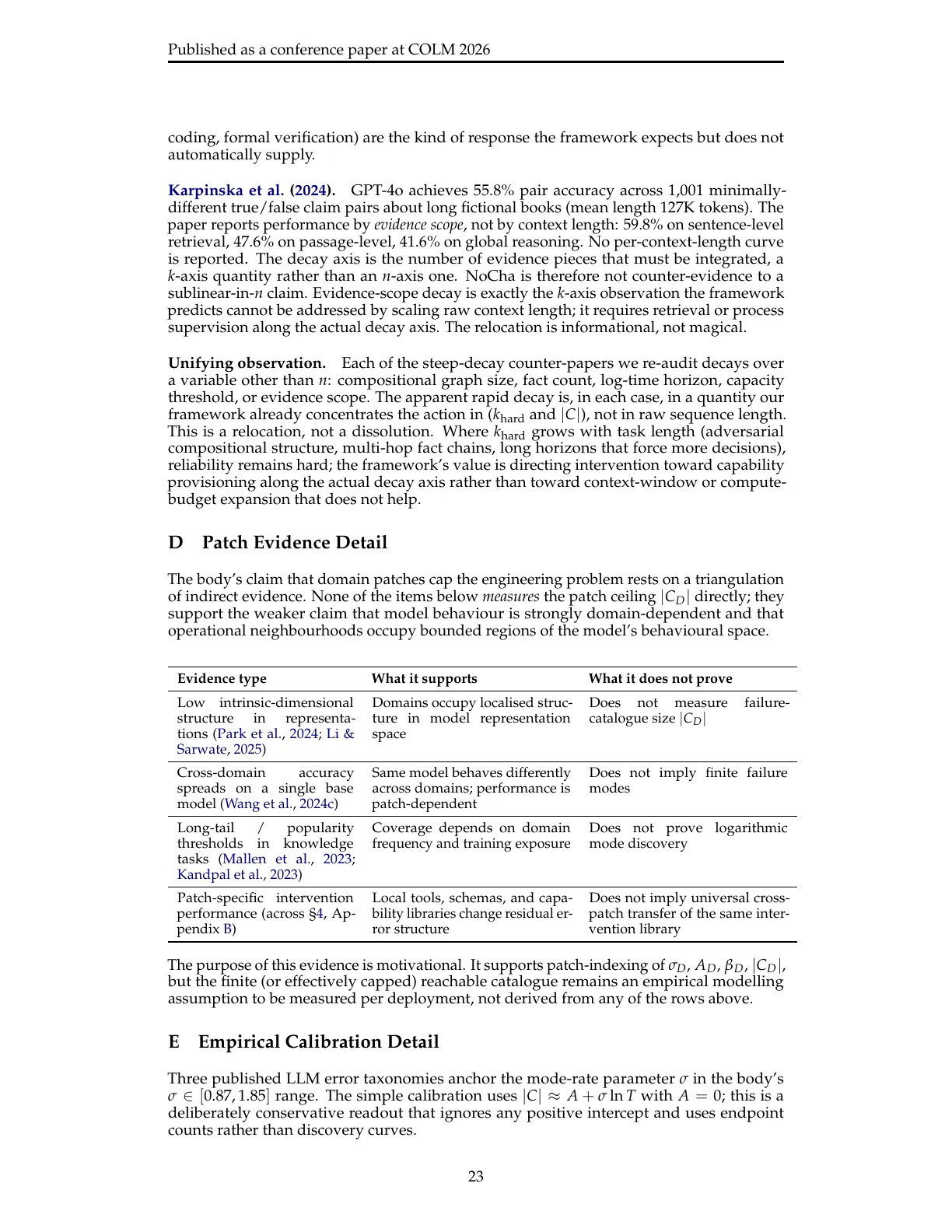
Text of page 23
Published as a conference paper at COLM 2026

coding, formal verification) are the kind of response the framework expects but does not
automatically supply.

Karpinska et al. (2024). GPT-4o achieves 55.8% pair accuracy across 1,001 minimallydifferent true/false claim pairs about long fictional books (mean length 127K tokens). The
paper reports performance by evidence scope, not by context length: 59.8% on sentence-level
retrieval, 47.6% on passage-level, 41.6% on global reasoning. No per-context-length curve
is reported. The decay axis is the number of evidence pieces that must be integrated, a
k-axis quantity rather than an n-axis one. NoCha is therefore not counter-evidence to a
sublinear-in-n claim. Evidence-scope decay is exactly the k-axis observation the framework
predicts cannot be addressed by scaling raw context length; it requires retrieval or process
supervision along the actual decay axis. The relocation is informational, not magical.

Unifying observation. Each of the steep-decay counter-papers we re-audit decays over
a variable other than n: compositional graph size, fact count, log-time horizon, capacity
threshold, or evidence scope. The apparent rapid decay is, in each case, in a quantity our
framework already concentrates the action in (k hard and | C | ), not in raw sequence length.
This is a relocation, not a dissolution. Where k hard grows with task length (adversarial
compositional structure, multi-hop fact chains, long horizons that force more decisions),
reliability remains hard; the framework’s value is directing intervention toward capability
provisioning along the actual decay axis rather than toward context-window or computebudget expansion that does not help.

D

Patch Evidence Detail

The body’s claim that domain patches cap the engineering problem rests on a triangulation
of indirect evidence. None of the items below measures the patch ceiling | C D | directly; they
support the weaker claim that model behaviour is strongly domain-dependent and that
operational neighbourhoods occupy bounded regions of the model’s behavioural space.

Evidence type

What it supports

What it does not prove

Low intrinsic-dimensional
structure in representations (Park et al., 2024; Li &
Sarwate, 2025)

Domains occupy localised structure in model representation
space

Does not measure
catalogue size | C D |

Cross-domain
accuracy
spreads on a single base
model (Wang et al., 2024c)

Same model behaves differently
across domains; performance is
patch-dependent

Does not imply finite failure
modes

Long-tail
/
popularity
thresholds in knowledge
tasks (Mallen et al., 2023;
Kandpal et al., 2023)

Coverage depends on domain
frequency and training exposure

Does not prove logarithmic
mode discovery

Patch-specific intervention
performance (across §4, Appendix B)

Local tools, schemas, and capability libraries change residual error structure

Does not imply universal crosspatch transfer of the same intervention library

failure-

The purpose of this evidence is motivational. It supports patch-indexing of σ D , A D , β D , | C D | ,
but the finite (or effectively capped) reachable catalogue remains an empirical modelling
assumption to be measured per deployment, not derived from any of the rows above.

E

Empirical Calibration Detail

Three published LLM error taxonomies anchor the mode-rate parameter σ in the body’s
σ ∈ [ 0.87, 1.85 ] range. The simple calibration uses | C | ≈ A + σ ln T with A = 0; this is a
deliberately conservative readout that ignores any positive intercept and uses endpoint
counts rather than discovery curves.

23
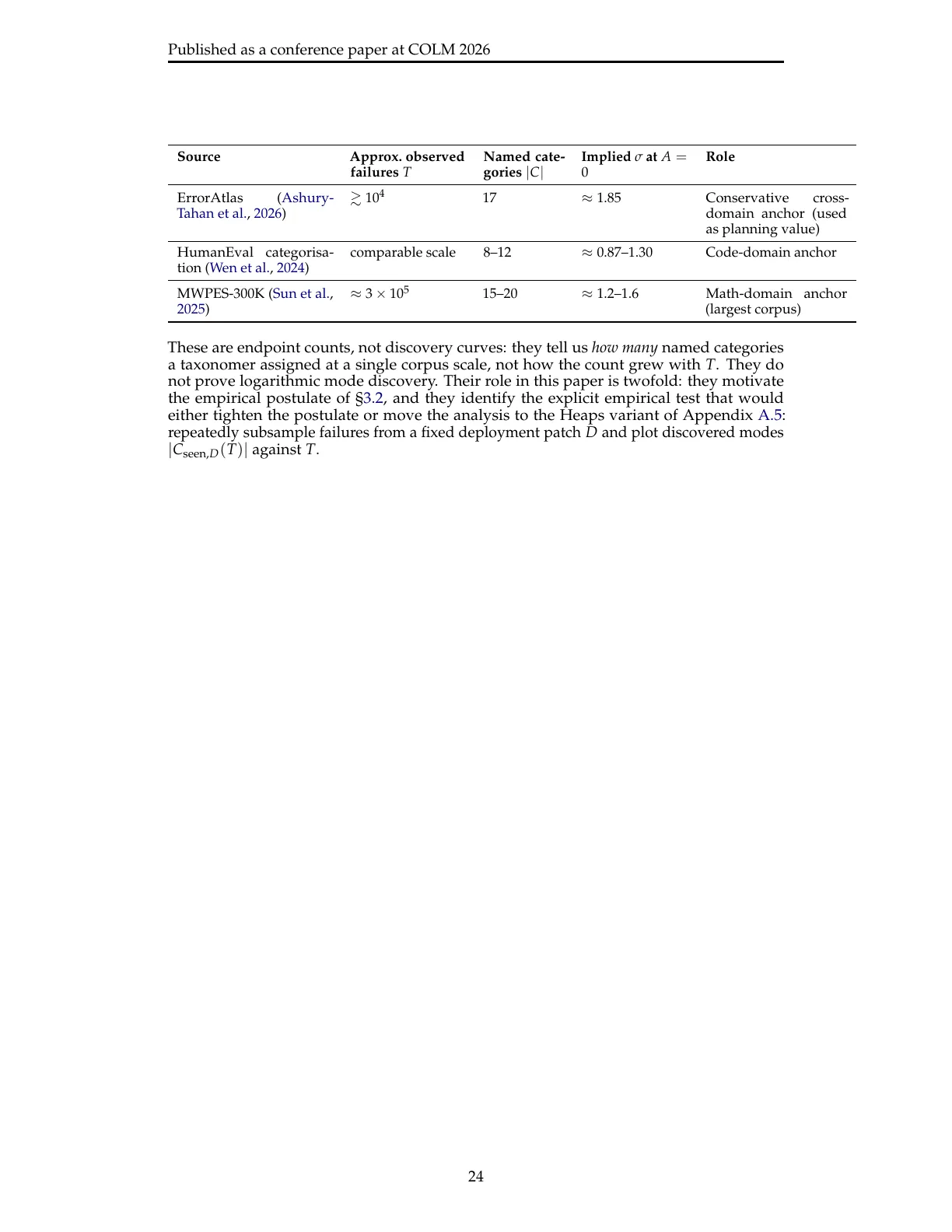
Text of page 24
Published as a conference paper at COLM 2026

Source

Approx. observed
failures T

Named categories | C |

Implied σ at A =
0

Role

ErrorAtlas
(Ashury-
Tahan et al., 2026)

≳ 10 4

17

≈ 1.85

Conservative
crossdomain anchor (used
as planning value)

HumanEval categorisation (Wen et al., 2024)

comparable scale

8–12

≈ 0.87–1.30

Code-domain anchor

MWPES-300K (Sun et al.,
2025)

≈ 3 × 10 5

15–20

≈ 1.2–1.6

Math-domain anchor
(largest corpus)

These are endpoint counts, not discovery curves: they tell us how many named categories
a taxonomer assigned at a single corpus scale, not how the count grew with T. They do
not prove logarithmic mode discovery. Their role in this paper is twofold: they motivate
the empirical postulate of §3.2, and they identify the explicit empirical test that would
either tighten the postulate or move the analysis to the Heaps variant of Appendix A.5:
repeatedly subsample failures from a fixed deployment patch D and plot discovered modes
| C seen,D ( T )| against T.

24